Note
Go to the end to download the full example code.
Creating simple meshes and swept geometries
Fedoo provides structured mesh generators for common shapes as well as operations for building new geometries from existing meshes. This example starts with a few built-in meshes, then creates solids and curved structures using extrusion, local frames, and surface thickening.
import numpy as np
import pyvista as pv

import fedoo as fd
Built-in two-dimensional meshes
Rectangles, disks, plates with holes, and I-shaped profiles can be generated directly. Here, a plate with a circular hole and a hollow disk illustrate two of the available structured generators.
plate = fd.mesh.hole_plate_mesh(
    nr=7,
    nt=7,
    length=4.0,
    height=3.0,
    radius=0.6,
    elm_type="quad4",
)

annulus = fd.mesh.hollow_disk_mesh(
    radius=1.5,
    thickness=0.45,
    nr=5,
    nt=33,
    elm_type="quad4",
)
Straight extrusion
Extruding a surface mesh along a scalar distance creates a volume mesh. The number of nodes controls the discretization through the extrusion direction.
disk = fd.mesh.disk_mesh(radius=1.0, nr=7, nt=9, elm_type="quad4")
cylinder = fd.mesh.extrude(disk, 1.8, n_nodes=6)
Sweep along a curved path
When the extrusion path is a line mesh, one local frame can be supplied at every path node. The frame axes orient the profile as it travels along the path. Cylindrical frames conveniently orient a straight profile around a circular path, producing a smooth cylindrical surface.
profile = fd.mesh.line_mesh(7, -0.45, 0.45, elm_type="lin2")
circle_path = fd.mesh.circle_mesh(n=40, r=1.5, ndim=3)
circle_frames = fd.mesh.generate_cylindrical_local_frame(circle_path)

curved_surface = fd.mesh.extrude(
    profile,
    circle_path,
    local_frame=circle_frames,
)
Surface thickening
A shell-like surface can be converted into a solid using area-weighted nodal
normals computed automatically by fedoo.mesh.thicken().
thick_ring = fd.mesh.thicken(curved_surface, thickness=0.18, n_nodes=3)
Helicoidal extrusion
For a spatial curve, a custom frame gives direct control over the profile orientation. The first axis below follows the helix tangent, the second is radial, and the third completes a right-handed orthonormal frame.
i_profile = fd.mesh.I_shape_mesh(
    height=0.65,
    width=0.5,
    web_thickness=0.12,
    flange_thickness=0.12,
    size_elm=0.1,
)

theta_max = 5 * np.pi
helix_height = 2.8
helix_radius = 1.15
helix_path = fd.mesh.line_mesh_cylindric(
    56,
    helix_radius,
    0,
    theta_max,
).as_3d()
helix_path.nodes[:, 2] = np.linspace(0, helix_height, helix_path.n_nodes)

cylindrical_frame = fd.mesh.generate_cylindrical_local_frame(helix_path)
radial = cylindrical_frame[:, 0]
azimuthal = cylindrical_frame[:, 1]
axial = cylindrical_frame[:, 2]

pitch = helix_height / theta_max
tangent = helix_radius * azimuthal + pitch * axial
tangent /= np.linalg.norm(tangent, axis=1, keepdims=True)
profile_normal = np.cross(tangent, radial)
helix_frame = np.stack((tangent, radial, profile_normal), axis=1)

helicoidal_beam = fd.mesh.extrude(
    i_profile,
    helix_path,
    local_frame=helix_frame,
)
Visualize the generated meshes
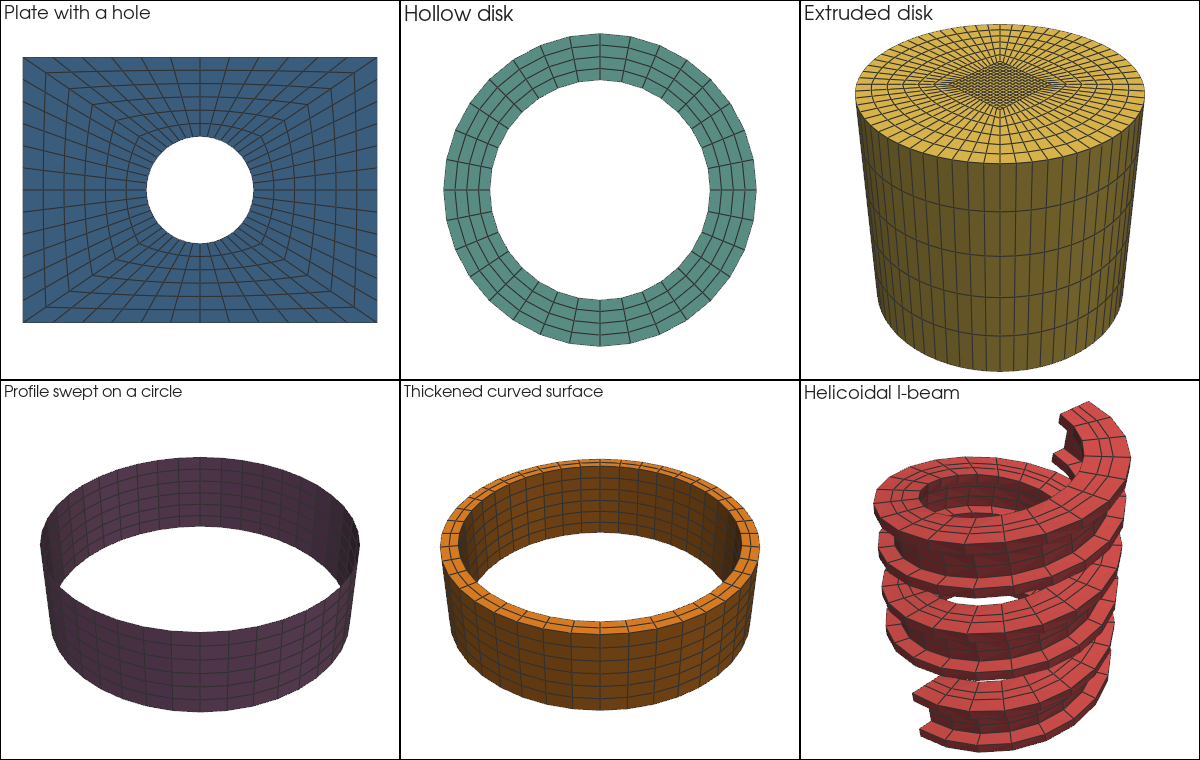
Fedoo meshes convert directly to PyVista datasets. Displaying the geometries together highlights how the same small set of generators and transformations can produce surfaces, solids, and smoothly swept structures.
plotter = pv.Plotter(shape=(2, 3), window_size=(1200, 760))
plotter.set_background("white")

geometries = (
    (plate, "Plate with a hole", "#4C78A8", "xy"),
    (annulus, "Hollow disk", "#72B7B2", "xy"),
    (cylinder, "Extruded disk", "#F2CF5B", "iso"),
    (curved_surface, "Profile swept on a circle", "#B279A2", "iso"),
    (thick_ring, "Thickened curved surface", "#F28E2B", "iso"),
    (helicoidal_beam, "Helicoidal I-beam", "#E15759", "iso"),
)

for index, (mesh, title, color, view) in enumerate(geometries):
    plotter.subplot(*divmod(index, 3))
    plotter.add_mesh(
        mesh.to_pyvista(),
        color=color,
        show_edges=True,
        edge_color="#303030",
        line_width=0.6,
    )
    plotter.add_text(title, font_size=11, color="#202020")
    if view == "xy":
        plotter.view_xy()
    else:
        plotter.view_isometric()
    plotter.camera.zoom(1.2)

plotter.show()
Total running time of the script: (0 minutes 0.371 seconds)