Note
Go to the end to download the full example code.
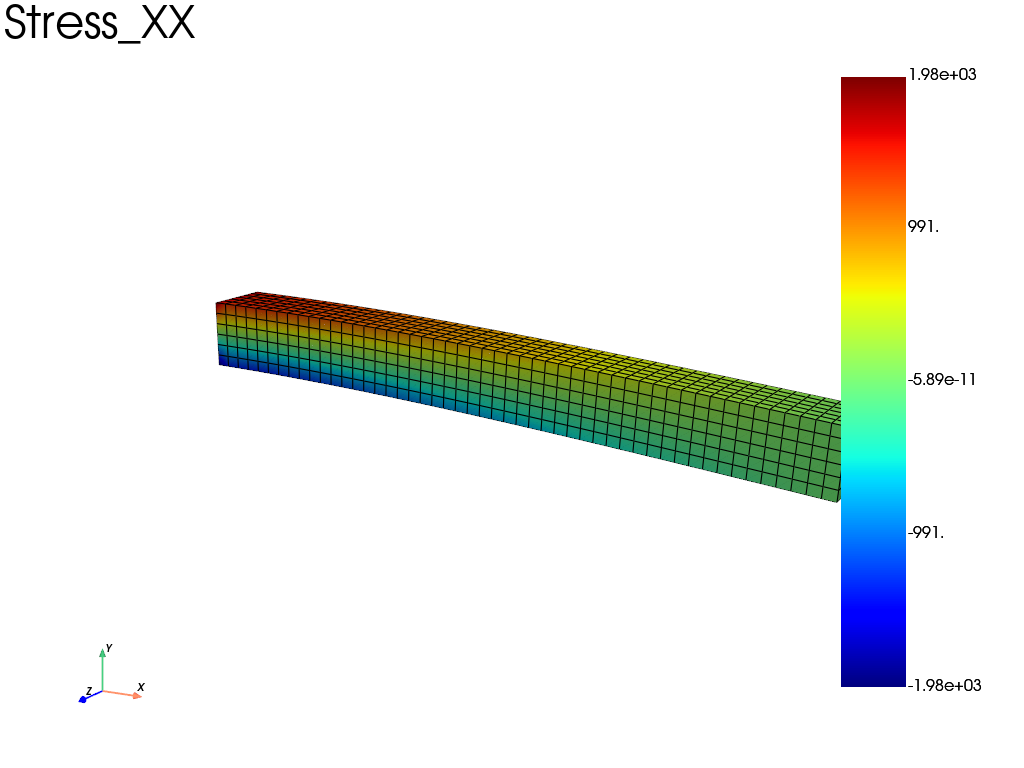
Cantilever beam using 3D hexahedral elements
Linear elastic cantilever beam meshed with hex8 elements: the left face is
clamped and a transverse displacement is imposed on the right face.
import fedoo as fd
Pre-treatment: mesh and problem definition
# Units: N, mm, MPa
mesh = fd.mesh.box_mesh(
    nx=51,
    ny=7,
    nz=7,
    x_min=0,
    x_max=1000,
    y_min=0,
    y_max=100,
    z_min=0,
    z_max=100,
    elm_type="hex8",
    name="Domain",
)

fd.ModelingSpace("3D")

# Material definition
fd.constitutivelaw.ElasticIsotrop(200e3, 0.3, name="ElasticLaw")
wf = fd.weakform.StressEquilibrium("ElasticLaw")

# Assembly
assembly = fd.Assembly.create(wf, mesh, "hex8")

# Type of problem
pb = fd.problem.Linear(assembly)

# Boundary conditions
nodes_left = mesh.node_sets["left"]
nodes_right = mesh.node_sets["right"]
nodes_top = mesh.node_sets["top"]
nodes_bottom = mesh.node_sets["bottom"]

pb.bc.add("Dirichlet", nodes_left, "Disp", 0)
pb.bc.add("Dirichlet", nodes_right, "DispY", -50)
Dirichlet boundary condition:
var = 'DispY'
n_nodes = 49
value = -50
Solve the problem
The default direct solver is used. pb.set_solver("cg") before
pb.solve() would use the conjugate gradient iterative solver instead.
pb.solve()
Post-treatment: get and plot results
# Get the displacement vector
U = pb.get_disp()

# Get the stress and strain tensor at nodes
res = pb.get_results(assembly, ["Stress", "Strain", "Disp"], "Node")
stress = res["Stress"]
strain = res["Strain"]

# plot the stress (xx component)
res.plot("Stress", "XX")
Total running time of the script: (0 minutes 0.725 seconds)