Note
Go to the end to download the full example code.
Tube compression (2Daxi): IPC versus penalty self-contact
Note
This example is too heavy to be run at each documentation build. The animation below was precomputed on 2026-11-10 with fedoo 1.1.0, simcoon 0+unknown, ipctk 1.6.1, numpy 2.5.4 (fedoo commit 8fa6ec0798fea2cd3c52159d1c5ffe508131a66b), in about 74 s (Linux x86_64, BLAS mkl). Run the script to reproduce it with your fedoo version.
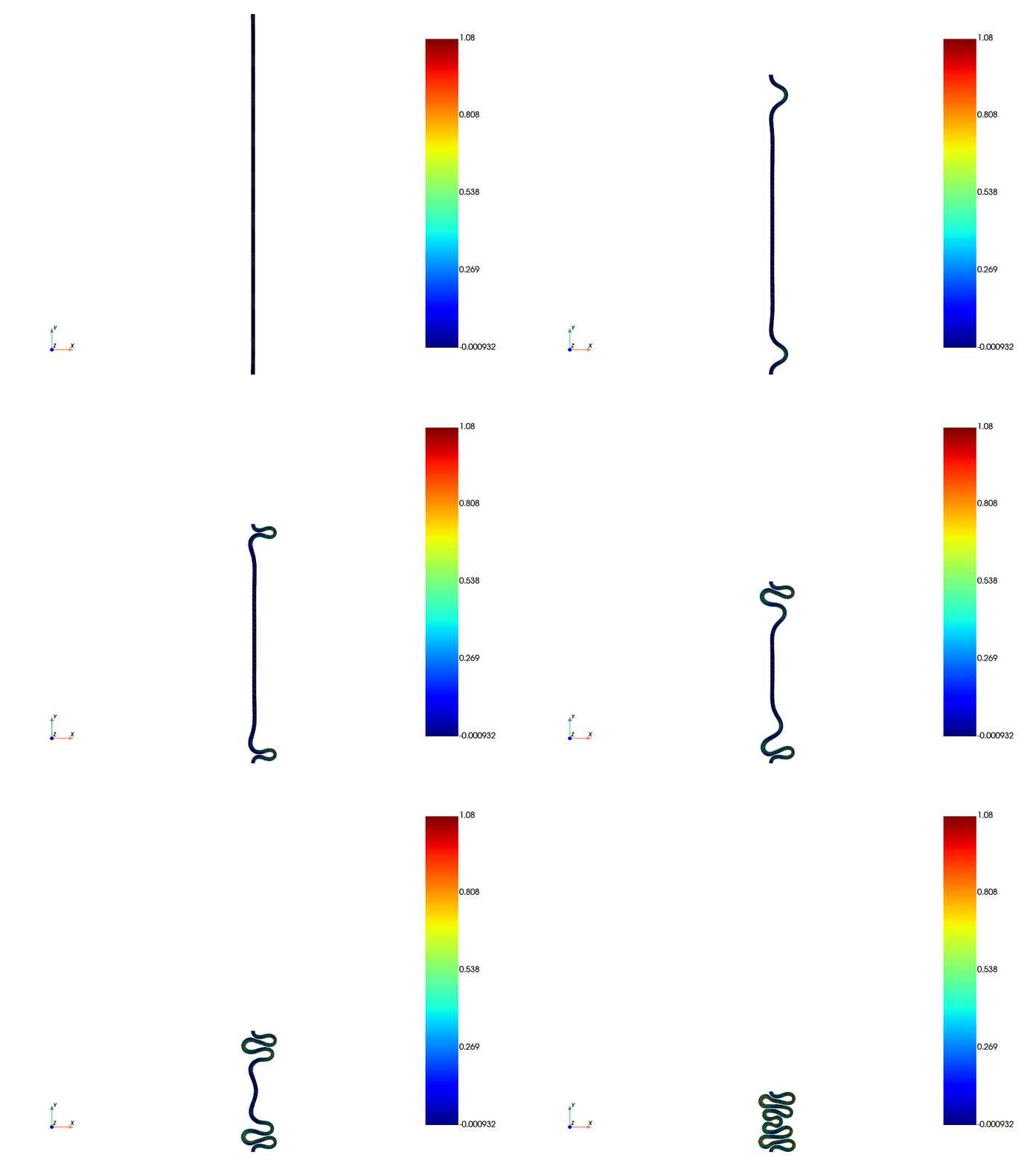
Same problem as Compression of a tube using 2D axisymmetric model, solved
twice: with IPCSelfContact (collisions weighted by \(2 \pi r\)) and
with the penalty SelfContact. For each run the script prints the solve
time, the axial reaction forces on the top and bottom faces (they should be
opposite), the peak axial stress and the peak equivalent plastic strain at
the last saved increment. The page has no figure: the deformed shape is
shown in Compression of a tube using 2D axisymmetric model, and the
results of both runs are written to results/.
This example requires ipctk.
import os
from time import time

import fedoo as fd
import numpy as np

os.chdir(os.path.dirname(os.path.abspath(__file__)) or ".")
if not os.path.isdir("results"):
    os.mkdir("results")

NLGEOM = "UL"


def solve(method):
    fd.ModelingSpace("2Daxi")
    mesh = fd.mesh.rectangle_mesh(5, 240, 23, 25, 0, 180)

    sigma_y = 300
    k = 1000
    m = 0.3
    E = 200e3
    nu = 0.3
    props = np.array([E, nu, 1e-5, sigma_y, k, m])
    material = fd.constitutivelaw.Simcoon("EPICP", props)

    wf = fd.weakform.StressEquilibrium(material, nlgeom=NLGEOM)
    solid_assembly = fd.Assembly.create(wf, mesh)

    if method == "ipc":
        contact = fd.constraint.IPCSelfContact(
            mesh,
            dhat=1e-3,
            dhat_is_relative=True,
        )
    else:
        surf = fd.mesh.extract_surface(mesh)
        contact = fd.constraint.contact.SelfContact(surf)
        contact.contact_search_once = True
        contact.eps_n = 1e4  # contact penalty
        contact.max_dist = 1.0  # max distance for the contact search

    assembly = fd.Assembly.sum(solid_assembly, contact)

    pb = fd.problem.NonLinear(assembly, nlgeom=NLGEOM)
    pb.set_nr_criterion(
        "Displacement",
        tol=1e-2,
        max_subiter=20,
        adaptive_stiffness=True,
    )

    res = pb.add_output(
        f"results/tube_compression_{method}",
        solid_assembly,
        ["Disp", "Stress", "Strain", "P"],
    )

    bottom = mesh.node_sets["bottom"]
    top = mesh.node_sets["top"]

    pb.bc.add("Dirichlet", bottom, "Disp", 0)
    pb.bc.add("Dirichlet", top, "Disp", [0, -150])
    pb.add_line_search()

    t0 = time()
    pb.nlsolve(dt=0.01, tmax=1, update_dt=True, print_info=1, dt_min=1e-8)
    solve_time = time() - t0

    # axial reaction forces: they should be opposite
    F = pb.get_ext_forces("Disp")
    return res, F[1, top].sum(), F[1, bottom].sum(), solve_time
Reduced numeric metrics
Reaction forces, peak axial stress and peak equivalent plastic strain at the last saved increment.
def _summarise(res, f_top, f_bottom, solve_time, label):
    res.load(-1)
    stress_yy = np.asarray(res.get_data("Stress", component="YY", data_type="Node"))
    p = np.asarray(res.get_data("P", data_type="Node"))
    print(f"--- {label} ---")
    print(f"  solve time           = {solve_time:.1f} s")
    print(f"  reaction top/bottom  = {f_top:.4e} / {f_bottom:.4e}")
    print(f"  peak |Stress YY|     = {np.abs(stress_yy).max():.4e}")
    print(f"  peak P (eq. plastic) = {p.max():.4e}")


results = {method: solve(method) for method in ("ipc", "penalty")}
print()
_summarise(*results["ipc"], "IPC")
_summarise(*results["penalty"], "Penalty")