Note
Go to the end to download the full example code.
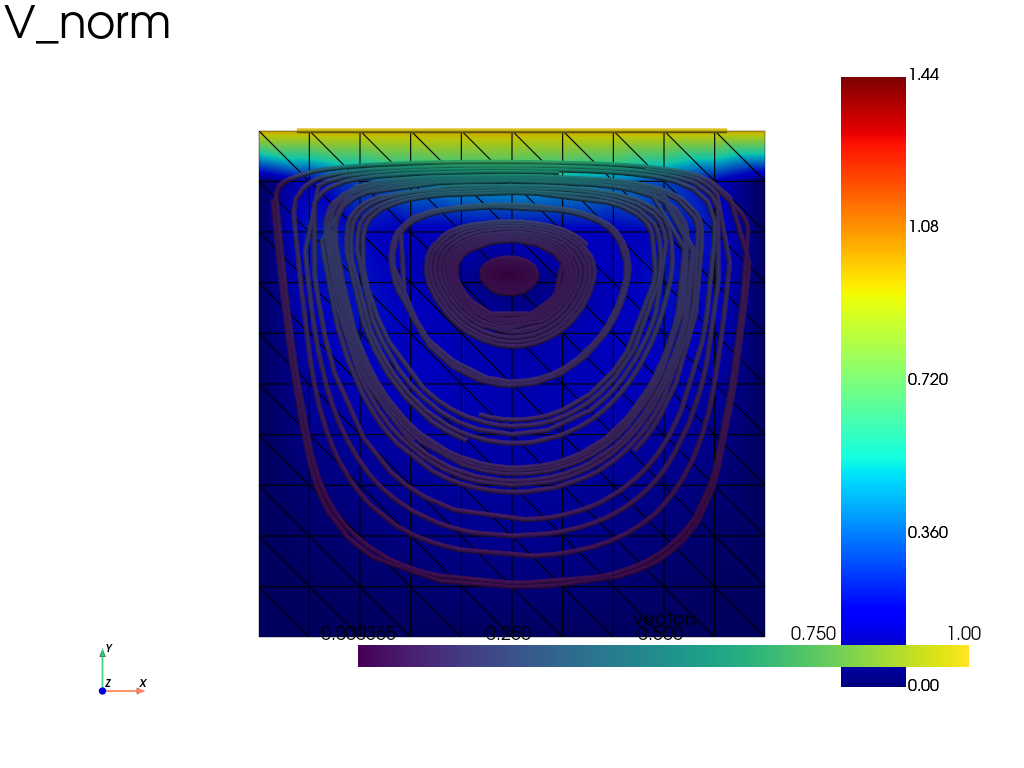
Lid-driven cavity (Stokes flow) with a user-defined weak form
Steady incompressible Stokes flow in a unit square cavity whose top wall
moves at a unit velocity, written with the differential operators of a
fedoo.ModelingSpace and a fedoo.WeakForm. The mixed problem
uses the stable p1+/p1 element (bubble-enriched velocity, linear
pressure). The weak form is the one of the Stokes example around a cylinder:
import fedoo as fd
import numpy as np

fd.Assembly.delete_memory()

space = fd.ModelingSpace("2D")

space.new_variable("Vx")
space.new_variable("Vy")
space.new_vector("V", ["Vx", "Vy"])
space.new_variable("P")  # pressure

# create simple DiffOp objects
dVx_dX = space.derivative("Vx", "X")
dVy_dY = space.derivative("Vy", "Y")
dVy_dX = space.derivative("Vy", "X")
dVx_dY = space.derivative("Vx", "Y")
P = space.variable("P")

mu = 0.1  # dynamic viscosity

# strain rate in Voigt notation: D_xx, D_yy, gamma_xy = 2 D_xy
D = [dVx_dX, dVy_dY, dVx_dY + dVy_dX]

# Momentum conservation equation
eq1 = (
    D[0].virtual * (-P + 2 * mu * D[0])
    + D[1].virtual * (-P + 2 * mu * D[1])
    + mu * D[2].virtual * D[2]
)

# Mass conservation equation
eq2 = P.virtual * (dVx_dX + dVy_dY)

wf = fd.WeakForm(eq1 + eq2)
Mesh, mixed element and boundary conditions
The pressure dof of the bubble nodes is unused and set to zero. All the velocities are prescribed on the boundary, so the pressure is only defined up to a constant (the bubble nodes do not fix it): it is set to zero at the bottom-left corner.
The two top corners belong both to a side wall (\(\mathbf{v} = 0\)) and
to the lid (\(v_x = 1\)). They are removed from the side walls, so that
they move with the lid (the “leaky” lid-driven cavity); two Dirichlet
conditions with different values on the same dof would emit a
BoundaryConditionWarning. This velocity discontinuity makes the pressure
singular at the top corners.
mesh = fd.mesh.rectangle_mesh(elm_type="tri3")
internal_nodes = mesh.add_internal_nodes(1)

elm_type = "p1+/p1"
new_elm = fd.lib_elements.CombinedElement(elm_type, "tri3")
new_elm.set_variable_interpolation("Vx", "tri3bubble")
new_elm.set_variable_interpolation("Vy", "tri3bubble")

fd.Assembly.create(wf, mesh, elm_type=elm_type, name="assembling")

pb = fd.problem.Linear("assembling")

top = mesh.node_sets["top"]
pb.bc.add("Dirichlet", np.setdiff1d(mesh.node_sets["left"], top), "V", 0)
pb.bc.add("Dirichlet", np.setdiff1d(mesh.node_sets["right"], top), "V", 0)
pb.bc.add("Dirichlet", "bottom", "V", 0)
pb.bc.add("Dirichlet", "top", ["Vx", "Vy"], [1.0, 0.0])
pb.bc.add("Dirichlet", internal_nodes, "P", 0)  # unused pressure dof of the bubbles
pb.bc.add("Dirichlet", [mesh.nearest_node([0, 0])], "P", 0)  # pressure level

pb.apply_boundary_conditions()

pb.solve()
Velocity magnitude and streamlines
Streamlines are not part of the fedoo plot function: they are added with
PyVista on the plotted mesh (res.meshplot).
res = pb.get_results("assembling", ["V", "P"])

pl = res.plot("V", component="norm", show=False)

# Add a zero out-of-plane component for PyVista's 3D streamline filter.
res.meshplot["vectors"] = np.c_[res["V"].T, np.zeros(mesh.n_nodes)]

line_streamlines = res.meshplot.streamlines(
    "vectors",
    pointa=(0.5, 0, 0),
    pointb=(0.5, 1, 0),
    n_points=10,
)


pl.add_mesh(line_streamlines.tube(radius=0.005))
pl.show()
Total running time of the script: (0 minutes 0.573 seconds)