Note
Go to the end to download the full example code.
Dynamic crack propagation by node release in a pre-strained strip
Note
This example is too heavy to be run at each documentation build. The animation below was precomputed on 2026-11-11 with fedoo 1.1.0, simcoon 0+unknown, ipctk 1.6.0, numpy 2.5.4 (fedoo commit 0c1c3c65c9bdd8702d3f2ad96d75c408d2ffb4d6), in about 46 s (Linux x86_64, BLAS mkl). Run the script to reproduce it with your fedoo version.
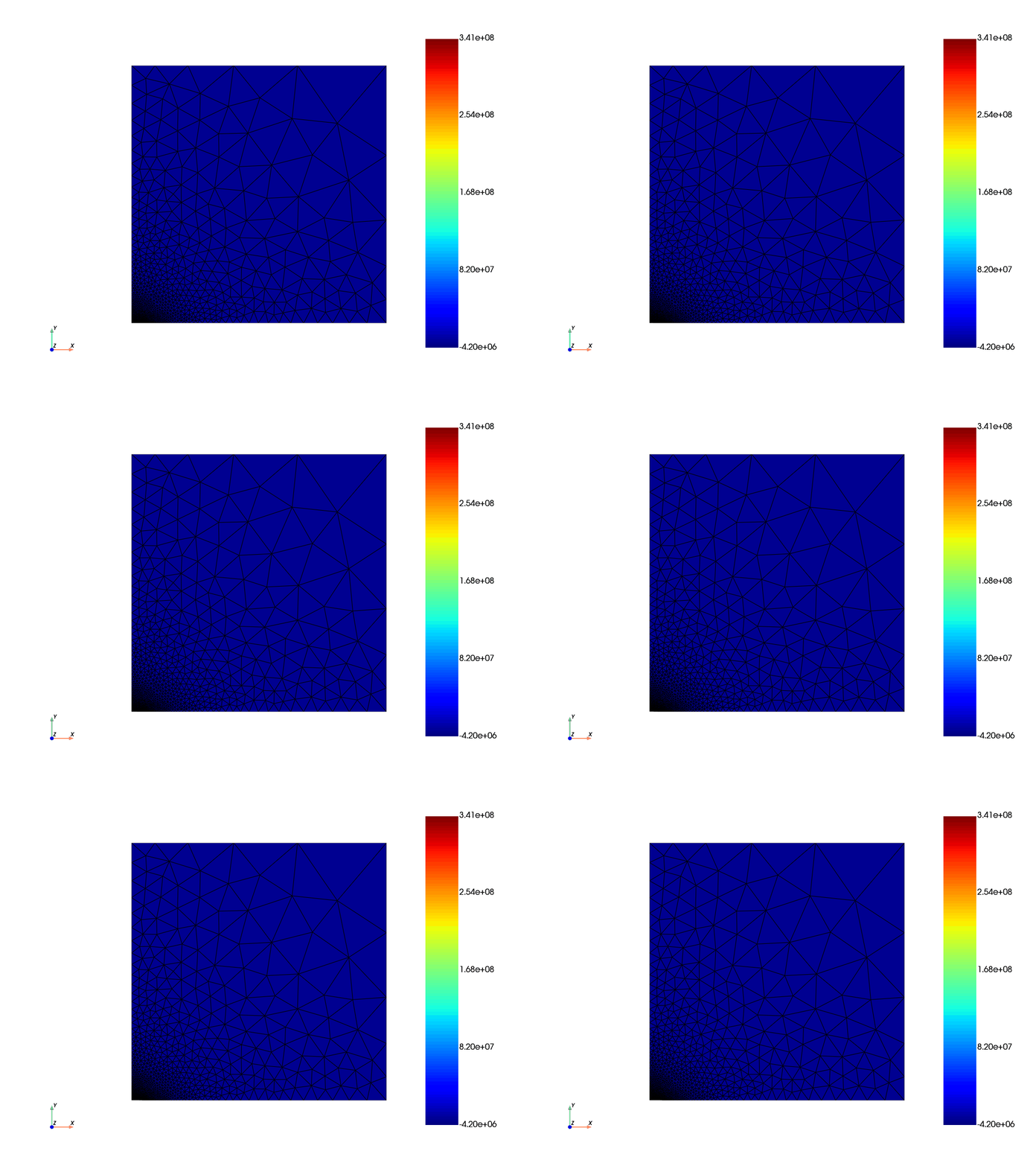
A plane-stress strip (half model, symmetry on the crack plane Y = ymin)
is first stretched statically. The crack then advances at a constant speed
coeff * c_R by releasing one node of the crack plane per time step
(linear implicit Newmark dynamics). The dynamic energy release rate
GId is computed from the elastic and kinetic energy balance and compared
with the static value Gqs.
The mesh is imported from Broberg2D_10000_10000.msh (10 x 10 domain,
uniform spacing MeshSize on the first 500 crack-plane intervals, graded
beyond). About 500 linear time steps are solved.
The model is a symmetric half of the strip, so the elastic and kinetic
energies are those of one half: the printed Gqs and GId are half of
the energy release rate of the full strip. Their ratio, the quantity of
interest here, is unaffected.
import fedoo as fd
import numpy as np
import os

SCRIPT_DIR = os.path.dirname(os.path.abspath(__file__))
Input parameters
coeff = 0.2  # crack velocity / Rayleigh wave speed
COEFF = 1  # number of time steps per released node
MeshSize = 1e-3  # based on the work of C. Fond

Epsilon = 0.01  # Initial static strain
E = 1.5e9  # Young Modulus
nu = 0.33  # Poisson ratio
rho = 1000  # Density

# Newmark parameters: gamma = 1/2 gives no numerical damping, beta = 1/2
# is unconditionally stable (the average-acceleration rule is beta = 1/4).
gamma = 0.5
beta = 0.5
Derived parameters
TransverseWaveSpeed = (E / (2 * rho * (1 + nu))) ** (1 / 2)
# Fit of c_R / c_T as a function of nu (plane strain). In plane stress the
# exact ratio corresponds to nu / (1 + nu); kept as is (about 1 % faster).
RayleighWaveSpeed = (
    0.874032 + 0.200396 * nu - 0.0756704 * (nu**2)
) * TransverseWaveSpeed
CrackVelocity = RayleighWaveSpeed * coeff

dt = MeshSize / CrackVelocity / COEFF  # StepTime
Mesh, material and assembly
fd.ModelingSpace("2Dstress")

meshID = "Domain"
mesh = fd.mesh.import_file(
    os.path.join(SCRIPT_DIR, "Broberg2D_10000_10000.msh"), name=meshID
)
mesh.nodes = mesh.nodes[:, :2]

material = fd.constitutivelaw.ElasticIsotrop(E, nu, name="ElasticLaw")
material.set_density(rho)

# weak form and assembly
fd.weakform.StressEquilibrium("ElasticLaw", name="StressEquilibrium")

fd.Assembly.create("StressEquilibrium", mesh, "tri3", name="StiffAssembling")

length = mesh.bounding_box.size_x
height = mesh.bounding_box.size_y

ImposedDisplacement = Epsilon * height


Xmin = mesh.find_nodes("X", mesh.bounding_box.xmin)
Xmax = mesh.find_nodes("X", mesh.bounding_box.xmax)
Ymin = mesh.find_nodes("Y", mesh.bounding_box.ymin)
Ymax = mesh.find_nodes("Y", mesh.bounding_box.ymax)
Ymin = Ymin[
    np.argsort(mesh.nodes[Ymin][:, 0])
]  # to get a list of nodes sorted from xmin to xmax
Static pre-strain
pb = fd.problem.Linear("StiffAssembling")

pb.bc.add("Dirichlet", Xmax, "DispX", 0)
pb.bc.add("Dirichlet", Xmin, "DispX", 0)
pb.bc.add("Dirichlet", Ymax, "DispY", ImposedDisplacement)

deb = pb.bc.add("Dirichlet", Ymin, "DispY", 0, name="deb")

pb.apply_boundary_conditions()
pb.solve()

U = pb.get_dof_solution()
# Static energy release rate (half model: half of the full-strip value)
Gqs = pb.get_elastic_energy() / (length)
Dynamic crack propagation by node release
Ecin, Eela = [], []

pb = fd.problem.LinearNewmark(
    assembly="StiffAssembling",
    time_step=dt,
    integrator=fd.time.Newmark(beta=beta, gamma=gamma),
)
pb.set_initial_displacement("all", U)

pb.set_initial_velocity("all", 0)
pb.set_initial_acceleration("all", 0)
pb.initialize()

os.makedirs(os.path.join(SCRIPT_DIR, "results"), exist_ok=True)
res = pb.add_output(
    os.path.join(SCRIPT_DIR, "results", "Broberg2D_Dynamic"),
    "StiffAssembling",
    ["Disp", "Stress"],
)

pb.bc.add("Dirichlet", Xmax, "DispX", 0)
pb.bc.add("Dirichlet", Xmin, "DispX", 0)
pb.bc.add("Dirichlet", Ymax, "DispY", ImposedDisplacement)

deb = pb.bc.add("Dirichlet", Ymin, "DispY", 0, name="deb")

# The crack advances at constant speed only where the crack-plane spacing is
# MeshSize (first 500 intervals); beyond, the mesh is graded and GId (divided
# by MeshSize) would be meaningless.
n_release = int(np.sum(np.isclose(np.diff(mesh.nodes[Ymin, 0]), MeshSize, rtol=1e-3)))
n_steps = n_release * COEFF
for i in range(n_steps):
    print("\r v = {}cr - {:.1f}%".format(coeff, (i + 1) / n_steps * 100), end="")

    if i % COEFF == 0:
        deb.node_set = deb.node_set[1:]

    pb.apply_boundary_conditions()
    pb.solve()
    # update_weakform=True refreshes the stress field (otherwise the saved
    # Stress stays equal to the static pre-strain); compute="none" keeps the
    # cached linear operators.
    pb.update(compute="none", update_weakform=True)
    pb.save_results(i)

    Ecin.append(pb.get_kinetic_energy())
    Eela.append(pb.get_elastic_energy())

Ecin = np.array(Ecin)
Eela = np.array(Eela)
# Dynamic energy release rate from the energy balance (half model, like Gqs)
GId = (-(Eela[1:] - Eela[:-1]) - (Ecin[1:] - Ecin[:-1])) / (MeshSize)

print("\nGqs (static) =", Gqs)
print(
    "mean GId / Gqs over the last half of the propagation =",
    np.mean(GId[len(GId) // 2 :]) / Gqs,
)
Normalized dynamic energy release rate
import matplotlib.pyplot as plt

fig, ax = plt.subplots(figsize=(7, 4))
ax.plot(np.arange(1, len(GId) + 1), GId / Gqs, lw=1)
ax.set_xlabel("Released node")
ax.set_ylabel(r"$G_{Id} / G_{qs}$")
ax.set_title(f"Crack speed {coeff} $c_R$")
ax.grid(True, alpha=0.3)
fig.tight_layout()
plt.show()