Note
Go to the end to download the full example code.
Nodal Hessian recovery on a fedoo mesh
Compute the recovered nodal gradient and Hessian of an analytic scalar
field on a 2D mesh using fedoo.recover_gradient and
fedoo.recover_hessian. The recovered fields are plotted and written to a
vtk file so you can inspect them in ParaView.
Pair with mmgpy.metrics.create_metric_from_hessian (and
fedoo.to_upper_diagonal to get mmg’s row-major upper-triangular
packing) to drive anisotropic adaptive remeshing.
import os

import numpy as np
import fedoo as fd
Build a 2D mesh and an analytic scalar field with a known closed-form Hessian:
mesh = fd.mesh.rectangle_mesh(nx=51, ny=51, elm_type="tri3")
x, y = mesh.nodes.T

field = np.sin(2 * np.pi * x) * np.sin(2 * np.pi * y)
Recover gradient and Hessian. Both calls reuse fedoo’s cached GP-to-Node projection matrix and shape-derivative tables - everything is vectorized, no per-vertex Python loop.
g = fd.recover_gradient(mesh, field)  # (n_nodes, 2)
H = fd.recover_hessian(mesh, field)  # (n_nodes, 2, 2)

# Compare against the analytic Hessian on interior nodes.
k = (2 * np.pi) ** 2
H_xx_exact = -k * np.sin(2 * np.pi * x) * np.sin(2 * np.pi * y)
H_xy_exact = +k * np.cos(2 * np.pi * x) * np.cos(2 * np.pi * y)

interior = (x > 0.1) & (x < 0.9) & (y > 0.1) & (y < 0.9)
err_xx = np.abs(H[interior, 0, 0] - H_xx_exact[interior]).max()
err_xy = np.abs(H[interior, 0, 1] - H_xy_exact[interior]).max()
print(f"max |H_xx - exact| (interior) = {err_xx:.3e}")
print(f"max |H_xy - exact| (interior) = {err_xy:.3e}")
max |H_xx - exact| (interior) = 6.866e-02
max |H_xy - exact| (interior) = 9.715e-04
Save a vtk file with the recovered fields for visualisation in ParaView
(in the results folder).
ds = fd.DataSet(
    mesh,
    data={
        "field": field,
        "grad": g.T,  # (2, n_nodes) for fedoo's vector layout
        "H_xx": H[:, 0, 0],
        "H_yy": H[:, 1, 1],
        "H_xy": H[:, 0, 1],
    },
    data_type="node",
)
os.makedirs("results", exist_ok=True)
ds.save("results/hessian_recovery.vtk")
print("Wrote results/hessian_recovery.vtk")
Wrote results/hessian_recovery.vtk
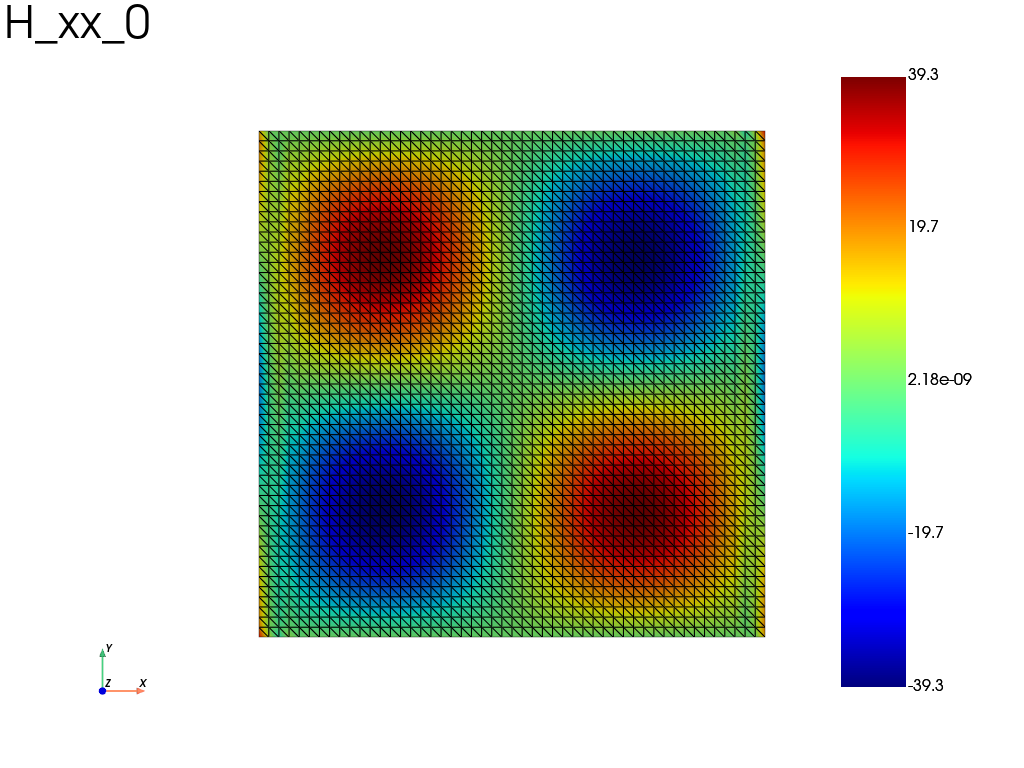
Plot the recovered second derivative \(\partial^2 f / \partial x^2\).
ds.plot("H_xx")
To drive an mmg adaptive remesh, pack the Hessian into mmg’s
row-major upper-triangular layout and feed it to
mmgpy.metrics.create_metric_from_hessian:
metric = fd.to_upper_diagonal(H)        # (n_nodes, 3) for 2D
# mmgpy.metrics.create_metric_from_hessian(metric, target_error=1e-3, ...)
Total running time of the script: (0 minutes 0.248 seconds)