Note
Go to the end to download the full example code.
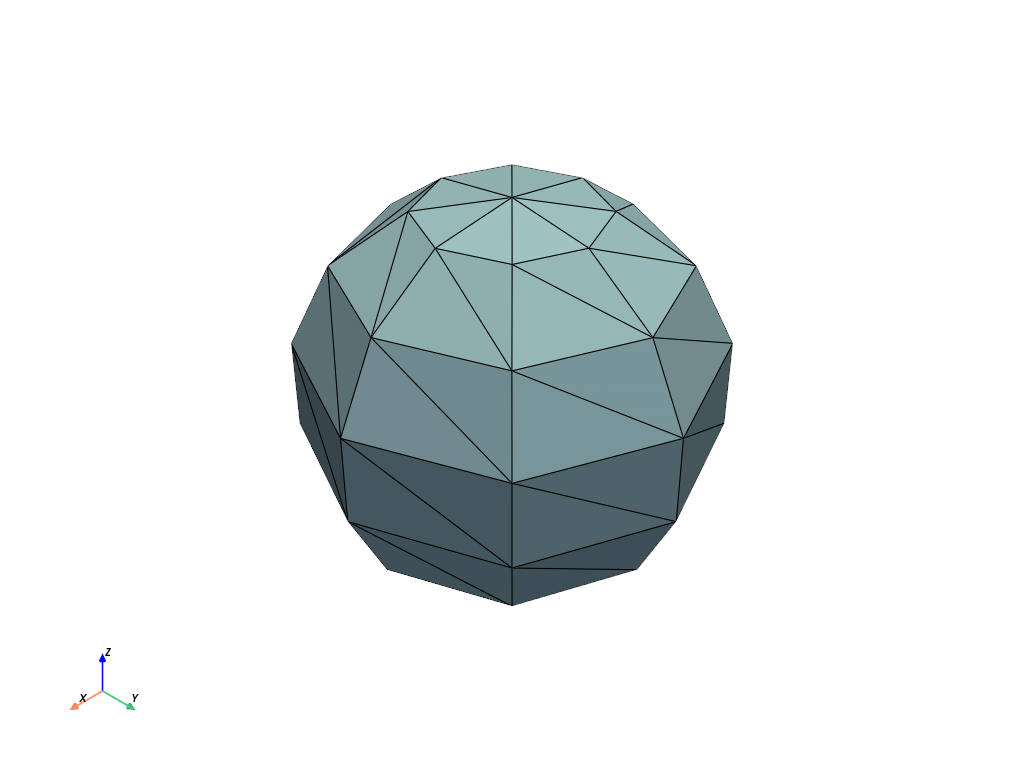
Elastoplastic compression of a ping-pong ball
A shell sphere (radius 20 mm, thickness 0.45 mm) is compressed by a pressure
applied on the two polar caps, with three point supports that only remove the
rigid body motions. The section is a
fedoo.constitutivelaw.ShellHomogeneousNonLinear integrated at three
points through the thickness with the Simcoon EPICP elastoplastic law in
plane stress. The shell kinematics are corotational
(fedoo.weakform.PlateEquilibrium with nlgeom=True), while the
strains passed to the material points remain small.
The mesh is deliberately coarse and only two load increments are computed, so that the example runs in a few seconds; the deformed shape is plotted.
Iter 1 - Time: 0.50000 - dt 0.50000 - NR iter: 3 - Err: 0.00071
Iter 2 - Time: 1.00000 - dt 0.50000 - NR iter: 3 - Err: 0.00227
import numpy as np
import pyvista as pv

import fedoo as fd


def run_simulation(
    mesh_resolution=8,
    pressure=2.0,
    n_steps=2,
    print_info=1,
):
    """Run a deliberately small pressure-compression simulation."""
    young_modulus = 2_000.0  # MPa
    poisson_ratio = 0.37
    yield_stress = 35.0  # MPa
    hardening_modulus = 100.0  # MPa
    hardening_exponent = 0.3
    radius = 20.0  # mm
    thickness = 0.45  # mm

    fd.ModelingSpace("3D")
    sphere = pv.Sphere(
        radius=radius,
        theta_resolution=mesh_resolution,
        phi_resolution=mesh_resolution,
    )
    mesh = fd.Mesh.from_pyvista(sphere)

    properties = np.array(
        [
            young_modulus,
            poisson_ratio,
            0.0,
            yield_stress,
            hardening_modulus,
            hardening_exponent,
        ]
    )
    material = fd.constitutivelaw.Simcoon("EPICP", properties)
    material.tangent_mode = 1  # continuum tangent (2 = algorithmic)
    shell = fd.constitutivelaw.ShellHomogeneousNonLinear(
        material,
        thickness,
        n_thickness_points=3,
        k=5 / 6,
    )

    weakform = fd.weakform.PlateEquilibrium(shell, nlgeom=True)
    assembly = fd.Assembly.create(weakform, mesh)

    loaded_elements = mesh.find_elements(
        f"Z>{mesh.bounding_box.zmax-3} or " f"Z<{mesh.bounding_box.zmin+3}"
    )
    pressure_load = fd.constraint.Pressure(
        mesh.extract_elements(loaded_elements),
        pressure,
    )

    problem = fd.problem.NonLinear(assembly, nlgeom=True)
    problem.bc.add(pressure_load)

    nodes = mesh.nodes
    node_a = int(np.argmin(nodes[:, 0]))
    node_b = int(np.argmax(nodes[:, 0]))
    node_c = int(np.argmax(nodes[:, 1]))
    problem.bc.add("Dirichlet", node_a, "Disp", 0)
    problem.bc.add("Dirichlet", node_b, ["DispY", "DispZ"], 0)
    problem.bc.add("Dirichlet", node_c, "DispZ", 0)
    problem.set_nr_criterion(
        "Displacement",
        tol=5e-3,
        max_subiter=15,
        adaptive_stiffness=True,
    )
    problem.nlsolve(
        dt=1 / n_steps,
        tmax=1,
        update_dt=False,
        print_info=print_info,
    )
    return problem, assembly, shell


if __name__ == "__main__":
    problem, assembly, shell = run_simulation()
    displacement = problem.get_disp()
    deformed = assembly.mesh.to_pyvista()
    # to_pyvista shares the node array with the fedoo mesh: do not modify it in place
    deformed.points = deformed.points + displacement.T
    deformed.plot(show_edges=True)
Total running time of the script: (0 minutes 0.621 seconds)