Note
Go to the end to download the full example code.
Weakly coupled thermo-mechanical analysis of a gyroid lattice
Note
This example is too heavy to be run at each documentation build. The animation below was precomputed on 2026-11-11 with fedoo 1.1.0, simcoon 0+unknown, ipctk 1.6.0, numpy 2.5.4 (fedoo commit 0c1c3c65c9bdd8702d3f2ad96d75c408d2ffb4d6), in about 232 s (Linux x86_64, BLAS mkl). Run the script to reproduce it with your fedoo version.
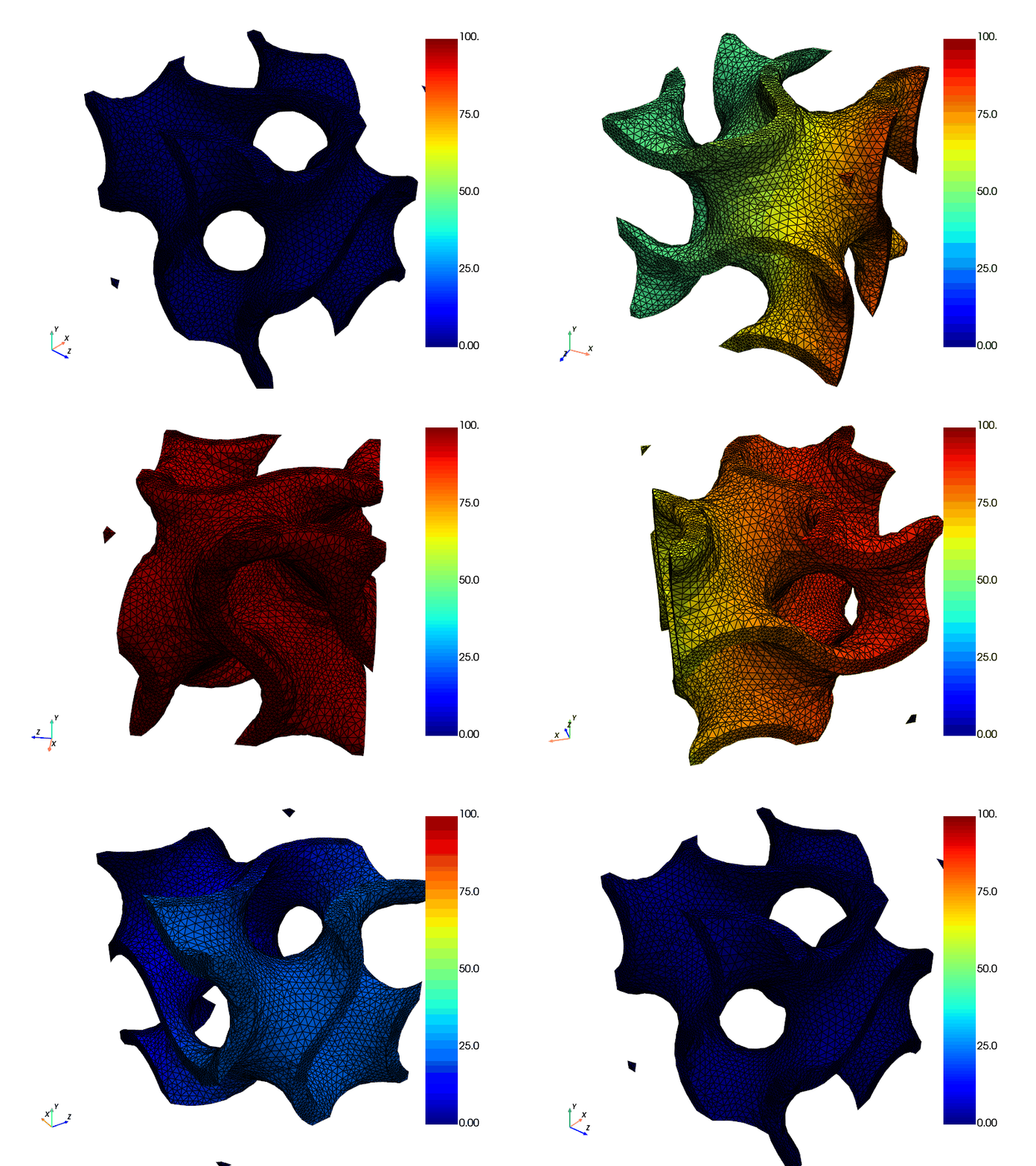
Staggered (weak) thermo-mechanical coupling on a 3D gyroid lattice: a transient
fedoo.weakform.HeatEquation problem and a small-strain
fedoo.weakform.StressEquilibrium problem with thermal expansion are
advanced increment by increment with
fedoo.problem.NonLinear.solve_time_increment(). At each increment the
converged temperature is copied into the mechanical assembly. The +X face is
heated to \(T = 100\) during the first phase and cooled back to
\(T = 0\) during the second one; all faces are clamped.
The material values are illustrative: the thermal properties are given in SI units while the mechanical ones are in MPa, and the thermal expansion coefficient is exaggerated to amplify the effect.
About 15 000 nodes and 2 x 100 increments of both problems (about 30 min). The last section reads the saved thermal and mechanical results and animates the temperature on the deformed lattice.
from pathlib import Path

import fedoo as fd
import numpy as np
import pyvista as pv
Mesh and boundary node sets
try:
    example_dir = Path(__file__).resolve().parent
except NameError:  # interactive session
    example_dir = Path.cwd()
mesh_file = example_dir.parents[1] / "util" / "meshes" / "gyroid.msh"
fd.mesh.import_file(str(mesh_file), name="Domain")
meshname = "Domain"
filename_res = str(example_dir / "results" / "thermo_meca_nl")

mesh = fd.Mesh[meshname]

# node sets for boundary conditions
Xmin, Xmax = mesh.bounding_box
left = mesh.find_nodes("X", Xmin[0])
right = mesh.find_nodes("X", Xmax[0])
bottom = mesh.find_nodes("Y", Xmin[1])
top = mesh.find_nodes("Y", Xmax[1])
back = mesh.find_nodes("Z", Xmin[2])
front = mesh.find_nodes("Z", Xmax[2])


boundary = np.unique(np.hstack((bottom, top, left, right, back, front)))
Thermal problem
Each problem has its own modeling space. The thermal values are illustrative: the conductivity is about ten times that of a steel and the specific heat about 1000 times smaller.
thermal_space = fd.ModelingSpace("3D")


K = 500  # thermal conductivity, W/(m.K) (illustrative value)
c = 0.500  # specific heat, J/(kg.K) (illustrative value)
rho = 7800  # density, kg/m3
thermal_law = fd.constitutivelaw.ThermalProperties(K, c, rho, name="ThermalLaw")
wf_th = fd.weakform.HeatEquation(thermal_law, space=thermal_space)
assemb = fd.Assembly.create(wf_th, meshname, name="Assembling_T")

pb_th = fd.problem.NonLinear("Assembling_T")
pb_th.set_time_integrator(fd.time.FIRST_ORDER, fd.time.BackwardEuler())

pb_th.set_nr_criterion("Displacement", tol=5e-2, max_subiter=5, err0=100)
Mechanical problem
Small strain problem (MPa units) with thermal expansion. mat selects the
law: 0 elastic (Simcoon ELISO), 1 Simcoon EPICP, 2 native
fedoo.constitutivelaw.ElastoPlasticity.
mech_space = fd.ModelingSpace("3D")

E = 200e3
nu = 0.3
alpha = 1e-3  # thermal expansion coefficient (large, to amplify the effect)
NLGEOM = False
mat = 0
if mat == 0:
    props = np.array([E, nu, alpha])
    mechanical_law = fd.constitutivelaw.Simcoon("ELISO", props, name="MechanicalLaw")
elif mat == 1 or mat == 2:
    Re = 300
    k = 1000
    m = 1
    if mat == 1:
        props = np.array([E, nu, alpha, Re, k, m])
        mechanical_law = fd.constitutivelaw.Simcoon(
            "EPICP", props, name="MechanicalLaw"
        )
    elif mat == 2:
        mechanical_law = fd.constitutivelaw.ElastoPlasticity(
            E, nu, Re, name="MechanicalLaw"
        )
        mechanical_law.set_hardening_function("power", h=k, beta=m)
else:
    mechanical_law = fd.constitutivelaw.ElasticIsotrop(E, nu, name="MechanicalLaw")

wf_mech = fd.weakform.StressEquilibrium("MechanicalLaw", nlgeom=NLGEOM)

fd.Assembly.create(wf_mech, meshname, name="Assembling_M")

pb_m = fd.problem.NonLinear("Assembling_M")
pb_m.set_nr_criterion("Displacement", tol=1e-2, err0=1)
Outputs and boundary conditions
The results are written in the results folder next to this script. The
temperature of the +X face rises linearly to 100 during the first half of
the heating phase, then stays constant. All the faces are clamped.
res_m = pb_m.add_output(
    filename_res + "_me",
    "Assembling_M",
    ["Disp", "Stress", "Stress_vm"],
)

res_th = pb_th.add_output(filename_res + "_th", "Assembling_T", ["Temp"])


def timeEvolution(timeFactor):
    if timeFactor < 0.5:
        return 2 * timeFactor
    else:
        return 1


pb_th.bc.add("Dirichlet", right, "Temp", 100, time_func=timeEvolution, name="temp")

pb_m.bc.add("Dirichlet", boundary, "Disp", 0)
Heating phase: staggered solution
At each increment the thermal problem is solved first, then its converged temperature at the Gauss points is copied into the state variables of the mechanical assembly before the mechanical increment is solved.
nb_iter = 100
tmax = 30
dt = tmax / nb_iter

pb_th.initialize()
pb_m.initialize()

pb_th.tmax = tmax
pb_m.tmax = tmax
pb_th.dtime = pb_m.dtime = dt

pb_th.set_start()
pb_m.set_start()

for i in range(nb_iter):
    pb_th.time = pb_m.time = time = i * dt
    convergence, nbNRiter, normRes = pb_th.solve_time_increment()
    if not (convergence):
        print("WARNING: iteration", i, "has not converged: err =", normRes)
    pb_th.set_start()
    pb_th.save_results(i)

    print(
        "Iter {} - Therm - Time: {:.5f} - NR iter: {} - Err: {:.5f}".format(
            i, time, nbNRiter, normRes
        )
    )
    pb_m.assembly.sv["Temp"] = pb_th.assembly.sv["Temp"]

    convergence, nbNRiter, normRes = pb_m.solve_time_increment()
    assert convergence, "mechanical problem has not converged"
    pb_m.set_start()
    pb_m.save_results(i)

    print(
        "Iter {} - Mech - Time: {:.5f} - NR iter: {} - Err: {:.5f}".format(
            i, time, nbNRiter, normRes
        )
    )
Cooling phase
The imposed temperature goes from its current value (100) to 0 with the same
time function. Without start_value="Current", the Dirichlet increments
would be computed from a zero start value and the face would stay at 100.
pb_th.bc[0].change_value(0, start_value="Current")

pb_th.t0 = tmax
pb_th.tmax = 2 * tmax
pb_m.t0 = tmax
pb_m.tmax = 2 * tmax

for i in range(nb_iter, 2 * nb_iter):
    # the time must be advanced and each increment closed by set_start, as in the
    # first phase, otherwise every increment is solved again from the same state
    pb_th.time = pb_m.time = time = i * dt
    convergence, nbNRiter, normRes = pb_th.solve_time_increment()
    if not (convergence):
        print("WARNING: iteration", i, "has not converged: err =", normRes)
    pb_th.set_start()
    pb_th.save_results(i)

    print(
        "Iter {} - Therm - Time: {:.5f} - NR iter: {} - Err: {:.5f}".format(
            i, time, nbNRiter, normRes
        )
    )
    pb_m.assembly.sv["Temp"] = pb_th.assembly.sv["Temp"]

    convergence, nbNRiter, normRes = pb_m.solve_time_increment()
    assert convergence, "mechanical problem has not converged"
    pb_m.set_start()
    pb_m.save_results(i)

    print(
        "Iter {} - Mech - Time: {:.5f} - NR iter: {} - Err: {:.5f}".format(
            i, time, nbNRiter, normRes
        )
    )
Animation
res_m.write_movie("results/stress_field", "Stress_vm") writes a movie of
a single result file. To show the temperature on the deformed lattice
(displacement amplified 5 times), both result files are read back with
fedoo.read_data(), the mechanical displacement is copied into the
thermal data set, and the frames are written into
results/thermomechanical_weak_coupling_3d.gif with a rotating camera.
DataSet.plot moves the nodes by the Disp field when scale is not
zero.
thermal_results = fd.read_data(filename_res + "_th.fdh5")
mechanical_results = fd.read_data(filename_res + "_me.fdh5")
n_frames = min(thermal_results.n_iter, mechanical_results.n_iter)
frames = range(0, n_frames, 2)  # one saved increment out of two

plotter = pv.Plotter(window_size=(800, 600), off_screen=True)
plotter.set_background("white")
plotter.open_gif(
    str(example_dir / "results" / "thermomechanical_weak_coupling_3d.gif"), fps=20
)
for frame, iteration in enumerate(frames):
    thermal_results.load(iteration)
    mechanical_results.load(iteration)
    thermal_results.node_data["Disp"] = mechanical_results.node_data["Disp"]
    thermal_results.plot(
        "Temp",
        data_type="Node",
        scale=5,
        show=False,
        show_edges=True,
        clim=(0, 100),
        scalar_bar_args={
            "title_font_size": 20,
            "label_font_size": 16,
            "color": "black",
        },
        title="",
        name="thermo-mechanical",
        plotter=plotter,
        lock_view=frame > 0,
    )
    if frame == 0:
        plotter.camera.SetFocalPoint(thermal_results.mesh.bounding_box.center)
        plotter.camera.position = (-2.090, 1.758, 1.708)
    plotter.camera.Azimuth(360 / len(frames))
    plotter.write_frame()
plotter.close()