Note
Go to the end to download the full example code.
Bunny bouncing on a plane — NonLinear + IPC contact.
Convex hull of Stanford bunny (watertight). Demonstrates tumbling on impact with asymmetric geometry.
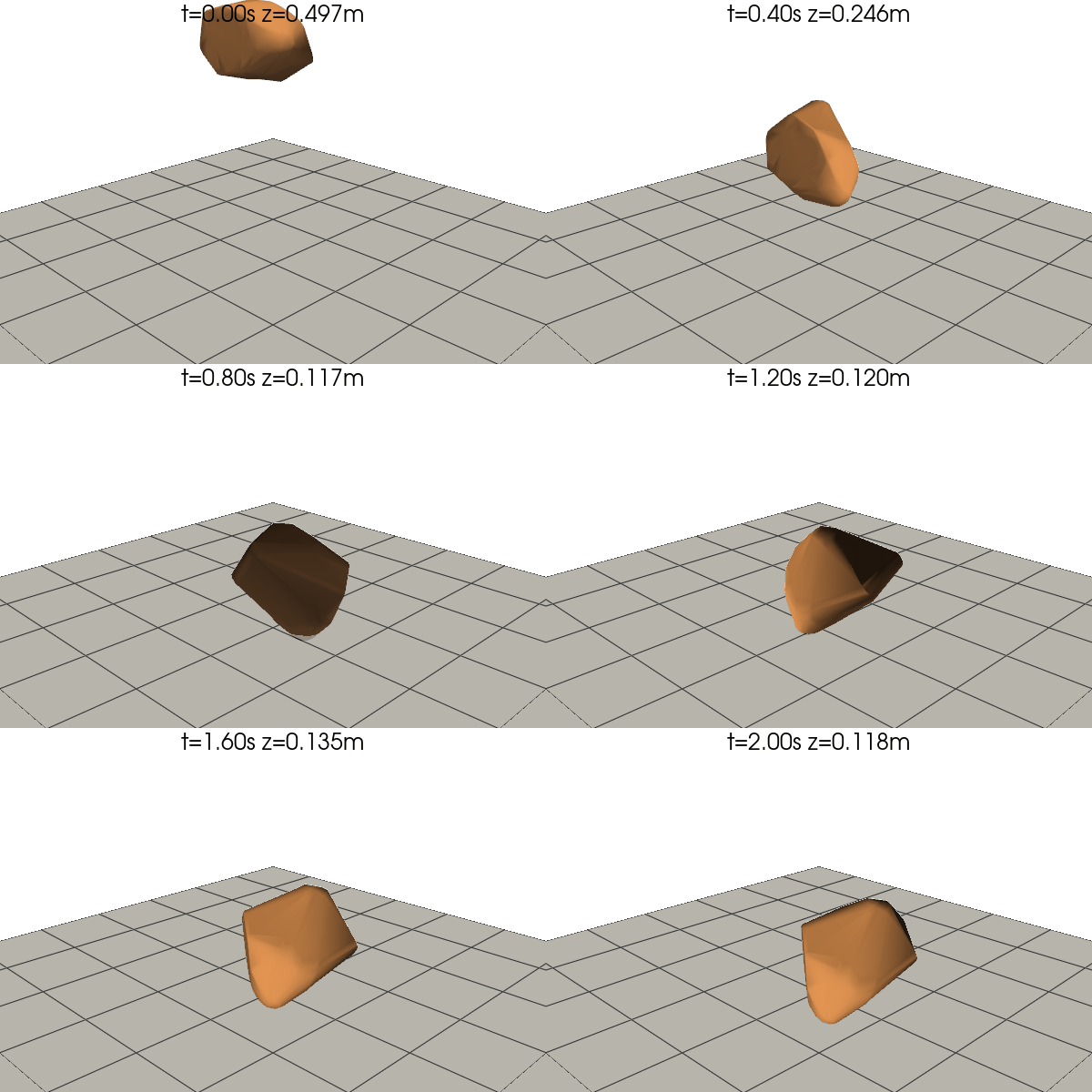
============================================================
BUNNY BOUNCE — NonLinear + IPC contact
============================================================
/home/runner/work/fedoo/fedoo/examples/rigid_body_bunny_bounce.py:32: PyVistaFutureWarning: The default value of `algorithm` for the filter
`UnstructuredGrid.extract_surface` will change in the future. It currently defaults to
`'dataset_surface'`, but will change to `None`. Explicitly set the `algorithm` keyword to
silence this warning.
  pv_bunny = pv_raw.delaunay_3d().extract_surface().triangulate().clean()
  Bunny: 239 nodes, mass=0.5kg
  4001 steps in 90.4s (22.6ms/step)
  z_min=0.0843m
  Saved: /home/runner/work/fedoo/fedoo/examples/rigid_body_bunny_bounce.gif
import os
import time
import numpy as np
import pyvista as pv

import fedoo as fd

from simcoon import Rotation  # required dependency (fedoo imports it at load)

g = 9.81
dt = 5e-4
t_end = 2.0

print("=" * 60)
print("BUNNY BOUNCE — NonLinear + IPC contact")
print("=" * 60)

space = fd.ModelingSpace("3D")
space.new_variable("DispX")
space.new_variable("DispY")
space.new_variable("DispZ")
space.new_vector("Disp", ("DispX", "DispY", "DispZ"))

# Watertight bunny from convex hull
pv_raw = pv.examples.download_bunny().decimate(0.97)
pv_bunny = pv_raw.delaunay_3d().extract_surface().triangulate().clean()
s = max(
    pv_bunny.bounds[1] - pv_bunny.bounds[0],
    pv_bunny.bounds[3] - pv_bunny.bounds[2],
    pv_bunny.bounds[5] - pv_bunny.bounds[4],
)
pv_bunny = pv_bunny.scale(0.25 / s, inplace=False)
pv_bunny = pv_bunny.translate(
    [-pv_bunny.center[0], -pv_bunny.center[1], -pv_bunny.bounds[4] + 0.4], inplace=False
)
pv_bunny = pv_bunny.compute_normals(consistent_normals=True, auto_orient_normals=True)

bunny_mesh = fd.Mesh.from_pyvista(pv_bunny)
plane_mesh = fd.Mesh.from_pyvista(
    pv.Plane(
        center=(0, 0, 0),
        direction=(0, 0, 1),
        i_size=1.5,
        j_size=1.5,
        i_resolution=6,
        j_resolution=6,
    ).triangulate()
)

mass = 0.5
bb = pv_bunny.bounds
lx, ly, lz = bb[1] - bb[0], bb[3] - bb[2], bb[5] - bb[4]
I = (mass / 12) * np.diag([ly**2 + lz**2, lx**2 + lz**2, lx**2 + ly**2])

body = fd.constraint.RigidBody(
    bunny_mesh,
    mass=mass,
    inertia_tensor=I,
    center_of_mass=np.array(pv_bunny.center),
    name="Bunny",
)
body.set_force([0, 0, -mass * g])
body.set_rayleigh_damping(1.0)
body.set_static_obstacle(plane_mesh, dhat=0.008, kappa=1e8)

print(f"  Bunny: {bunny_mesh.n_nodes} nodes, mass={mass}kg")

# Solve with manual loop for trajectory
pb = fd.problem.NonLinear(body.assembly)
pb.set_time_integrator(fd.time.SECOND_ORDER, fd.time.Newmark())
pb.initialize()

idx = body.assembly._dof_indices
q_hist = [np.zeros(6)]
t_hist = [0.0]

t0 = time.time()
n_steps = int(round(t_end / dt))
for step in range(n_steps):
    pb.dtime = dt
    pb.solve_time_increment()
    pb.set_start()
    dof = pb.get_dof_solution()
    q_hist.append(dof[idx].copy())
    t_hist.append((step + 1) * dt)

elapsed = time.time() - t0
t_hist = np.array(t_hist)
q_hist = np.array(q_hist)
z_hist = body.center_of_mass[2] + q_hist[:, 2]
print(
    f"  {len(t_hist)} steps in {elapsed:.1f}s ({elapsed / len(t_hist) * 1000:.1f}ms/step)"
)
print(f"  z_min={z_hist.min():.4f}m")

# Animation (low res for file size)
_here = os.path.dirname(__file__) if "__file__" in globals() else os.getcwd()
out = os.path.join(_here, "rigid_body_bunny_bounce.gif")
fps = 15
frame_skip = max(1, int(1.0 / (fps * dt)))
frame_indices = np.arange(0, len(t_hist), frame_skip)

vis = pv_bunny.copy()
pts_ref = vis.points.copy()
center = body.center_of_mass

pl = pv.Plotter(window_size=[600, 400], off_screen=True)
pl.set_background("white")
pl.add_mesh(
    pv.Plane(
        center=(0, 0, 0),
        direction=(0, 0, 1),
        i_size=1.5,
        j_size=1.5,
        i_resolution=8,
        j_resolution=8,
    ),
    color="lightgrey",
    opacity=0.8,
    show_edges=True,
)
pl.add_mesh(vis, color="sandybrown", smooth_shading=True)
pl.camera_position = [(1.0, -1.0, 0.7), (0, 0, 0.2), (0, 0, 1)]
pl.open_gif(out, fps=fps)

for i in frame_indices:
    qi = q_hist[i]
    R = Rotation.from_rotvec(qi[3:]).as_matrix()
    vis.points[:] = (pts_ref - center) @ R.T + center + qi[:3]
    vis.GetPoints().Modified()
    pl.add_text(
        f"t={t_hist[i]:.2f}s z={z_hist[i]:.3f}m",
        position="upper_edge",
        font_size=10,
        color="black",
        name="t",
    )
    pl.render()
    pl.write_frame()

pl.close()
print(f"  Saved: {out}")
Total running time of the script: (1 minutes 37.034 seconds)