Note
Go to the end to download the full example code.
Disk indentation (2D plane strain) — IPC contact with Hertz comparison
A stiff elastic disk is pressed vertically into a softer elastic rectangle (plane strain). This is a classical Hertz-like contact benchmark.
The plate is meshed with gmsh, using a graded size field that concentrates elements near the contact zone. The disk uses fedoo’s built-in disk_mesh.
The simulation uses the IPC barrier method for contact and compares the computed force-indentation curve to the 2D Hertz analytical prediction (Johnson, Contact Mechanics, Ch. 4):
with \(a\) the contact half-width, \(P\) the force per unit length and \(E^*\) the effective modulus.
Only the load-width relation \(P(a)\) is independent of the geometry of the body. In 2D the displacement of a half-space under a line load grows logarithmically with the distance, so an indentation depth \(\delta\) is only defined relative to a reference depth. The \(\delta(a)\) relation above (Johnson’s cylinder formula) implicitly places this reference at a depth of the order of \(R\), whereas the plate here is clamped at \(h = 40 \gg R = 5\). The extra compliance of the plate below that depth adds to the indentation, so the FEM force at a given \(\delta\) is expected to be lower than the Hertz curve. A reference-free comparison would plot \(P\) against the contact half-width \(a\). At the final increment \(a/R \approx 0.85\), well outside the small-contact assumption \(a \ll R\) of the Hertz theory, so the curves are only expected to agree qualitatively.
Note
Requires ipctk and gmsh.
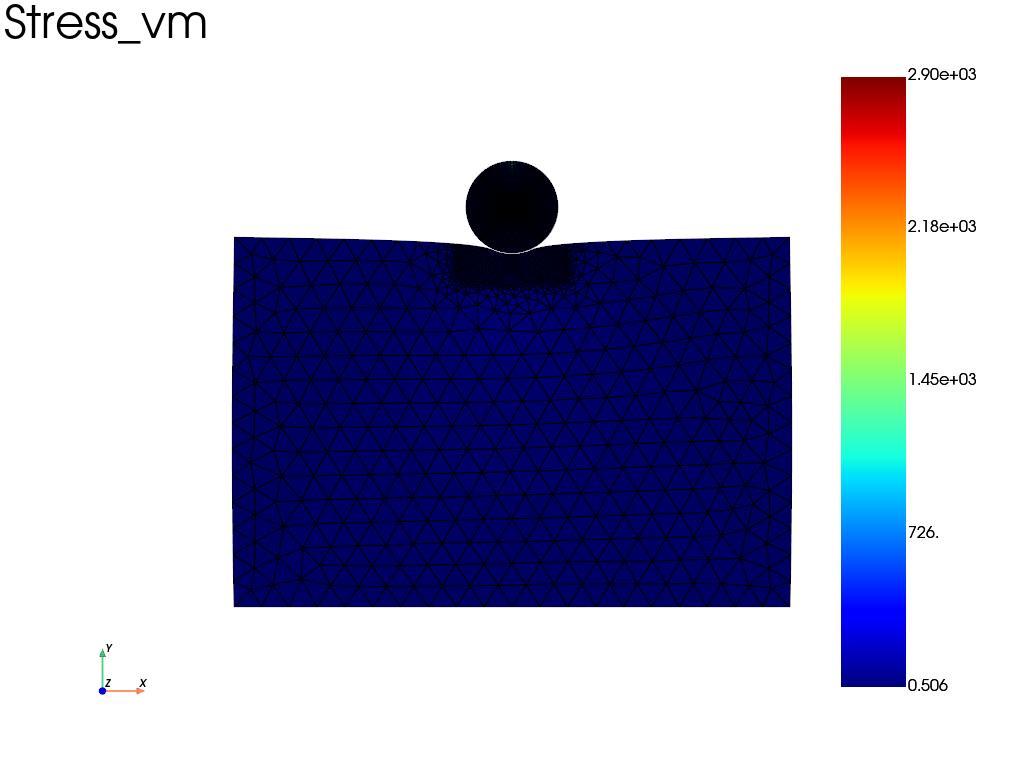
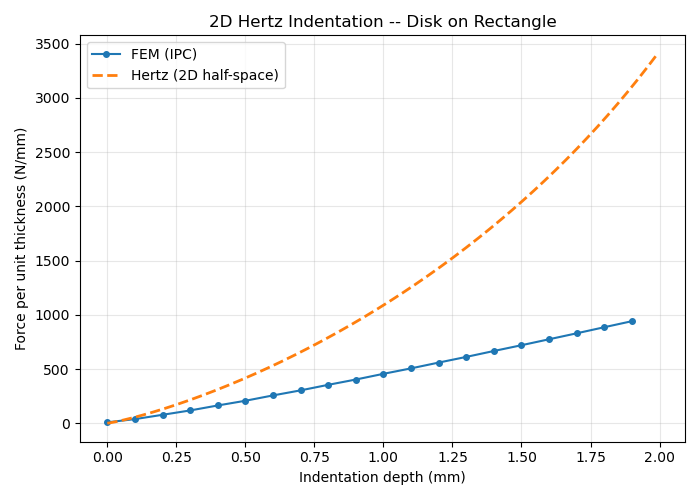
Plate mesh: 1146 nodes, 2177 elems
Disk mesh:  4233 nodes, 8280 elems
Total mesh: 5379 nodes, 10457 elems, type=tri3
============================================================
2D DISK INDENTATION -- IPC CONTACT
============================================================
Iter 1 - Time: 0.05000 - dt 0.05000 - NR iter: 4 - Err: 0.00029
Iter 2 - Time: 0.10000 - dt 0.05000 - NR iter: 4 - Err: 0.00487
Iter 3 - Time: 0.15000 - dt 0.05000 - NR iter: 3 - Err: 0.00015
Iter 4 - Time: 0.20000 - dt 0.05000 - NR iter: 3 - Err: 0.00090
Iter 5 - Time: 0.25000 - dt 0.05000 - NR iter: 2 - Err: 0.00086
Iter 6 - Time: 0.30000 - dt 0.05000 - NR iter: 2 - Err: 0.00097
Iter 7 - Time: 0.35000 - dt 0.05000 - NR iter: 2 - Err: 0.00477
Iter 8 - Time: 0.40000 - dt 0.05000 - NR iter: 2 - Err: 0.00097
Iter 9 - Time: 0.45000 - dt 0.05000 - NR iter: 3 - Err: 0.00077
Iter 10 - Time: 0.50000 - dt 0.05000 - NR iter: 3 - Err: 0.00018
Iter 11 - Time: 0.55000 - dt 0.05000 - NR iter: 3 - Err: 0.00213
Iter 12 - Time: 0.60000 - dt 0.05000 - NR iter: 2 - Err: 0.00015
Iter 13 - Time: 0.65000 - dt 0.05000 - NR iter: 3 - Err: 0.00114
Iter 14 - Time: 0.70000 - dt 0.05000 - NR iter: 3 - Err: 0.00116
Iter 15 - Time: 0.75000 - dt 0.05000 - NR iter: 3 - Err: 0.00072
Iter 16 - Time: 0.80000 - dt 0.05000 - NR iter: 2 - Err: 0.00029
Iter 17 - Time: 0.85000 - dt 0.05000 - NR iter: 3 - Err: 0.00096
Iter 18 - Time: 0.90000 - dt 0.05000 - NR iter: 2 - Err: 0.00197
Iter 19 - Time: 0.95000 - dt 0.05000 - NR iter: 3 - Err: 0.00109
Iter 20 - Time: 1.00000 - dt 0.05000 - NR iter: 1 - Err: 0.00408
Hertz comparison saved to results/indentation_2d_hertz.png

<pyvista.plotting.plotter.Plotter object at 0x73c90a216530>
import fedoo as fd
import numpy as np
import os
import tempfile

if "__file__" in globals():
    os.chdir(os.path.dirname(os.path.abspath(__file__)))

# =========================================================================
# Parameters
# =========================================================================

fd.ModelingSpace("2D")

# Units: N, mm, MPa
E_plate = 1e3  # soft plate
E_disk = 1e5  # stiff disk (quasi-rigid, 100x stiffer)
nu = 0.3
R = 5.0  # disk radius
plate_half = 30.0  # half-width of the plate
plate_h = 40.0  # plate height
gap = 0.1  # initial gap between disk bottom and plate top
imposed_disp = -2.0  # total vertical displacement of disk top

# =========================================================================
# Plate mesh (gmsh -- graded refinement near contact)
# =========================================================================

import gmsh

gmsh.initialize()
gmsh.option.setNumber("General.Verbosity", 1)

plate_tag = gmsh.model.occ.addRectangle(
    -plate_half,
    0,
    0,
    2 * plate_half,
    plate_h,
)
gmsh.model.occ.synchronize()
gmsh.model.addPhysicalGroup(2, [plate_tag], tag=1, name="plate")

# Fine elements near the top-centre (contact zone), coarse far away
gmsh.model.mesh.field.add("Box", 1)
gmsh.model.mesh.field.setNumber(1, "VIn", 0.3)
gmsh.model.mesh.field.setNumber(1, "VOut", 3.0)
gmsh.model.mesh.field.setNumber(1, "XMin", -6)
gmsh.model.mesh.field.setNumber(1, "XMax", 6)
gmsh.model.mesh.field.setNumber(1, "YMin", plate_h - 4)
gmsh.model.mesh.field.setNumber(1, "YMax", plate_h)
gmsh.model.mesh.field.setNumber(1, "Thickness", 4)
gmsh.model.mesh.field.setAsBackgroundMesh(1)
gmsh.option.setNumber("Mesh.MeshSizeExtendFromBoundary", 0)
gmsh.option.setNumber("Mesh.MeshSizeFromPoints", 0)
gmsh.option.setNumber("Mesh.MeshSizeFromCurvature", 0)

gmsh.model.mesh.generate(2)
plate_msh = os.path.join(tempfile.gettempdir(), "plate_indent2d.msh")
gmsh.write(plate_msh)
gmsh.finalize()

mesh_plate = fd.mesh.import_msh(plate_msh, mesh_type="surface")
# gmsh always stores 3D coordinates; strip Z for 2D modelling space
if mesh_plate.nodes.shape[1] == 3:
    mesh_plate.nodes = mesh_plate.nodes[:, :2]
mesh_plate.element_sets["plate"] = np.arange(mesh_plate.n_elements)
print(f"Plate mesh: {mesh_plate.n_nodes} nodes, {mesh_plate.n_elements} elems")

# =========================================================================
# Disk mesh (fedoo built-in)
# =========================================================================

# tri3, the element type of the gmsh plate mesh, so that both can be stacked
mesh_disk = fd.mesh.disk_mesh(radius=R, nr=12, nt=24, elm_type="tri3")
# Position: disk center at (0, plate_top + R + gap)
mesh_disk.nodes += np.array([0, plate_h + R + gap])
mesh_disk.element_sets["disk"] = np.arange(mesh_disk.n_elements)
print(f"Disk mesh:  {mesh_disk.n_nodes} nodes, {mesh_disk.n_elements} elems")

# Stack into single mesh
mesh = fd.Mesh.stack(mesh_plate, mesh_disk)
print(
    f"Total mesh: {mesh.n_nodes} nodes, {mesh.n_elements} elems, type={mesh.elm_type}"
)

# =========================================================================
# IPC contact
# =========================================================================

surf = fd.mesh.extract_surface(mesh)
ipc_contact = fd.constraint.IPCContact(
    mesh,
    surface_mesh=surf,
    dhat=0.05,  # absolute dhat (< gap)
    dhat_is_relative=False,
    use_ccd=True,
)

# =========================================================================
# Material, assembly, BCs
# =========================================================================

mat_plate = fd.constitutivelaw.ElasticIsotrop(E_plate, nu)
mat_disk = fd.constitutivelaw.ElasticIsotrop(E_disk, nu)
material = fd.constitutivelaw.Heterogeneous(
    (mat_plate, mat_disk),
    ("plate", "disk"),
)

wf = fd.weakform.StressEquilibrium(material, nlgeom=False)
solid = fd.Assembly.create(wf, mesh)
assembly = fd.Assembly.sum(solid, ipc_contact)

pb = fd.problem.NonLinear(assembly)

nodes_bottom = mesh.find_nodes("Y", 0)
nodes_disk_top = mesh.find_nodes("Y", mesh.bounding_box.ymax)
disk_nodes = np.arange(mesh_plate.n_nodes, mesh.n_nodes)
nodes_disk_axis = disk_nodes[np.isclose(mesh.nodes[disk_nodes, 0], 0.0)]

pb.bc.add("Dirichlet", nodes_bottom, "Disp", 0)
# The highest point is a single node. Prescribing it alone leaves a rigid
# rotation mode while the disk is separated from the plate. Horizontal
# symmetry on the disk centreline removes that mode without preventing its
# vertical deformation.
pb.bc.add("Dirichlet", nodes_disk_axis, "DispX", 0)
pb.bc.add("Dirichlet", nodes_disk_top, "DispY", imposed_disp)
pb.set_nr_criterion("Force", tol=5e-3, max_subiter=8)

# =========================================================================
# Output and tracking callback
# =========================================================================

if not os.path.isdir("results"):
    os.mkdir("results")
res = pb.add_output("results/indentation_2d", solid, ["Disp", "Stress"])

history = {"time": [], "reaction_y": []}


def track(pb):
    history["time"].append(pb.time)
    F = pb.get_ext_forces("Disp")
    history["reaction_y"].append(np.sum(F[1, nodes_disk_top]))


# =========================================================================
# Solve
# =========================================================================

print("=" * 60)
print("2D DISK INDENTATION -- IPC CONTACT")
print("=" * 60)
pb.nlsolve(
    dt=0.05,
    tmax=1,
    update_dt=True,
    print_info=1,
    callback=track,
)

# =========================================================================
# Hertz comparison
# =========================================================================

try:
    import matplotlib.pyplot as plt

    t = np.array(history["time"])
    Fy = -np.array(history["reaction_y"])  # positive = pushing down

    # Approximate indentation depth: prescribed displacement minus gap
    # (valid because the disk is 100x stiffer, so it barely deforms)
    delta = np.maximum(t * abs(imposed_disp) - gap, 0)

    # Hertz theory for 2D plane strain (cylinder on elastic half-space)
    # Effective modulus: 1/E* = (1-nu1^2)/E1 + (1-nu2^2)/E2
    E_star = 1.0 / ((1 - nu**2) / E_plate + (1 - nu**2) / E_disk)

    # 2D Hertz (Johnson, Contact Mechanics, Ch. 4), solved parametrically in
    # the contact half-width a (see the formulas in the header). P(a) is
    # reference-free; delta(a) assumes a reference depth of order R, while the
    # plate is clamped much deeper (plate_h >> R), so the FEM curve lies below.

    def hertz_2d(a):
        """Return (delta, P) for given contact half-width a."""
        d = a**2 / (4 * R) * (2 * np.log(4 * R / a) - 1)
        P = np.pi * E_star / (4 * R) * a**2
        return d, P

    # Build Hertz curve by sweeping contact half-width
    a_vals = np.linspace(0.01, R * 0.95, 500)
    delta_hertz, F_hertz = np.array([hertz_2d(a) for a in a_vals]).T

    # Keep only the range that overlaps with FEM data
    mask = delta_hertz <= delta.max() * 1.05
    delta_hertz = delta_hertz[mask]
    F_hertz = F_hertz[mask]

    fig, ax = plt.subplots(figsize=(7, 5))
    ax.plot(delta, Fy, "o-", ms=4, label="FEM (IPC)")
    ax.plot(delta_hertz, F_hertz, "--", lw=2, label="Hertz (2D half-space)")
    ax.set_xlabel("Indentation depth (mm)")
    ax.set_ylabel("Force per unit thickness (N/mm)")
    ax.set_title("2D Hertz Indentation -- Disk on Rectangle")
    ax.legend()
    ax.grid(True, alpha=0.3)
    fig.tight_layout()
    fig.savefig("results/indentation_2d_hertz.png", dpi=150)
    print("Hertz comparison saved to results/indentation_2d_hertz.png")
    plt.show()
except ImportError:
    print("matplotlib not available -- skipping Hertz comparison plot")

# =========================================================================
# Stress plot
# =========================================================================

res.plot("Stress", "vm", "Node", show=False, scale=1)
Total running time of the script: (0 minutes 4.038 seconds)