Note
Go to the end to download the full example code.
Sphere indentation (3D) — IPC contact with Hertz comparison
Note
This example is too heavy to be run at each documentation build. The animation below was precomputed on 2026-11-10 with fedoo 1.1.0, simcoon 0+unknown, ipctk 1.6.1, numpy 2.5.4 (fedoo commit 8fa6ec0798fea2cd3c52159d1c5ffe508131a66b), in about 42 s (Linux x86_64, BLAS mkl). Run the script to reproduce it with your fedoo version.
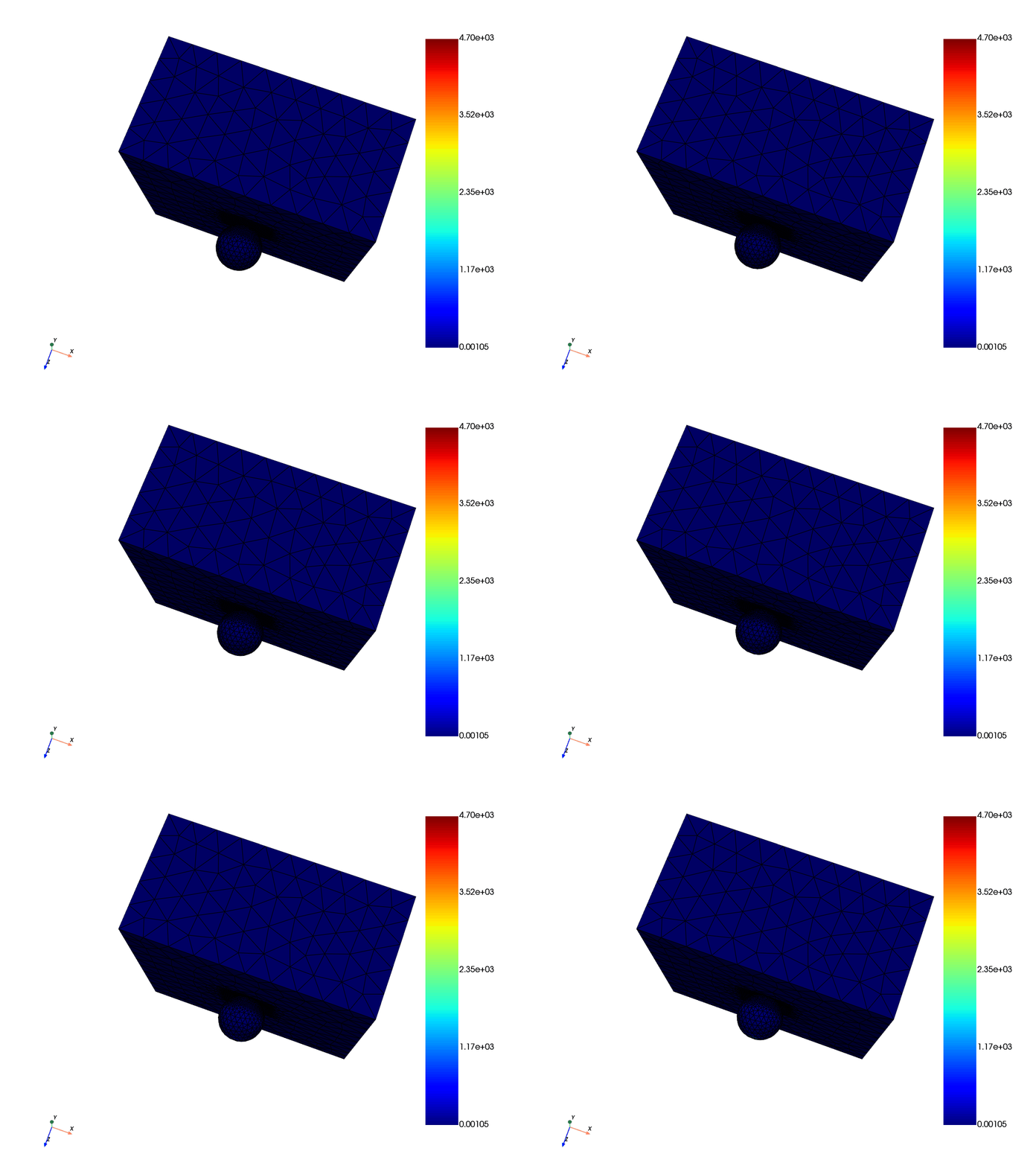
A stiff elastic sphere is pressed vertically into a softer elastic block. This is the classical 3D Hertz contact benchmark.
Both bodies are meshed with gmsh, using graded size fields that concentrate elements near the contact zone.
The simulation uses the IPC barrier method for contact and compares the computed force-indentation curve to the Hertz analytical prediction:
The FEM force is expected to end about 25-30 % above the Hertz prediction. Plausible contributions, which were not measured separately, are the finite plate with a clamped base (Hertz assumes an elastic half-space) and the stiffness of linear tetrahedra on this coarse mesh. The contact is also not small at the end of the loading (\(a/R \approx 0.62\)): for a rigid sphere, Sneddon’s exact solution gives a force about 4 % below the paraboloid Hertz law at \(\delta = 1.9\), which partly offsets these effects.
Note
Requires ipctk and gmsh.
import fedoo as fd
import numpy as np
import os
import tempfile

os.chdir(os.path.dirname(os.path.abspath(__file__)) or ".")

# =========================================================================
# Parameters
# =========================================================================

fd.ModelingSpace("3D")

# Units: N, mm, MPa
E_plate = 1e3  # soft plate
E_sphere = 1e5  # stiff sphere (quasi-rigid, 100x stiffer)
nu = 0.3
R = 5.0  # sphere radius
plate_half = 25.0  # half-width of the plate
plate_h = 25.0  # plate thickness
gap = 0.1  # initial gap between sphere bottom and plate top
imposed_disp = -2.0  # total vertical displacement of sphere top

sphere_cz = plate_h + R + gap  # sphere centre z-coordinate

# =========================================================================
# Sphere mesh (gmsh)
# =========================================================================

import gmsh

gmsh.initialize()
gmsh.option.setNumber("General.Verbosity", 1)

sphere_tag = gmsh.model.occ.addSphere(0, 0, sphere_cz, R)
gmsh.model.occ.synchronize()
gmsh.model.addPhysicalGroup(3, [sphere_tag], tag=2, name="sphere")

# Fine elements near the contact tip (bottom of sphere), coarser elsewhere
gmsh.model.mesh.field.add("Box", 1)
gmsh.model.mesh.field.setNumber(1, "VIn", 0.4)
gmsh.model.mesh.field.setNumber(1, "VOut", 1.2)
gmsh.model.mesh.field.setNumber(1, "XMin", -R)
gmsh.model.mesh.field.setNumber(1, "XMax", R)
gmsh.model.mesh.field.setNumber(1, "YMin", -R)
gmsh.model.mesh.field.setNumber(1, "YMax", R)
gmsh.model.mesh.field.setNumber(1, "ZMin", sphere_cz - R)
gmsh.model.mesh.field.setNumber(1, "ZMax", sphere_cz - R + 3)
gmsh.model.mesh.field.setNumber(1, "Thickness", 2)
gmsh.model.mesh.field.setAsBackgroundMesh(1)
gmsh.option.setNumber("Mesh.MeshSizeExtendFromBoundary", 0)
gmsh.option.setNumber("Mesh.MeshSizeFromPoints", 0)
gmsh.option.setNumber("Mesh.MeshSizeFromCurvature", 0)

gmsh.model.mesh.generate(3)
sphere_msh = os.path.join(tempfile.gettempdir(), "sphere_indent3d.msh")
gmsh.write(sphere_msh)
gmsh.finalize()

mesh_sphere = fd.mesh.import_msh(sphere_msh)
mesh_sphere.element_sets["sphere"] = mesh_sphere.element_sets.get(
    "sphere", np.arange(mesh_sphere.n_elements)
)
print(f"Sphere mesh: {mesh_sphere.n_nodes} nodes, {mesh_sphere.n_elements} tet4")

# =========================================================================
# Plate mesh (gmsh -- graded refinement near contact)
# =========================================================================

gmsh.initialize()
gmsh.option.setNumber("General.Verbosity", 1)

plate_tag = gmsh.model.occ.addBox(
    -plate_half,
    -plate_half,
    0,
    2 * plate_half,
    2 * plate_half,
    plate_h,
)
gmsh.model.occ.synchronize()
gmsh.model.addPhysicalGroup(3, [plate_tag], tag=1, name="plate")

# Fine elements beneath the indenter, coarse far away
gmsh.model.mesh.field.add("Box", 1)
gmsh.model.mesh.field.setNumber(1, "VIn", 0.6)
gmsh.model.mesh.field.setNumber(1, "VOut", 5.0)
gmsh.model.mesh.field.setNumber(1, "XMin", -6)
gmsh.model.mesh.field.setNumber(1, "XMax", 6)
gmsh.model.mesh.field.setNumber(1, "YMin", -6)
gmsh.model.mesh.field.setNumber(1, "YMax", 6)
gmsh.model.mesh.field.setNumber(1, "ZMin", plate_h - 5)
gmsh.model.mesh.field.setNumber(1, "ZMax", plate_h)
gmsh.model.mesh.field.setNumber(1, "Thickness", 3)
gmsh.model.mesh.field.setAsBackgroundMesh(1)
gmsh.option.setNumber("Mesh.MeshSizeExtendFromBoundary", 0)
gmsh.option.setNumber("Mesh.MeshSizeFromPoints", 0)
gmsh.option.setNumber("Mesh.MeshSizeFromCurvature", 0)

gmsh.model.mesh.generate(3)
plate_msh = os.path.join(tempfile.gettempdir(), "plate_indent3d.msh")
gmsh.write(plate_msh)
gmsh.finalize()

mesh_plate = fd.mesh.import_msh(plate_msh)
mesh_plate.element_sets["plate"] = mesh_plate.element_sets.get(
    "plate", np.arange(mesh_plate.n_elements)
)
print(f"Plate mesh: {mesh_plate.n_nodes} nodes, {mesh_plate.n_elements} tet4")

# =========================================================================
# Stack into single mesh
# =========================================================================

mesh = fd.Mesh.stack(mesh_plate, mesh_sphere)
print(f"Total mesh:  {mesh.n_nodes} nodes, {mesh.n_elements} tet4")

# =========================================================================
# IPC contact
# =========================================================================

surf = fd.mesh.extract_surface(mesh, quad2tri=True)
ipc_contact = fd.constraint.IPCContact(
    mesh,
    surface_mesh=surf,
    dhat=0.05,  # absolute dhat (< gap to avoid initial contact)
    dhat_is_relative=False,
    use_ccd=True,
)

# =========================================================================
# Material, assembly, BCs
# =========================================================================

mat_plate = fd.constitutivelaw.ElasticIsotrop(E_plate, nu)
mat_sphere = fd.constitutivelaw.ElasticIsotrop(E_sphere, nu)
material = fd.constitutivelaw.Heterogeneous(
    (mat_plate, mat_sphere),
    ("plate", "sphere"),
)

wf = fd.weakform.StressEquilibrium(material, nlgeom=False)
solid = fd.Assembly.create(wf, mesh)
assembly = fd.Assembly.sum(solid, ipc_contact)

pb = fd.problem.NonLinear(assembly)

nodes_bottom = mesh.find_nodes("Z", 0)
nodes_sphere_top = mesh.find_nodes("Z", mesh.bounding_box.zmax)
sphere_nodes = np.arange(mesh_plate.n_nodes, mesh.n_nodes)
nodes_sphere_meridian = sphere_nodes[np.isclose(mesh.nodes[sphere_nodes, 1], 0.0)]
nodes_sphere_axis = sphere_nodes[
    np.isclose(mesh.nodes[sphere_nodes, 0], 0.0)
    & np.isclose(mesh.nodes[sphere_nodes, 1], 0.0)
]

pb.bc.add("Dirichlet", nodes_bottom, "Disp", 0)
# The sphere top is a single node. Symmetry constraints on a meridian and the
# vertical axis suppress its three rigid rotations while it is out of contact.
pb.bc.add("Dirichlet", nodes_sphere_meridian, "DispY", 0)
pb.bc.add("Dirichlet", nodes_sphere_axis, "DispX", 0)
pb.bc.add("Dirichlet", nodes_sphere_top, "DispZ", imposed_disp)
pb.set_nr_criterion("Force", tol=5e-3, max_subiter=8)

# =========================================================================
# Output and tracking callback
# =========================================================================

if not os.path.isdir("results"):
    os.mkdir("results")
res = pb.add_output("results/indentation_3d", solid, ["Disp", "Stress"])

history = {"time": [], "reaction_z": []}


def track(pb):
    history["time"].append(pb.time)
    F = pb.get_ext_forces("Disp")
    history["reaction_z"].append(np.sum(F[2, nodes_sphere_top]))


# =========================================================================
# Solve
# =========================================================================

print("=" * 60)
print("3D SPHERE INDENTATION -- IPC CONTACT")
print("=" * 60)
pb.nlsolve(
    dt=0.05,
    tmax=1,
    update_dt=True,
    print_info=2,
    callback=track,
)

# =========================================================================
# Hertz comparison
# =========================================================================

try:
    import matplotlib.pyplot as plt

    t = np.array(history["time"])
    Fz = -np.array(history["reaction_z"])  # positive = pushing down

    # Approximate indentation depth (prescribed - gap)
    # valid because the sphere is 100x stiffer so it barely deforms
    delta = np.maximum(t * abs(imposed_disp) - gap, 0)

    # Hertz theory for 3D -- two elastic bodies
    # 1/E* = (1-nu1^2)/E1 + (1-nu2^2)/E2
    E_star = 1.0 / ((1 - nu**2) / E_plate + (1 - nu**2) / E_sphere)

    # F = 4/3 * E* * sqrt(R) * delta^(3/2)
    delta_hertz = np.linspace(0, delta.max(), 200)
    F_hertz = (4.0 / 3.0) * E_star * np.sqrt(R) * delta_hertz**1.5

    fig, ax = plt.subplots(figsize=(7, 5))
    ax.plot(delta, Fz, "o-", ms=4, label="FEM (IPC)")
    ax.plot(delta_hertz, F_hertz, "--", lw=2, label="Hertz (3D half-space)")
    ax.set_xlabel("Indentation depth (mm)")
    ax.set_ylabel("Force (N)")
    ax.set_title("3D Hertz Indentation -- Sphere on Plate")
    ax.legend()
    ax.grid(True, alpha=0.3)
    fig.tight_layout()
    fig.savefig("results/indentation_3d_hertz.png", dpi=150)
    print("Hertz comparison saved to results/indentation_3d_hertz.png")
    plt.show()
except ImportError:
    print("matplotlib not available -- skipping Hertz comparison plot")

# =========================================================================
# Stress plot
# =========================================================================

res.plot("Stress", "vm", "Node", show=False, scale=1, elevation=75, azimuth=20)