Note
Go to the end to download the full example code.
Rigid Stanford bunny tumbling on a plane (IPC)
Note
This example is too heavy to be run at each documentation build. The animation below was precomputed on 2026-11-11 with fedoo 1.1.0, simcoon 0+unknown, ipctk 1.6.0, numpy 2.5.4 (fedoo commit 0c1c3c65c9bdd8702d3f2ad96d75c408d2ffb4d6), in about 62 s (Linux x86_64, BLAS mkl). Run the script to reproduce it with your fedoo version.
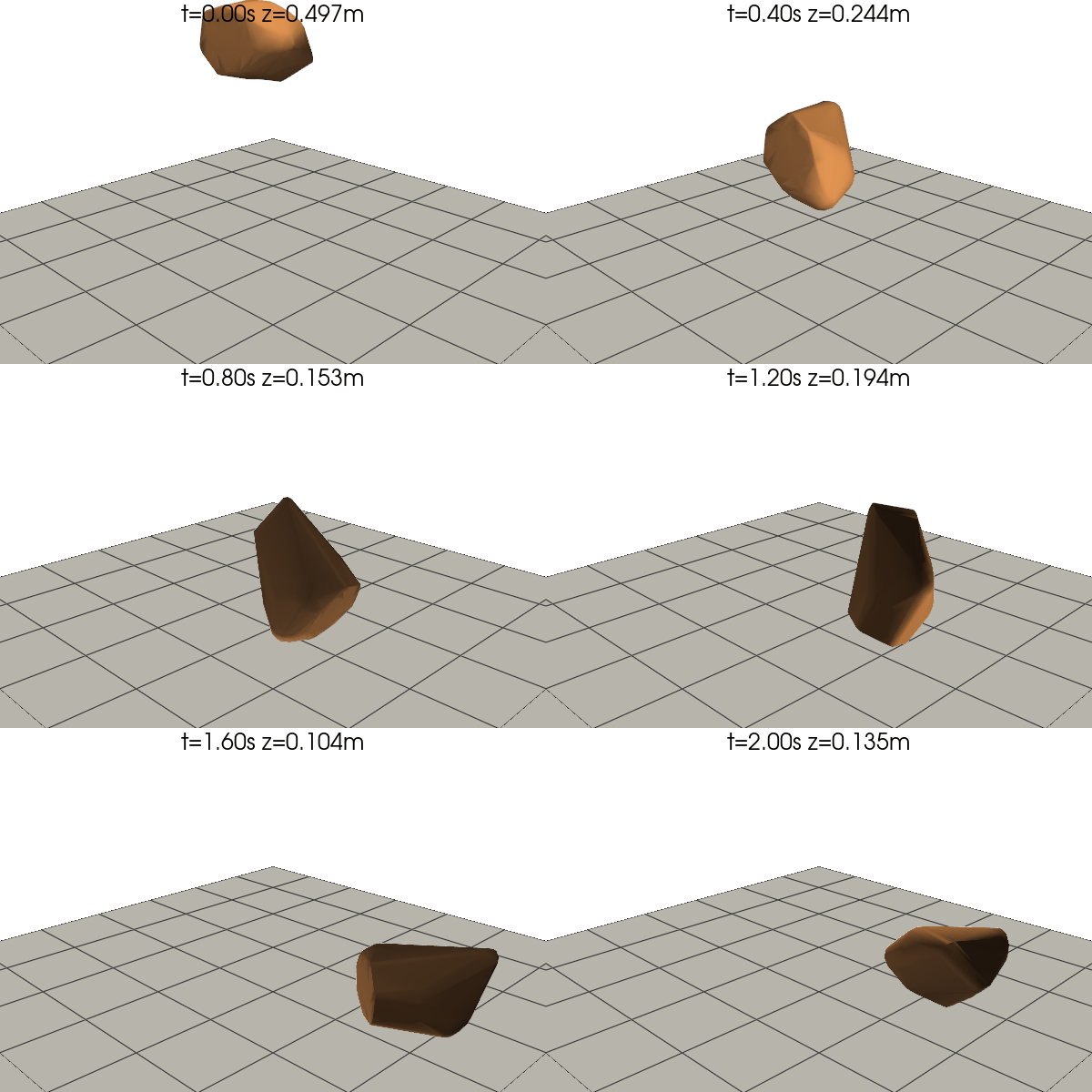
Compared with Rigid-body bounce with IPC contact, the
rigid body is not a sphere but the convex hull of the Stanford bunny (a
watertight, asymmetric surface), which tumbles on impact. The centre of
mass is taken at the centre of the bounding box and the inertia tensor is
that of a box of the same size (simple approximations). The time loop is
written by hand to store the orientation at each increment, read from the
rigid tie quaternion, and to write the animation
rigid_body_bunny_bounce.gif.
This example requires ipctk.
import os
import time
import numpy as np
import pyvista as pv

import fedoo as fd

g = 9.81
dt = 5e-4
t_end = 2.0

print("=" * 60)
print("BUNNY BOUNCE — NonLinear + IPC contact")
print("=" * 60)

space = fd.ModelingSpace("3D")
space.new_variable("DispX")
space.new_variable("DispY")
space.new_variable("DispZ")
space.new_vector("Disp", ("DispX", "DispY", "DispZ"))

# Watertight bunny from convex hull
pv_raw = pv.examples.download_bunny().decimate(0.97)
pv_bunny = pv_raw.delaunay_3d().extract_surface().triangulate().clean()
s = max(
    pv_bunny.bounds[1] - pv_bunny.bounds[0],
    pv_bunny.bounds[3] - pv_bunny.bounds[2],
    pv_bunny.bounds[5] - pv_bunny.bounds[4],
)
pv_bunny = pv_bunny.scale(0.25 / s, inplace=False)
pv_bunny = pv_bunny.translate(
    [-pv_bunny.center[0], -pv_bunny.center[1], -pv_bunny.bounds[4] + 0.4], inplace=False
)
pv_bunny = pv_bunny.compute_normals(consistent_normals=True, auto_orient_normals=True)

bunny_mesh = fd.Mesh.from_pyvista(pv_bunny)
plane_mesh = fd.Mesh.from_pyvista(
    pv.Plane(
        center=(0, 0, 0),
        direction=(0, 0, 1),
        i_size=1.5,
        j_size=1.5,
        i_resolution=6,
        j_resolution=6,
    ).triangulate()
)

mass = 0.5
bb = pv_bunny.bounds
lx, ly, lz = bb[1] - bb[0], bb[3] - bb[2], bb[5] - bb[4]
I = (mass / 12) * np.diag([ly**2 + lz**2, lx**2 + lz**2, lx**2 + ly**2])

body = fd.constraint.RigidBody(
    bunny_mesh,
    mass=mass,
    inertia_tensor=I,
    center_of_mass=np.array(pv_bunny.center),
    name="Bunny",
)
body.set_force([0, 0, -mass * g])
body.set_rayleigh_damping(1.0)
body.set_static_obstacle(plane_mesh, dhat=0.008, kappa=1e8)

print(f"  Bunny: {bunny_mesh.n_nodes} nodes, mass={mass}kg")

# Solve with manual loop for trajectory
pb = fd.problem.NonLinear(body.assembly)
pb.set_time_integrator(fd.time.SECOND_ORDER, fd.time.Newmark())
pb.initialize()

idx = body.assembly.dof_indices
q_hist = [np.zeros(6)]
# With the default quaternion storage (use_quaternion=True), the rotational dofs
# are the sum of the incremental rotation vectors, not the total rotation vector:
# the converged orientation is read from the rigid tie at each increment.
R_hist = [np.eye(3)]
t_hist = [0.0]

t0 = time.time()
n_steps = int(round(t_end / dt))
for step in range(n_steps):
    pb.dtime = dt
    pb.solve_time_increment()
    pb.set_start()
    dof = pb.get_dof_solution()
    q_hist.append(dof[idx].copy())
    R_hist.append(body.constraint.Q_total.as_matrix())
    t_hist.append((step + 1) * dt)

elapsed = time.time() - t0
t_hist = np.array(t_hist)
q_hist = np.array(q_hist)
z_hist = body.center_of_mass[2] + q_hist[:, 2]
print(
    f"  {len(t_hist)} steps in {elapsed:.1f}s ({elapsed / len(t_hist) * 1000:.1f}ms/step)"
)
print(f"  z_min={z_hist.min():.4f}m")

# Animation (low res for file size)
_here = os.path.dirname(__file__) if "__file__" in globals() else os.getcwd()
out = os.path.join(_here, "rigid_body_bunny_bounce.gif")
fps = 15
frame_skip = max(1, int(1.0 / (fps * dt)))
frame_indices = np.arange(0, len(t_hist), frame_skip)

vis = pv_bunny.copy()
pts_ref = vis.points.copy()
center = body.center_of_mass

pl = pv.Plotter(window_size=[600, 400], off_screen=True)
pl.set_background("white")
pl.add_mesh(
    pv.Plane(
        center=(0, 0, 0),
        direction=(0, 0, 1),
        i_size=1.5,
        j_size=1.5,
        i_resolution=8,
        j_resolution=8,
    ),
    color="lightgrey",
    opacity=0.8,
    show_edges=True,
)
pl.add_mesh(vis, color="sandybrown", smooth_shading=True)
pl.camera_position = [(1.0, -1.0, 0.7), (0, 0, 0.2), (0, 0, 1)]
pl.open_gif(out, fps=fps)

for i in frame_indices:
    qi = q_hist[i]
    R = R_hist[i]
    vis.points[:] = (pts_ref - center) @ R.T + center + qi[:3]
    vis.GetPoints().Modified()
    pl.add_text(
        f"t={t_hist[i]:.2f}s z={z_hist[i]:.3f}m",
        position="upper_edge",
        font_size=10,
        color="black",
        name="t",
    )
    pl.render()
    pl.write_frame()

pl.close()
print(f"  Saved: {out}")