Note
Go to the end to download the full example code.
Matrix with a stiff inclusion: three ways to assign materials
A square plate (plane stress) contains a circular inclusion five times stiffer
than the matrix. Both materials are linear elastic and the problem is solved
with fedoo.problem.Linear. The example shows three ways to give
different materials to different element sets:
one assembly per material, summed into a global assembly;
a single
fedoo.constitutivelaw.ElasticIsotroplaw whose Young modulus is an array with one value per element;a
fedoo.constitutivelaw.Heterogeneouslaw that maps one law to each element set.
The three methods give the same solution. Change method to switch between
them. See the elastoplastic heterogeneous structure example for the nonlinear
version.
import fedoo as fd
import numpy as np
Mesh of the matrix and of the inclusion
The plate with a hole and the disk are meshed separately, then merged into a single mesh. The coincident nodes of the interface are merged so that the inclusion is perfectly bonded to the matrix.
mesh = fd.mesh.hole_plate_mesh(
    nr=11, nt=11, length=100, height=100, radius=20, elm_type="quad4", name="Domain"
)

mesh.element_sets["matrix"] = np.arange(0, mesh.n_elements)

mesh_disk = fd.mesh.disk_mesh(20, 11, 11)
mesh_disk.element_sets["inclusion"] = np.arange(0, mesh_disk.n_elements)

mesh = mesh + mesh_disk

# glue the inclusion to the matrix
mesh.merge_nodes(np.c_[mesh.node_sets["hole_edge"], mesh.node_sets["boundary"]])
Materials and assembly
Matrix: \(E = 2 \times 10^4\), inclusion: \(E = 10^5\), both with \(\nu = 0.3\).
# 2D problem with the plane stress assumption.
fd.ModelingSpace("2Dstress")

method = 1  # 1: sum of assemblies, 2: array properties, 3: Heterogeneous law
if method == 1:
    # method 1: one assembly per material, then sum of the assemblies
    material1 = fd.constitutivelaw.ElasticIsotrop(2e4, 0.3)
    material2 = fd.constitutivelaw.ElasticIsotrop(1e5, 0.3)

    # weak formulation of the mechanical equilibrium equation
    wf1 = fd.weakform.StressEquilibrium(material1)
    wf2 = fd.weakform.StressEquilibrium(material2)

    # global assembly
    assemb1 = fd.Assembly.create(wf1, mesh.extract_elements("matrix"))
    assemb2 = fd.Assembly.create(wf2, mesh.extract_elements("inclusion"))

    assembly = assemb1 + assemb2

elif method == 2:
    # method 2: constitutive law with one property value per element.
    # Simpler, but only works if both materials use the same kind of law.
    E = np.empty(mesh.n_elements)
    E[mesh.element_sets["matrix"]] = 2e4
    E[mesh.element_sets["inclusion"]] = 1e5

    material = fd.constitutivelaw.ElasticIsotrop(E, 0.3)
    wf = fd.weakform.StressEquilibrium(material)
    assembly = fd.Assembly.create(wf, mesh)

elif method == 3:
    # method 3: heterogeneous constitutive law
    material1 = fd.constitutivelaw.ElasticIsotrop(2e4, 0.3)
    material2 = fd.constitutivelaw.ElasticIsotrop(1e5, 0.3)

    material = fd.constitutivelaw.Heterogeneous(
        (material1, material2), ("matrix", "inclusion")
    )

    wf = fd.weakform.StressEquilibrium(material)
    assembly = fd.Assembly.create(wf, mesh)
Linear problem and boundary conditions
The left edge is clamped and a displacement \(u_x = 20\) is prescribed on the right edge (with \(u_y = 0\)).
pb = fd.problem.Linear(assembly)

left = mesh.find_nodes("X", mesh.bounding_box.xmin)
right = mesh.find_nodes("X", mesh.bounding_box.xmax)

pb.bc.add("Dirichlet", left, "Disp", 0)
pb.bc.add("Dirichlet", right, "Disp", [20, 0])

pb.apply_boundary_conditions()

pb.solve()
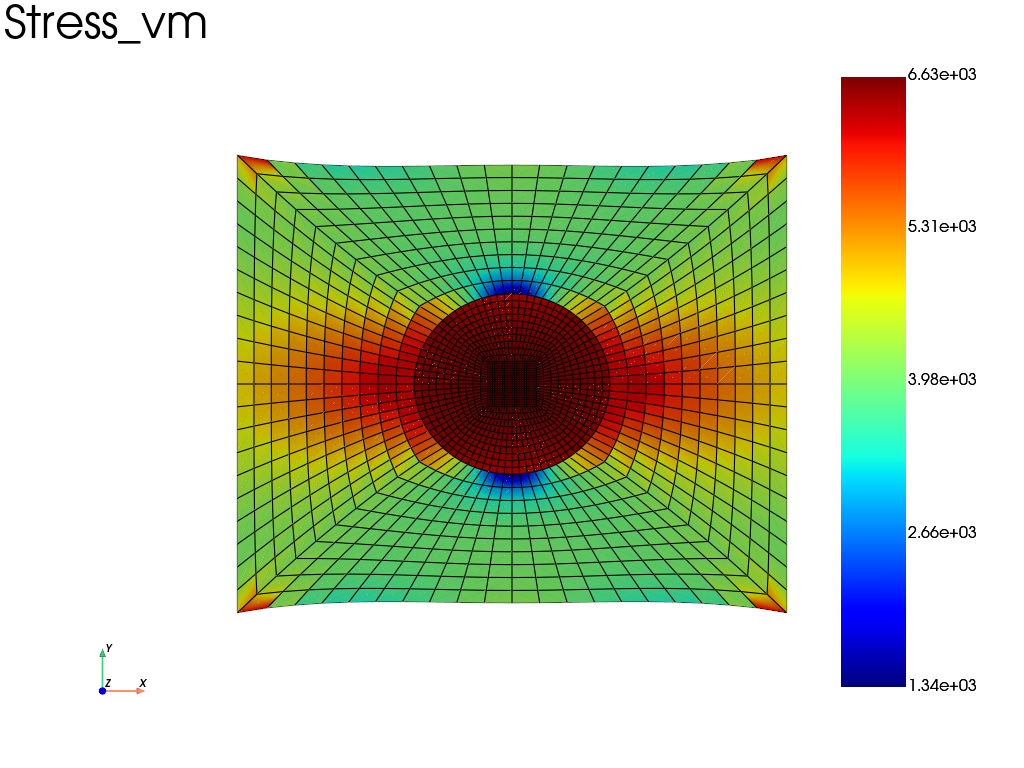
Von Mises stress
With method 1, each assembly has its own results, plotted in the same window.
field_plot = "Stress"
component = "vm"
if method == 1:
    # stress, strain and displacement (nodal values) of each assembly
    res1 = pb.get_results(assemb1, ["Stress", "Strain", "Disp"])
    res2 = pb.get_results(assemb2, ["Stress", "Strain", "Disp"])

    pl = res2.plot(field_plot, component=component, show=False)
    res1.plot(field_plot, component=component, plotter=pl)

if method == 2 or method == 3:
    res = pb.get_results(assembly, ["Stress", "Strain", "Disp"])
    res.plot(field_plot, component=component)
Total running time of the script: (0 minutes 0.301 seconds)