Note
Go to the end to download the full example code.
Elastoplastic matrix with an elastic inclusion (Heterogeneous law)
Note
This example is too heavy to be run at each documentation build. The animation below was precomputed on 2026-11-10 with fedoo 1.1.0, simcoon 0+unknown, ipctk 1.6.1, numpy 2.5.4 (fedoo commit 8fa6ec0798fea2cd3c52159d1c5ffe508131a66b), in about 530 s (Linux x86_64, BLAS mkl). Run the script to reproduce it with your fedoo version.
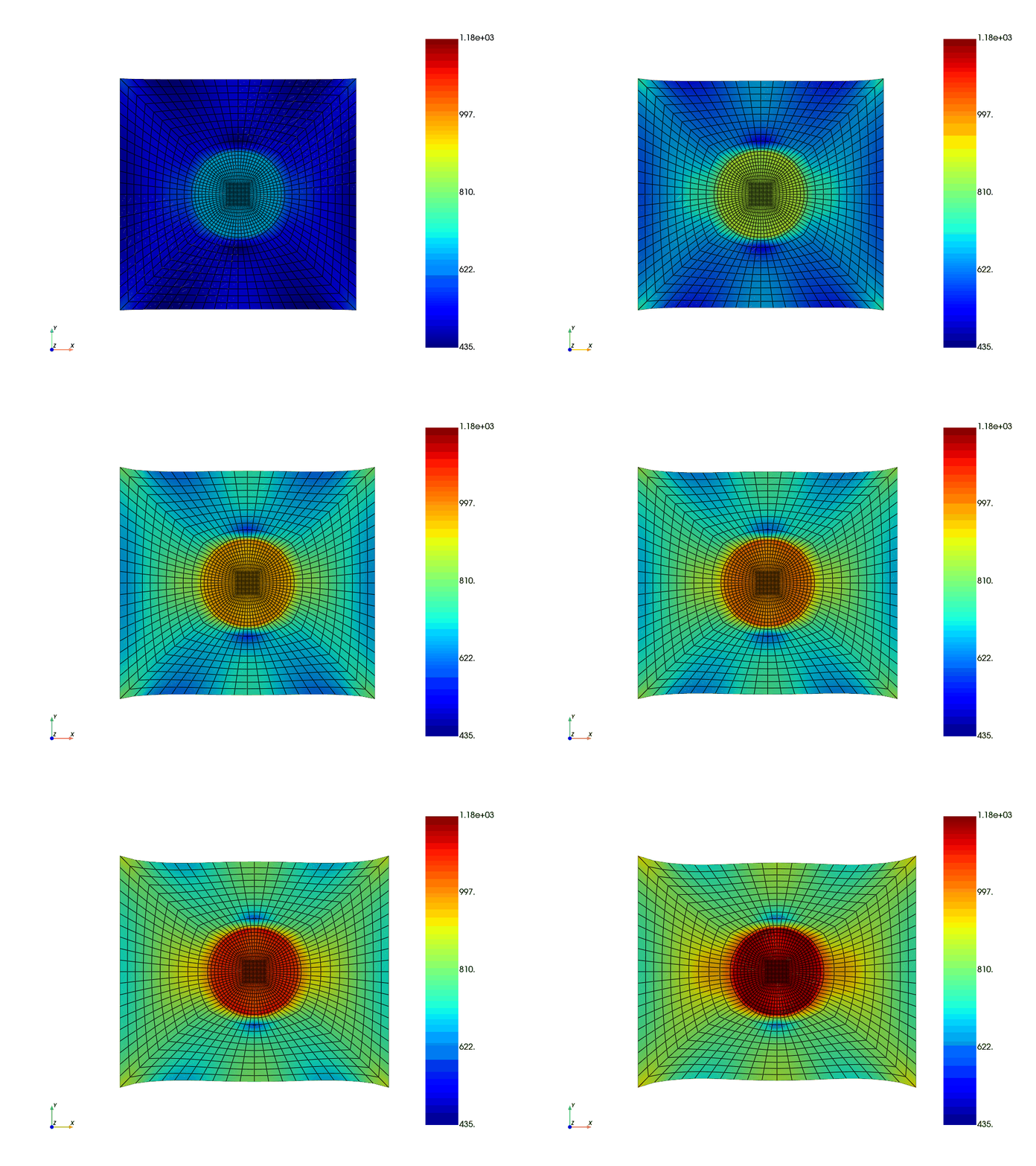
Nonlinear version of the “matrix with a stiff inclusion” example. The matrix
follows the J2 elastoplastic law with power-law hardening of Simcoon
(EPICP) and the circular inclusion is linear elastic. The plate (plane
stress) is stretched by 20 % in finite strain (nlgeom=True) with
fedoo.problem.NonLinear.
The two laws are combined in a single
fedoo.constitutivelaw.Heterogeneous law (method = 3), or put in
two assemblies that are summed (method = 1).
import fedoo as fd
import numpy as np
Mesh of the matrix and of the inclusion
The plate with a hole and the disk are meshed separately, then merged into a single mesh. The coincident nodes of the interface are merged so that the inclusion is perfectly bonded to the matrix.
# 2D problem with the plane stress assumption.
fd.ModelingSpace("2Dstress")

mesh = fd.mesh.hole_plate_mesh(
    nr=11, nt=11, length=100, height=100, radius=20, elm_type="quad4", name="Domain"
)

mesh.element_sets["matrix"] = np.arange(0, mesh.n_elements)

mesh_disk = fd.mesh.disk_mesh(20, 11, 11)
mesh_disk.element_sets["inclusion"] = np.arange(0, mesh_disk.n_elements)

mesh = mesh + mesh_disk

# glue the inclusion to the matrix
mesh.merge_nodes(np.c_[mesh.node_sets["hole_edge"], mesh.node_sets["boundary"]])
Materials and assembly
Matrix: EPICP with \(E = 2 \times 10^5\), \(\nu = 0.3\) and a
yield stress of 200. Inclusion: linear elastic, \(E = 10^5\).
method = 3  # 1: sum of assemblies, 3: Heterogeneous law
if method == 1:
    # method 1: one assembly per material, then sum of the assemblies
    material2 = fd.constitutivelaw.ElasticIsotrop(1e5, 0.3)
    props = np.array([2e5, 0.3, 1e-5, 200, 1000, 0.3])  # E, nu, alpha, Re, k, m
    material1 = fd.constitutivelaw.Simcoon("EPICP", props)

    # weak formulation of the mechanical equilibrium equation
    wf1 = fd.weakform.StressEquilibrium(material1, nlgeom=True)
    wf2 = fd.weakform.StressEquilibrium(material2, nlgeom=True)

    # global assembly
    assemb1 = fd.Assembly.create(wf1, mesh.extract_elements("matrix"))
    assemb2 = fd.Assembly.create(wf2, mesh.extract_elements("inclusion"))

    assembly = assemb1 + assemb2

elif method == 3:
    # method 3: heterogeneous constitutive law
    material2 = fd.constitutivelaw.ElasticIsotrop(1e5, 0.3)
    props = np.array([2e5, 0.3, 1e-5, 200, 1000, 0.3])  # E, nu, alpha, Re, k, m
    material1 = fd.constitutivelaw.Simcoon("EPICP", props)

    material = fd.constitutivelaw.Heterogeneous(
        (material1, material2), ("matrix", "inclusion")
    )

    wf = fd.weakform.StressEquilibrium(material, nlgeom=True)
    assembly = fd.Assembly.create(wf, mesh)
Nonlinear problem and boundary conditions
The left edge is clamped and a displacement \(u_x = 20\) is prescribed on the right edge (with \(u_y = 0\)).
pb = fd.problem.NonLinear(assembly)

left = mesh.find_nodes("X", mesh.bounding_box.xmin)
right = mesh.find_nodes("X", mesh.bounding_box.xmax)

pb.bc.add("Dirichlet", left, "Disp", 0)
pb.bc.add("Dirichlet", right, "Disp", [20, 0])

# results of each increment (written in the "results" folder), used to build
# the animation of the gallery page
if method == 3:
    pb.add_output("results/heterogeneous_struct_nl", assembly, ["Disp", "Stress"])

pb.nlsolve(dt=0.1, print_info=1)
Von Mises stress at the end of the loading
field_plot = "Stress"
component = "vm"
if method == 1:
    # stress, strain and displacement (nodal values) of each assembly
    res1 = pb.get_results(assemb1, ["Stress", "Strain", "Disp"])
    res2 = pb.get_results(assemb2, ["Stress", "Strain", "Disp"])

    pl = res2.plot(field_plot, component=component, show=False)
    res1.plot(field_plot, component=component, plotter=pl)

if method == 2 or method == 3:
    res = pb.get_results(assembly, ["Stress", "Strain", "Disp"])
    res.plot(field_plot, component=component)