Three libraries, one workflow
Each library is an independent Python package, and they are designed to be chained: microgen builds and meshes the microstructure, fedoo solves the finite element problem on that mesh, and simcoon provides the material behaviour at every integration point.



One script, three imports
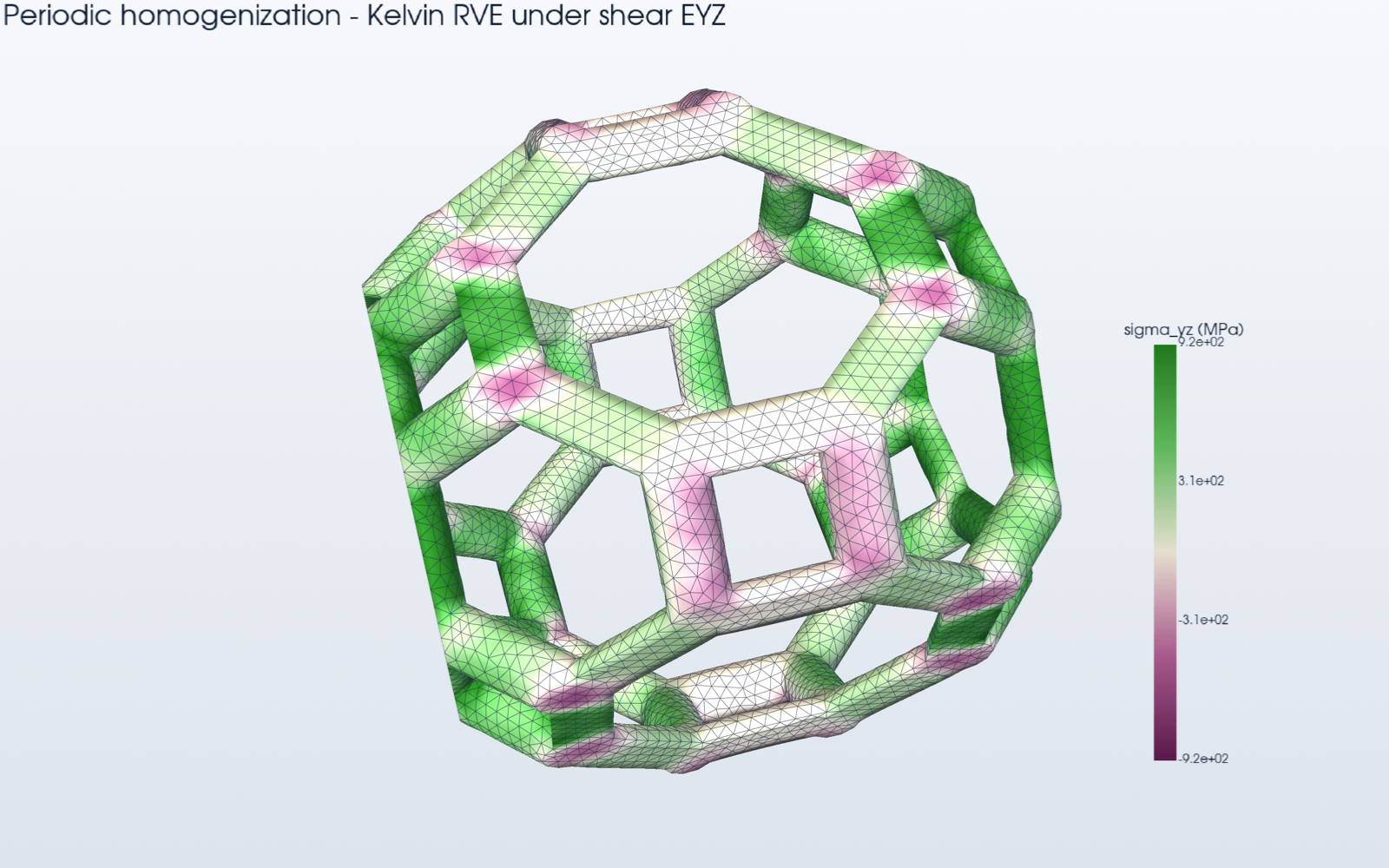
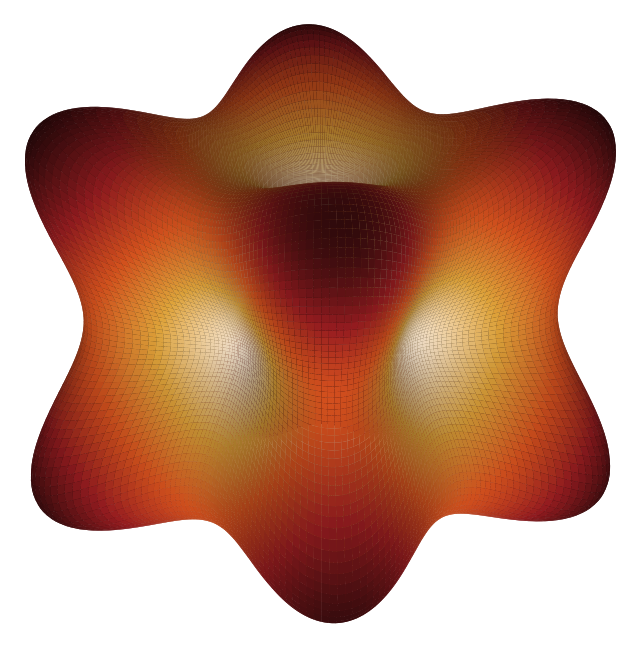
A Kelvin cell (truncated octahedron lattice) and its elastic anisotropy: microgen generates the cell and its periodic mesh, remeshed with mmg, fedoo computes the effective stiffness by periodic homogenization, and simcoon tensors give the symmetry class, the elastic constants and the directional Young's modulus.
Show the Python script and its output
import fedoo as fd
import numpy as np
import pyvista as pv
import simcoon as sim
from microgen import Phase, Rve, TruncatedOctahedron, mesh_periodic
from microgen.remesh import remesh_keeping_boundaries_for_fem

# microgen: a Kelvin cell, meshed with matching nodes on opposite faces,
# then remeshed with mmg for well-shaped tetrahedra
cell = Phase.from_cad(TruncatedOctahedron(strut_radius=0.08).generate_cad())
cell.cad.export_step("kelvin.step")
mesh_periodic(
    mesh_file="kelvin.step",
    rve=Rve(dim=1),
    list_phases=[cell],
    size=0.03,
    order=1,
    output_file="kelvin.vtk",
)
remesh_keeping_boundaries_for_fem(
    pv.UnstructuredGrid("kelvin.vtk"), periodic=True, hmax=0.03
).save("kelvin.vtk")

# fedoo: effective elastic stiffness of the cell, from six periodic load cases
fd.ModelingSpace("3D")
mesh = fd.Mesh.read("kelvin.vtk")
material = fd.constitutivelaw.ElasticIsotrop(70e3, 0.3)
assembly = fd.Assembly.create(fd.weakform.StressEquilibrium(material), mesh)
L = fd.homogen.get_homogenized_stiffness(assembly)

# simcoon: symmetry class and elastic constants of the effective medium
print("symmetry:", sim.check_symetries(L, 20.0)["umat_type"])
E, nu, G = sim.L_cubic_props(L).ravel()
print(f"E = {E:.0f} MPa, nu = {nu:.3f}, G = {G:.0f} MPa")

# directional Young's modulus: a uniaxial stress along each direction n,
# the strain from the compliance, then 1 / E(n) = sigma : eps
theta, phi = np.meshgrid(np.linspace(0, np.pi, 91), np.linspace(0, 2 * np.pi, 181))
n = np.stack([np.sin(theta) * np.cos(phi), np.sin(theta) * np.sin(phi), np.cos(theta)], -1)
n = n.reshape(-1, 3)
sigma = sim.Tensor2.stress(np.einsum("ni,nj->nij", n, n))
eps = sim.Tensor4.stiffness(L).inverse() @ sigma
E_n = 1 / np.einsum("nij,nij->n", sigma.mat, eps.mat)
print(f"E(n) from {E_n.min():.0f} MPa along {n[E_n.argmin()].round(2)}")
print(f"       to {E_n.max():.0f} MPa along {n[E_n.argmax()].round(2)}")
The script prints:
A full simulation framework
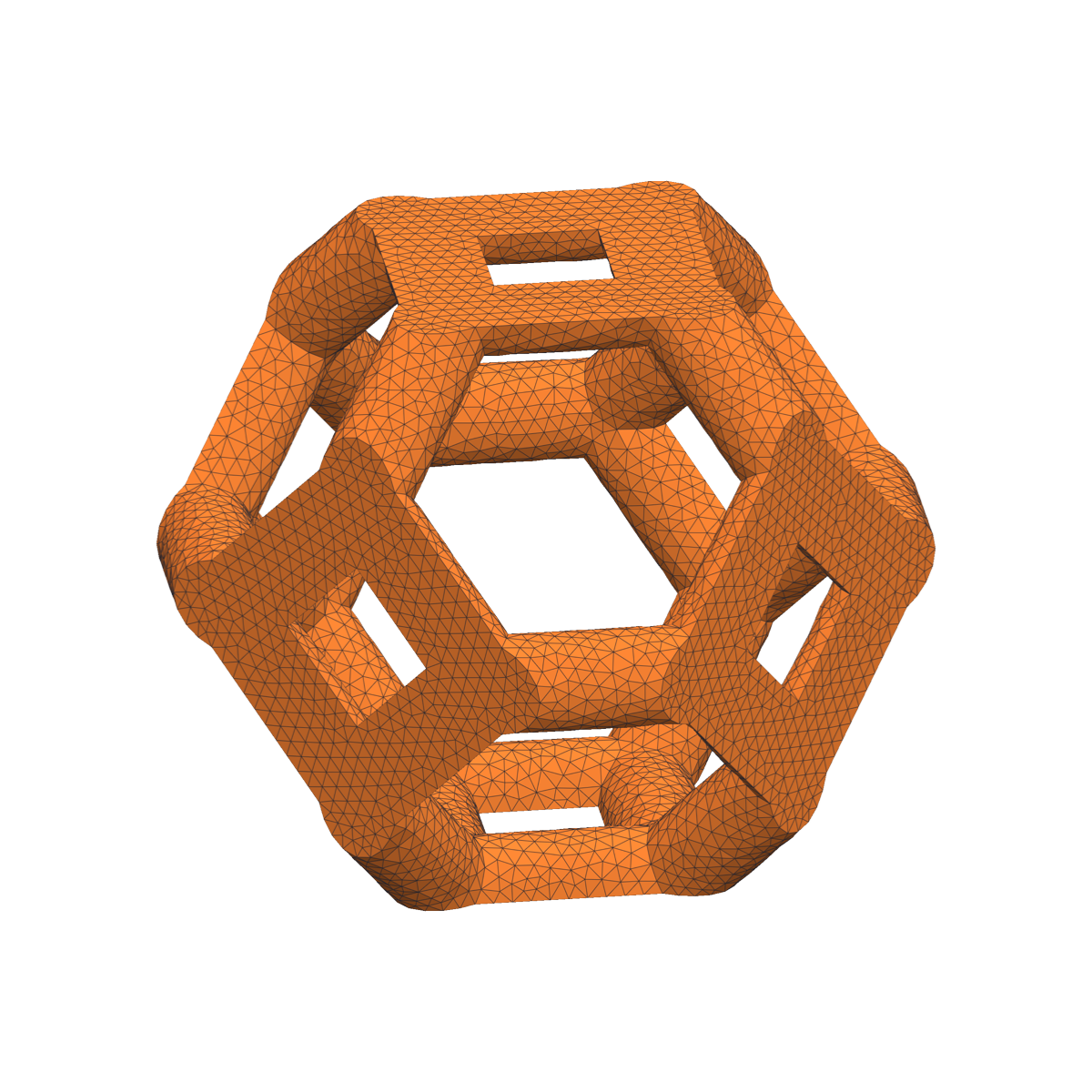
microgen — periodic mesh of the Kelvin cell after mmg remeshing.
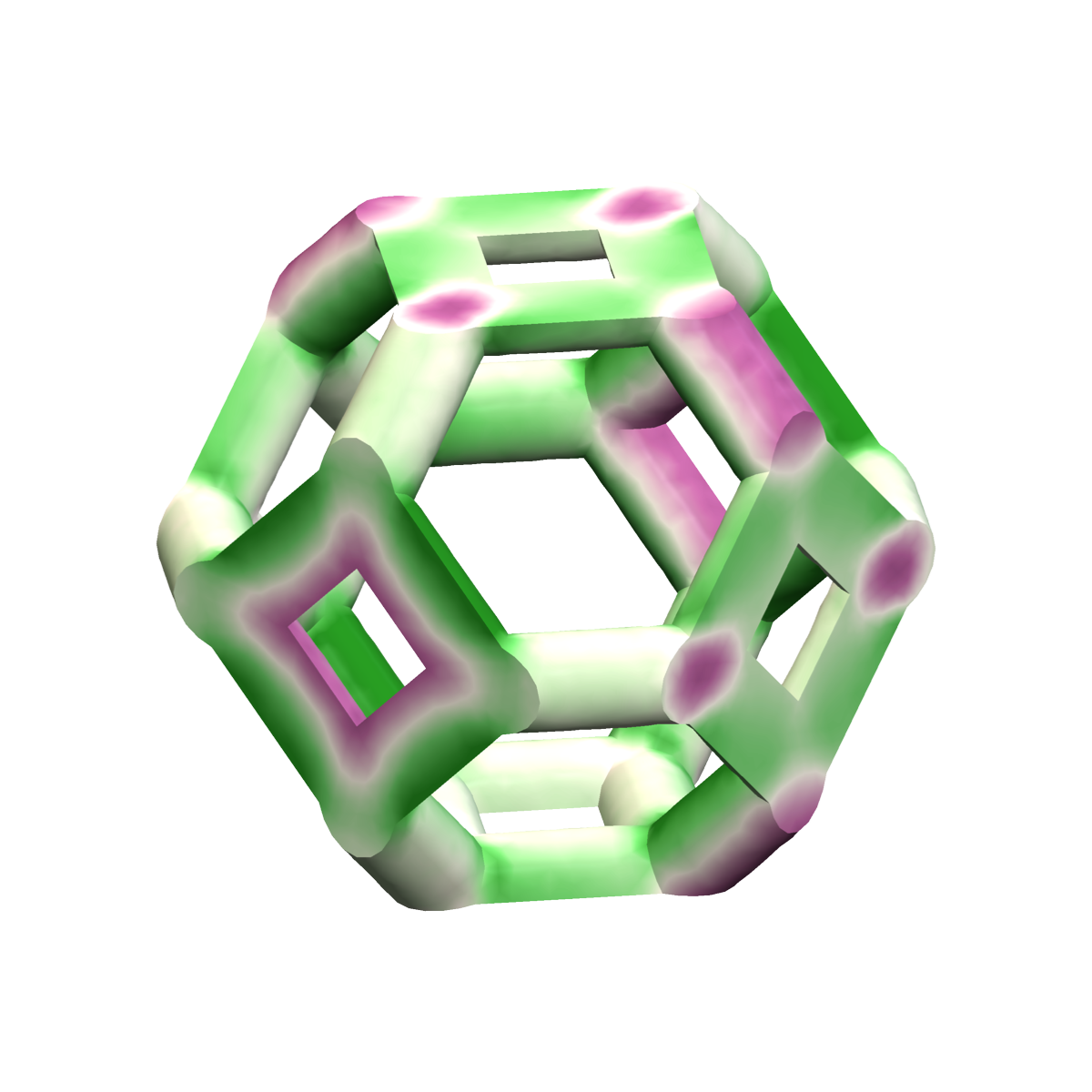
fedoo — one of the six load cases: shear stress σyz under a mean shear strain (magenta to green: −132 to +132 MPa for γyz = 1 %).
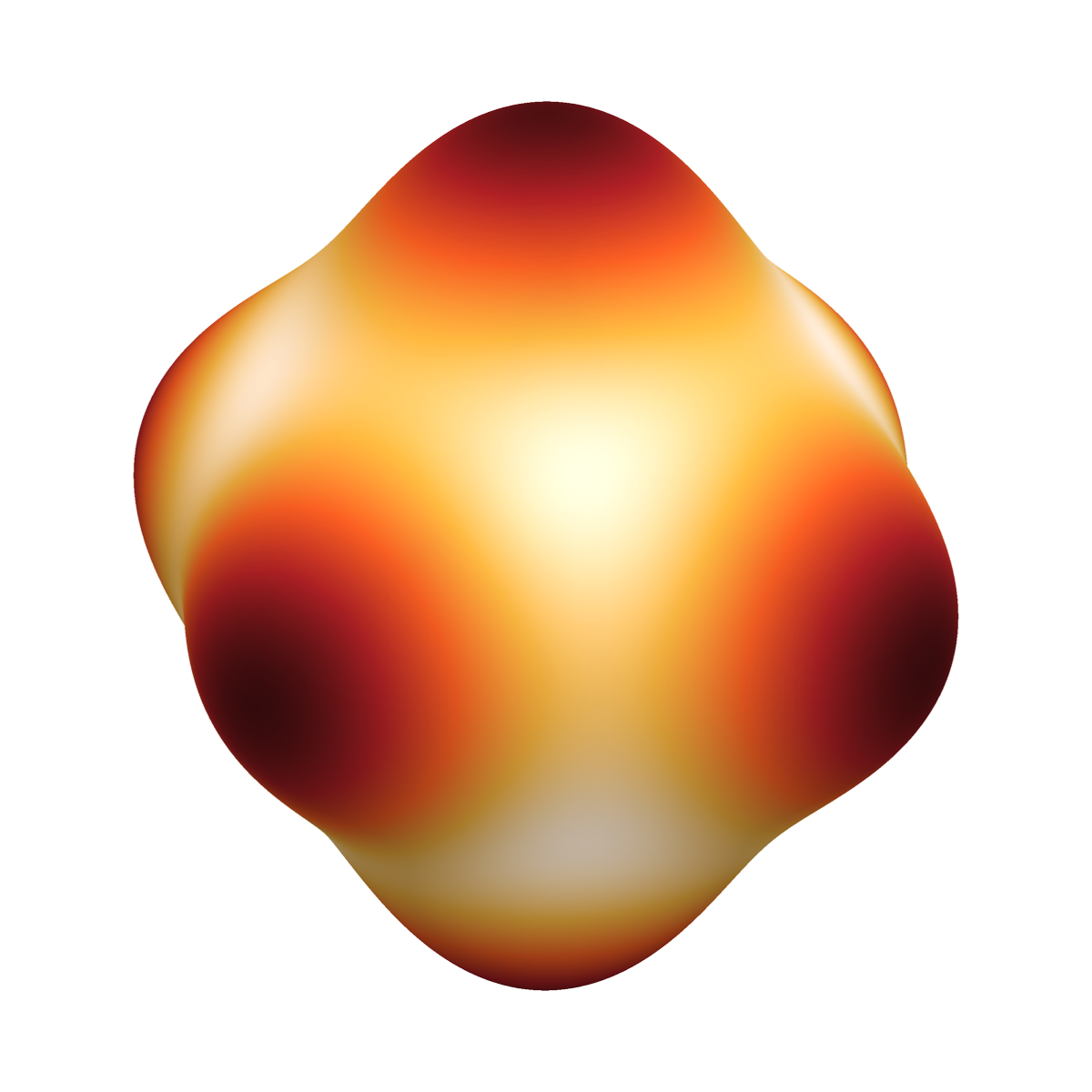
simcoon — directional Young's modulus E(n) (light to dark: 1140 to 1553 MPa).
The cell has a density of 13.7 % and a matrix of modulus 70 GPa. Its effective stiffness is cubic: stiffest along the cell axes, at 1553 MPa, and softest along the diagonals, at 1140 MPa. The mesh has about 15 600 nodes; the images are produced with the same parameters by scripts/render_libraries.py.
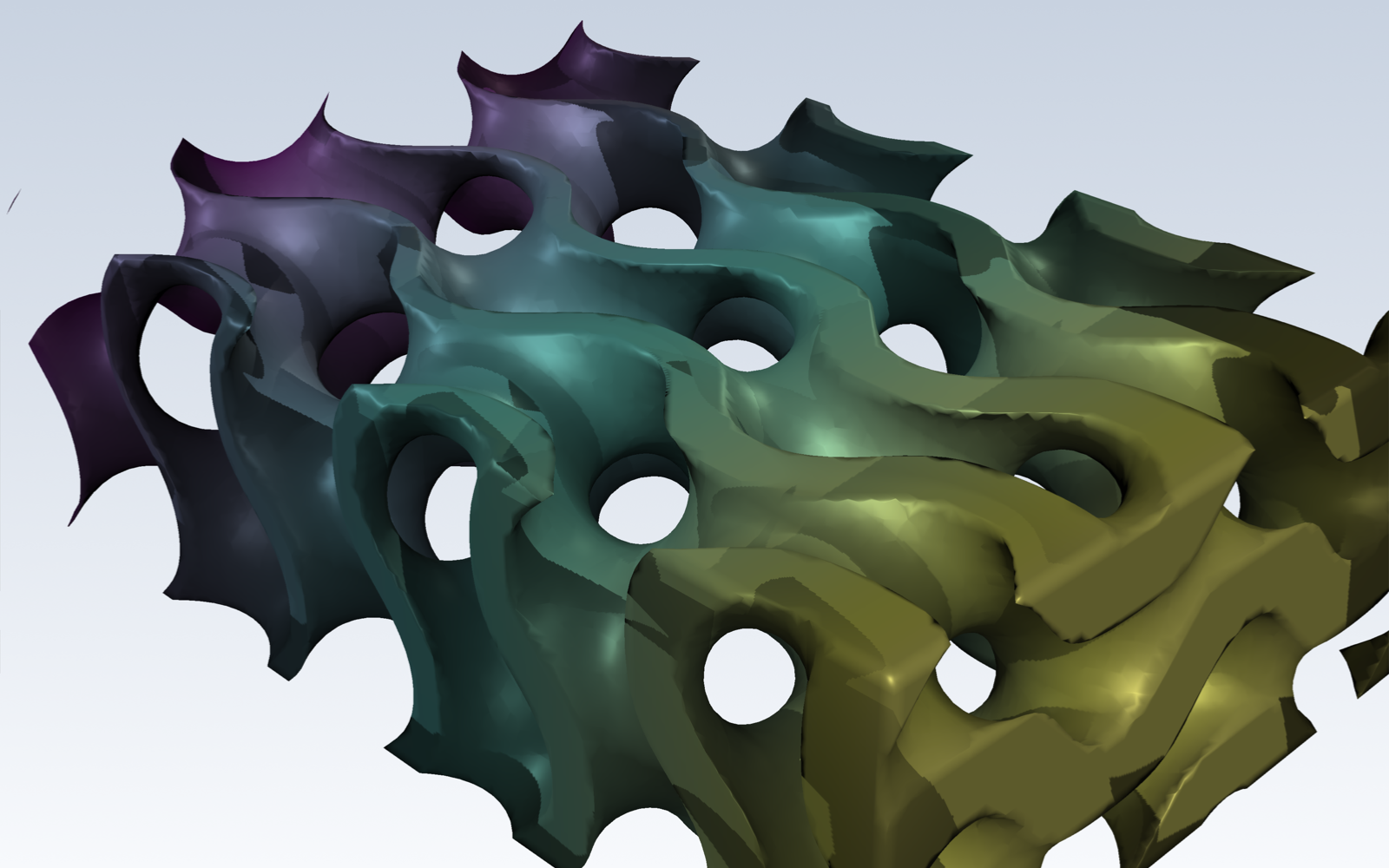
The same chain on a nonlinear problem, an elasto-plastic gyroid with its tangent modulus, is on the home page.
Requirements
The script needs the CAD backend of microgen (pip install "microgen[cad]"), the mmg executables (conda install -c conda-forge mmg) and, for reasonable solve times, a fast direct sparse solver for fedoo (pypardiso or python-mumps). See Get started for the installation of the three libraries.