Note
Go to the end to download the full example code.
Boolean operations on implicit fields
Since microgen 2.0, every shape carries an implicit field f(x, y, z),
negative inside. Booleans are then operations on numbers, not on
boundary representations:
union
a | bismin(fa, fb),intersection
a & bismax(fa, fb),difference
a - bismax(fa, -fb),complement
~ais-fa.
They cost nothing until the shape is meshed, never fail on tangent or
coincident faces, apply to TPMS, spinodoids, lattices and primitives
alike, and need no CAD kernel. Smooth variants add fillets of radius k
at the junctions, which are hard to get with a BREP kernel.
Constructive solid geometry
The classic CSG example: a box intersected with a sphere, minus three cylinders along the axes.
box = Box(dim=(1.0, 1.0, 1.0))
sphere = Sphere(radius=0.65)
cylinders = (
    Cylinder(height=1.5, radius=0.3)
    | Cylinder(height=1.5, radius=0.3, orientation=(90.0, 0.0, 0.0))
    | Cylinder(height=1.5, radius=0.3, orientation=(0.0, 90.0, 90.0))
)

start = time.perf_counter()
csg = (box & sphere) - cylinders
print(f"Composing the CSG tree: {1e3 * (time.perf_counter() - start):.2f} ms")

bounds = (-0.6, 0.6, -0.6, 0.6, -0.6, 0.6)
start = time.perf_counter()
csg_mesh = csg.generate_surface_mesh(bounds=bounds, resolution=120)
print(f"Meshing it: {time.perf_counter() - start:.2f} s, {csg_mesh.n_cells} triangles")
Composing the CSG tree: 0.04 ms
Meshing it: 0.21 s, 151984 triangles
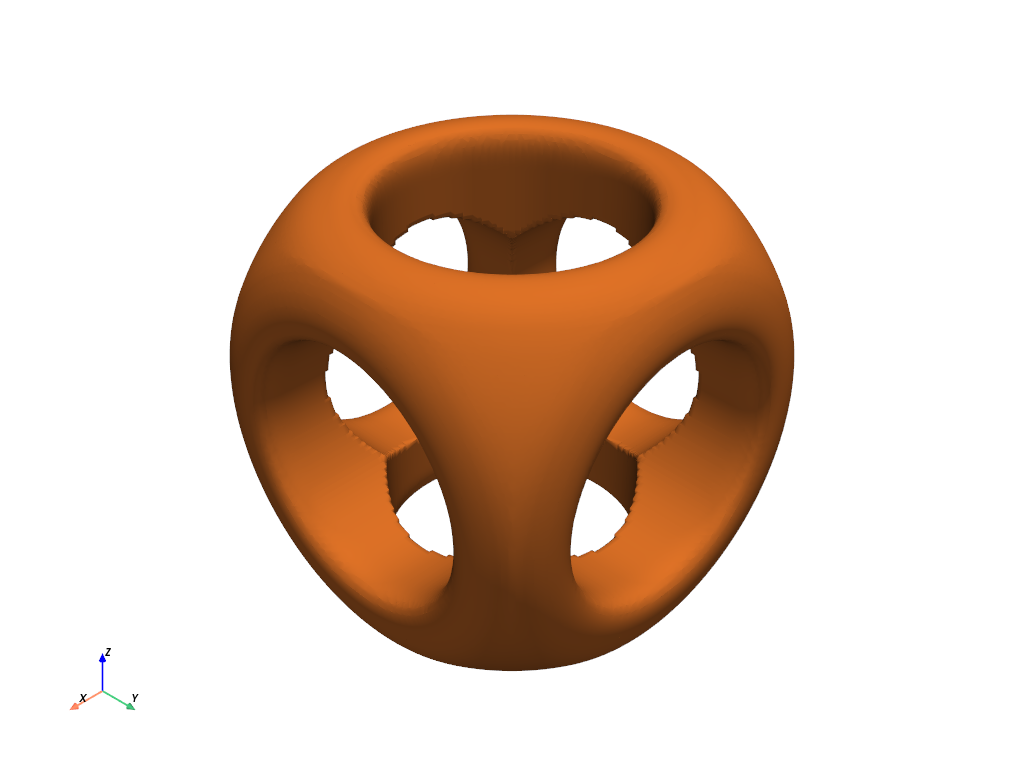
Smooth booleans
smooth_union, smooth_intersection and smooth_difference blend
the two fields over a distance k: the edges of the CSG part become
fillets.
smooth = box.smooth_intersection(sphere, k=0.1).smooth_difference(cylinders, k=0.1)
smooth_mesh = smooth.generate_surface_mesh(bounds=bounds, resolution=120)
smooth_mesh.plot(color="#ef7d2d", smooth_shading=True)
Mixing primitives and TPMS
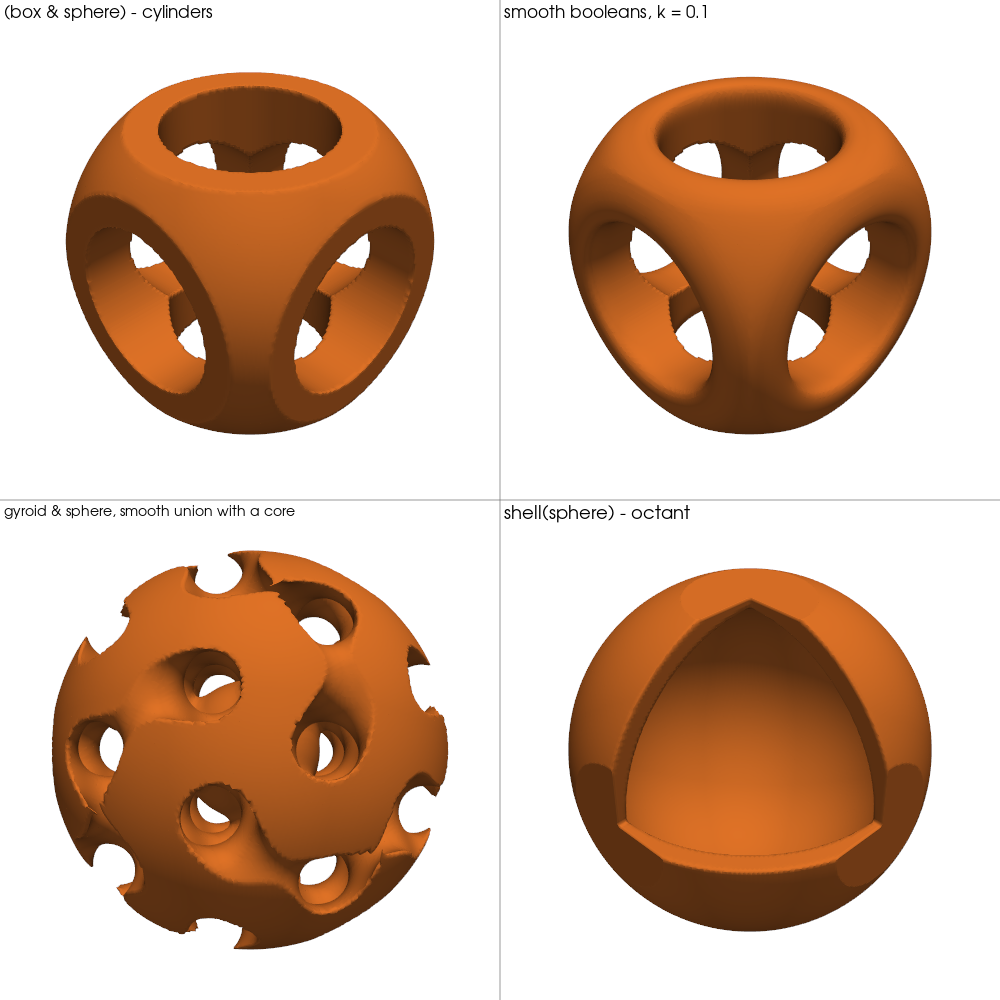
The same operators combine any implicit shapes. Here, a gyroid is
clipped by a sphere and joined to a solid core with a smooth union.
microgen.implicit_ops.shell() turns a solid into a hollow wall of
given thickness.
gyroid = Tpms(
    surface_function=surface_functions.gyroid, offset=0.6, cell_size=0.5, repeat_cell=3
)
gyroid_ball = (gyroid & Sphere(radius=0.7)).smooth_union(Sphere(radius=0.25), k=0.1)
gyroid_ball_mesh = gyroid_ball.generate_surface_mesh(
    bounds=(-0.75, 0.75, -0.75, 0.75, -0.75, 0.75), resolution=150
)

octant = Box(dim=(1.0, 1.0, 1.0), center=(0.5, 0.5, 0.5))
shelled = implicit_ops.shell(Sphere(radius=0.6), thickness=0.08) - octant
shelled_mesh = shelled.generate_surface_mesh(bounds=bounds, resolution=120)
Hard CSG, smooth CSG, a gyroid ball with a solid core, and a hollow sphere cut open by removing one octant.
pl = pv.Plotter(shape=(2, 2), window_size=(1000, 1000))
for i, (title, mesh) in enumerate(
    [
        ("(box & sphere) - cylinders", csg_mesh),
        ("smooth booleans, k = 0.1", smooth_mesh),
        ("gyroid & sphere, smooth union with a core", gyroid_ball_mesh),
        ("shell(sphere) - octant", shelled_mesh),
    ]
):
    pl.subplot(i // 2, i % 2)
    pl.add_text(title, font_size=10)
    pl.add_mesh(mesh, color="#ef7d2d", smooth_shading=True)
pl.link_views()
pl.show()
Total running time of the script: (0 minutes 5.229 seconds)