Note
Go to the end to download the full example code.
Periodic RVE of short fibres
A short fibre composite as a representative volume element (RVE): randomly
oriented fibres placed without overlap in a unit cell. Each fibre is an
implicit microgen.Capsule (a cylinder with hemispherical ends) or a
microgen.Cylinder (flat, sharp ends), and the reinforcement is the
union of their fields.
The switch periodic below selects the kind of RVE:
periodic = True(default): the microstructure is periodic. A fibre that crosses a face of the cell reappears on the opposite face, so that copies of the RVE tile space without a seam. This is the RVE needed for periodic boundary conditions, as in the homogenization tools of fedoo and simcoon.periodic = False: the fibres are simply cut by the faces of the cell and do not reappear on the other side. Opposite faces do not match, and the RVE is meant for other boundary conditions (imposed displacements or tractions on each face).
Periodicity takes two ingredients, both switched by periodic: distances
between fibres measured across the faces (minimum image convention) when the
fibres are placed, and periodic images of the fibres when they are built.
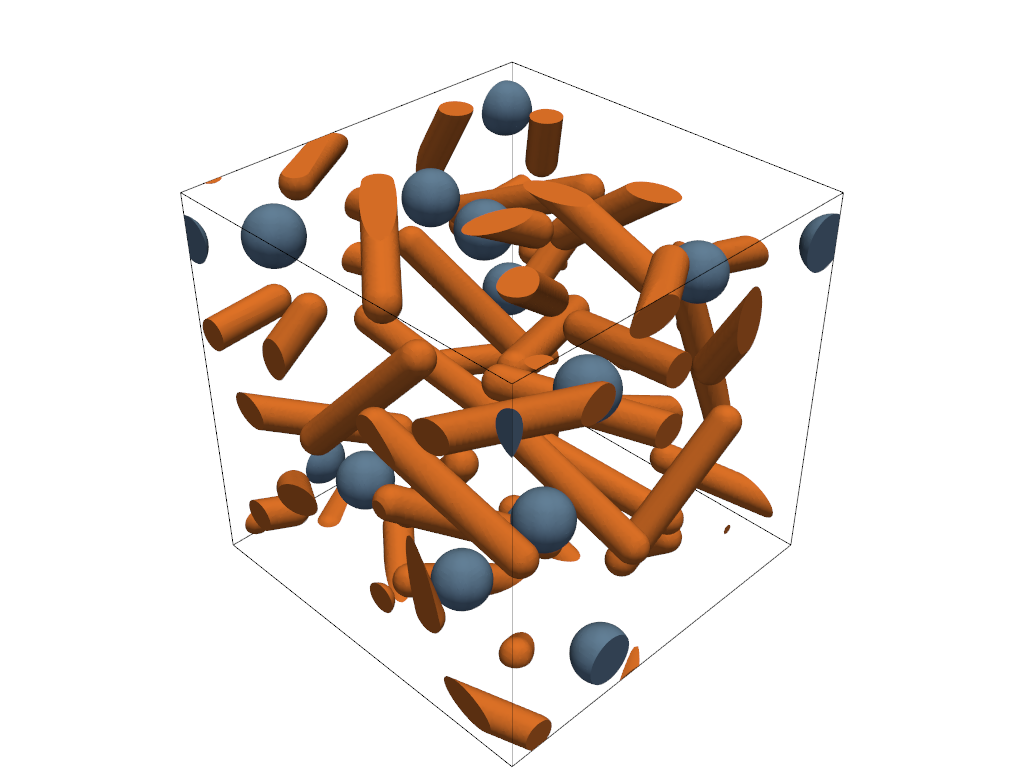
The same approach mixes inclusion types: spheres are added at the end, and the hybrid RVE is again a single implicit shape.
Parameters
periodic selects a periodic RVE (True) or fibres cut by the cell
(False); every step below that depends on it says so.
periodic = True
length, radius, gap = 0.4, 0.04, 0.01
n_fibres = 30
Placing the fibres
Random sequential addition: a fibre is drawn at random and accepted if the
points sampled along its axis stay at more than 2 * radius + gap from
the points of the accepted fibres.
Periodic: the distance is measured with the minimum image convention,
delta -= round(delta), i.e. to the nearest copy of the other fibre in
the neighbouring cells. Two fibres near opposite faces are then also kept
apart, since they will meet once the fibres wrap around.
rng = np.random.default_rng(2)
t = np.linspace(-0.5, 0.5, 15)[:, None]  # sampling along the axis
fibres = []  # (centre, Euler angles, axis points)
accepted_points = np.empty((0, 3))
while len(fibres) < n_fibres:
    center = rng.uniform(0.0, 1.0, 3)
    rotation = Rotation.random(random_state=rng)
    axis = rotation.apply((1.0, 0.0, 0.0))
    points = center + length * t * axis
    if len(accepted_points):
        delta = points[:, None, :] - accepted_points[None, :, :]
        if periodic:
            delta -= np.round(delta)
        if np.linalg.norm(delta, axis=2).min() <= 2 * radius + gap:
            continue
    fibres.append((center, rotation.as_euler("ZXZ", degrees=True)))
    accepted_points = np.vstack([accepted_points, points])
Periodic images
Periodic: each fibre is copied with the shifts of the 26 neighbouring
cells, (i, j, k) with i, j, k in {-1, 0, 1}, and the copies
that reach the cell are kept. The part of a fibre that leaves the cell
through the face x = 1 is thus brought back through the face x = 0 by its
copy shifted by (-1, 0, 0).
Not periodic: only the fibres themselves are kept, shift = (0, 0, 0).
shifts = list(itertools.product((-1, 0, 1), repeat=3)) if periodic else [(0, 0, 0)]
reach = 0.5 * length + radius
images = [
    (tuple(center + shift), tuple(angles))
    for center, angles in fibres
    for shift in shifts
    if np.all((center + shift > -reach) & (center + shift < 1 + reach))
]
print(f"{n_fibres} fibres, {len(images)} shapes with their periodic images")
30 fibres, 86 shapes with their periodic images
Rounded fibres
Capsules: the axis of length length is capped by two hemispheres.
capsules = [
    Capsule(center=center, orientation=angles, height=length, radius=radius)
    for center, angles in images
]

# The phase is sampled on a grid whose nodes lie on the faces of the cell,
# and its surface is taken from the volume cells where the field is
# negative: fibres cut by a face get flat caps with sharp edges.
cell_bounds = (0.0, 1.0, 0.0, 1.0, 0.0, 1.0)
fibre_phase = Phase.from_shape(
    batch_smooth_union(capsules), bounds=cell_bounds, resolution=121
)


def surface_in_cell(phase):
    """Surface of the cells where the field is negative, cut flat by the cell faces."""
    volume = phase.volume_mesh()
    return volume.extract_surface(algorithm="dataset_surface").triangulate().clean()


# *Periodic*: the parts of a fibre cut by a face come back through the
# opposite face, so the cell holds exactly ``n_fibres`` whole fibres and the
# volume fraction is known in closed form. *Not periodic*: the parts outside
# the cell are lost and the fraction is lower.
single = np.pi * radius**2 * length + 4 / 3 * np.pi * radius**3
measured = fibre_phase.volume_mesh().volume
if periodic:
    print(f"Fibre volume fraction: {measured:.4f} (exact {n_fibres * single:.4f})")
else:
    print(
        f"Fibre volume fraction: {measured:.4f} (whole fibres: {n_fibres * single:.4f})"
    )
fibre_surface = surface_in_cell(fibre_phase)
fibre_surface.save("fibres_rve.stl")

box = pv.Box(bounds=(0, 1, 0, 1, 0, 1))
pl = pv.Plotter()
pl.add_mesh(fibre_surface, color="#ef7d2d", smooth_shading=True, split_sharp_edges=True)
pl.add_mesh(box, style="wireframe", color="black")
pl.show()
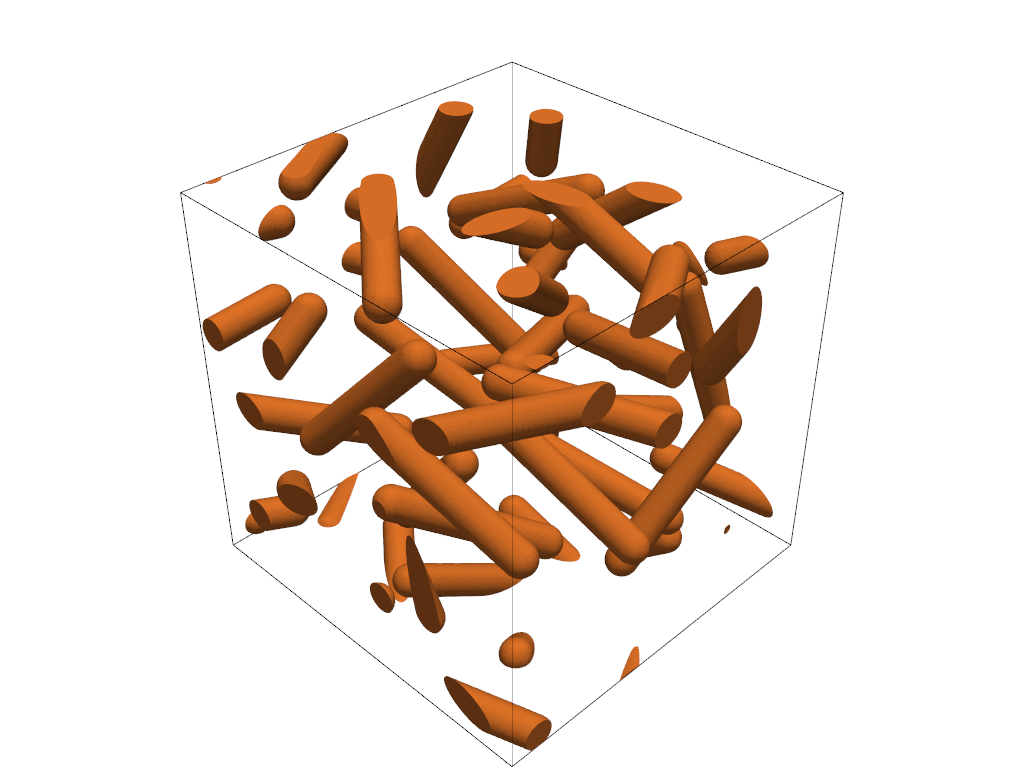
Fibre volume fraction: 0.0676 (exact 0.0684)
Checking the periodicity
The implicit field gives a direct check: a point of a face is in a fibre
exactly when its image on the opposite face is. The test holds on the
three pairs of faces of a periodic RVE, and fails when periodic = False.
fibre_field = batch_smooth_union(capsules)
u, v = (a.ravel() for a in np.meshgrid(np.linspace(0, 1, 80), np.linspace(0, 1, 80)))
zero, one = np.zeros_like(u), np.ones_like(u)
for axis, face_0, face_1 in (
    ("x", (zero, u, v), (one, u, v)),
    ("y", (u, zero, v), (u, one, v)),
    ("z", (u, v, zero), (u, v, one)),
):
    same = np.array_equal(
        fibre_field.evaluate(*face_0) < 0, fibre_field.evaluate(*face_1) < 0
    )
    print(f"Faces {axis} = 0 and {axis} = 1 match: {same}")
Faces x = 0 and x = 1 match: True
Faces y = 0 and y = 1 match: True
Faces z = 0 and z = 1 match: True
Sharp fibres
Cylinders with flat ends, on the same axes. A cylinder of height length
lies inside the capsule of the same fibre, so the fibres still do not
overlap.
Marching cubes round off every sharp edge (the flat ends, and the cuts by
the cell faces). Since the fibres do not overlap, each one can instead be
meshed exactly with microgen.Cylinder.generate_surface_mesh() and
clipped by the six faces of the cell, which keeps every edge sharp.
cylinders = [
    Cylinder(center=center, orientation=angles, height=length, radius=radius)
    for center, angles in images
]
cell_faces = [
    ((-1, 0, 0), (1, 0, 0)),
    ((1, 0, 0), (0, 0, 0)),
    ((0, -1, 0), (0, 1, 0)),
    ((0, 1, 0), (0, 0, 0)),
    ((0, 0, -1), (0, 0, 1)),
    ((0, 0, 1), (0, 0, 0)),
]  # (normal pointing into the cell, point on the face)
pieces = []
for cylinder in cylinders:
    mesh = cylinder.generate_surface_mesh(resolution=48).triangulate().clean()
    for normal, origin in cell_faces:
        # Signed distance of the points to the face, positive inside the cell.
        inside = (mesh.points - origin) @ np.asarray(normal, dtype=float)
        if inside.max() <= 0.0:  # fibre image entirely out of the cell
            mesh = None
            break
        if inside.min() < 0.0:  # fibre crossing the face
            mesh = mesh.clip_closed_surface(normal=normal, origin=origin).clean()
    if mesh is not None:
        pieces.append(mesh)
sharp_fibres = pv.merge(pieces)
sharp_fibres.save("fibres_rve_sharp.stl")

exact = n_fibres * np.pi * radius**2 * length
label = "exact" if periodic else "whole fibres"
print(f"Sharp fibre volume fraction: {sharp_fibres.volume:.4f} ({label} {exact:.4f})")

pl = pv.Plotter()
pl.add_mesh(sharp_fibres, color="#ef7d2d", smooth_shading=True, split_sharp_edges=True)
pl.add_mesh(box, style="wireframe", color="black")
pl.show()
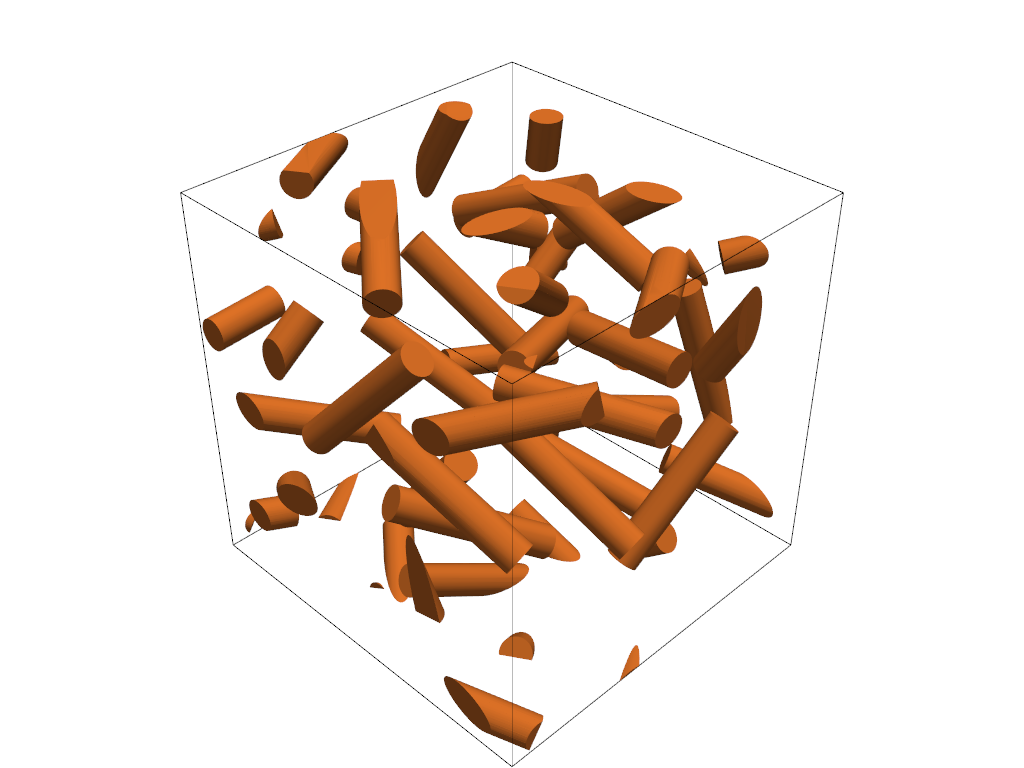
Sharp fibre volume fraction: 0.0601 (exact 0.0603)
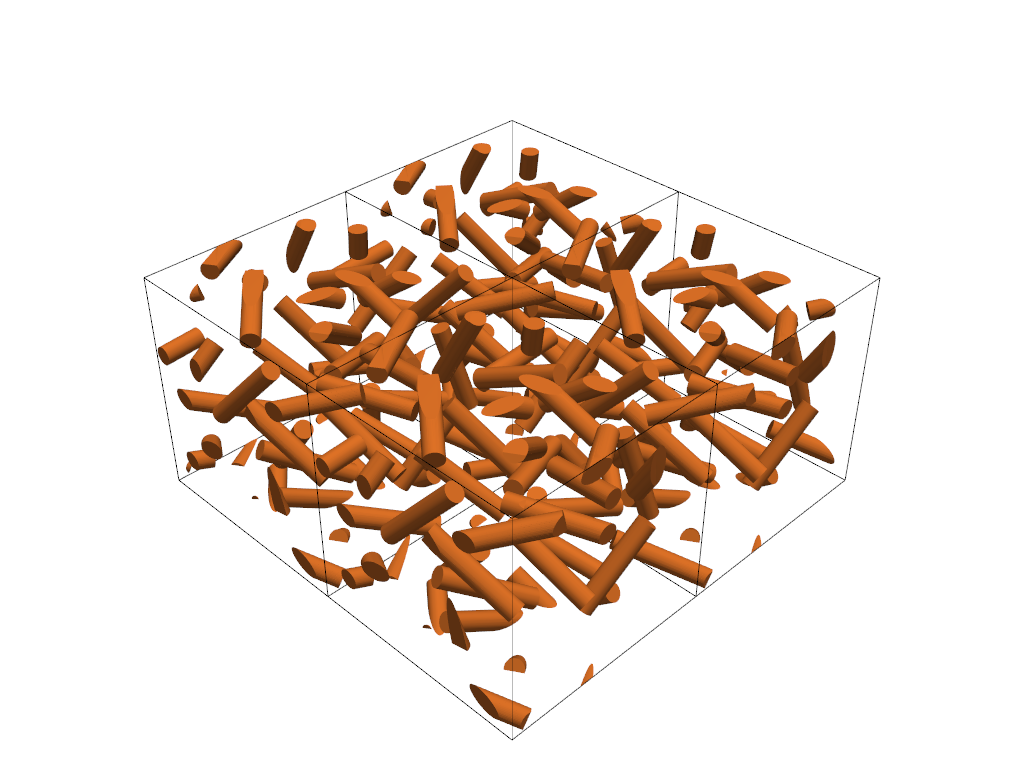
Tiling the RVE
Four copies of the RVE side by side. Periodic: the fibres cut by a face continue in the neighbouring cell and the tiling shows no seam. Not periodic: the fibres stop at the faces and the seams are visible.
pl = pv.Plotter()
for i, j in itertools.product(range(2), repeat=2):
    shift = (float(i), float(j), 0.0)
    pl.add_mesh(
        sharp_fibres.translate(shift, inplace=False),
        color="#ef7d2d",
        smooth_shading=True,
        split_sharp_edges=True,
    )
    pl.add_mesh(box.translate(shift, inplace=False), style="wireframe", color="black")
pl.show()
Hybrid RVE
Add spheres in the space left by the fibres. The test uses the
fibre field itself: a sphere is accepted if the field of the fibres at its
centre (the distance to the nearest fibre surface) exceeds its radius. The
spheres follow the same periodic switch: minimum image distance between
spheres, and periodic images.
sphere_radius = 0.07
sphere_centers = []
while len(sphere_centers) < 12:
    candidate = rng.uniform(0.0, 1.0, 3)
    clear_of_fibres = fibre_field.evaluate(*candidate[:, None]) > sphere_radius + gap
    delta = np.asarray(sphere_centers).reshape(-1, 3) - candidate
    if periodic:
        delta -= np.round(delta)
    clear_of_spheres = np.all(np.linalg.norm(delta, axis=1) > 2 * sphere_radius + gap)
    if clear_of_fibres[0] and clear_of_spheres:
        sphere_centers.append(candidate)

spheres = [
    Sphere(center=tuple(center + shift), radius=sphere_radius)
    for center in sphere_centers
    for shift in shifts
    if np.all((center + shift > -sphere_radius) & (center + shift < 1 + sphere_radius))
]
particle_phase = Phase.from_shape(
    batch_smooth_union(spheres), bounds=cell_bounds, resolution=121
)
The hybrid RVE: fibres in orange, spheres in blue.
pl = pv.Plotter()
pl.add_mesh(fibre_surface, color="#ef7d2d", smooth_shading=True, split_sharp_edges=True)
pl.add_mesh(
    surface_in_cell(particle_phase),
    color="#6a8caf",
    smooth_shading=True,
    split_sharp_edges=True,
)
pl.add_mesh(box, style="wireframe", color="black")
pl.show()
Total running time of the script: (0 minutes 7.289 seconds)