Note
Go to the end to download the full example code.
Cell size grading
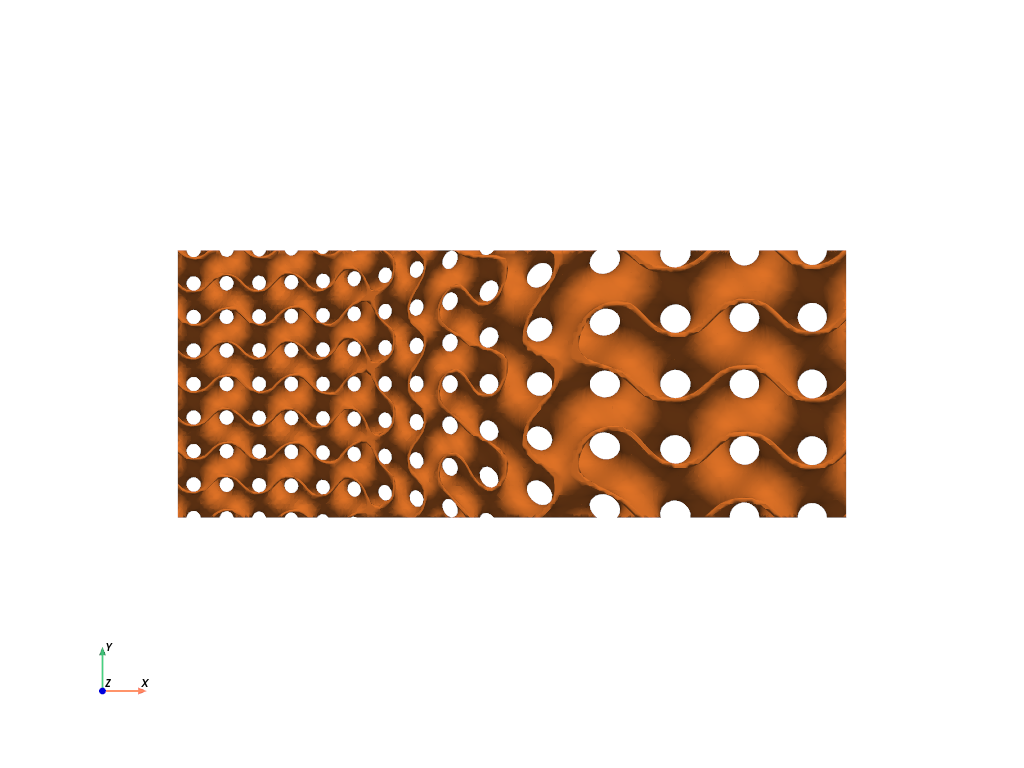
A gyroid whose cell size follows a sigmoid transition along \(x\), from 2 to 4. Linear and Gaussian transitions are also given.
import numpy as np
import numpy.typing as npt
import pyvista as pv

from microgen import Tpms
from microgen.shape.surface_functions import gyroid


def sigmoid(
    x: npt.NDArray[np.float64],
    start: float,
    end: float,
) -> npt.NDArray[np.float64]:
    """Sigmoid transition function."""
    k = -0.4  # transition
    return start + (end - start) / (1 + np.exp(k * x))


def lerp(
    x: npt.NDArray[np.float64],
    start: float,
    end: float,
) -> npt.NDArray[np.float64]:
    """Linear interpolation function."""
    t = (x - np.min(x)) / (np.max(x) - np.min(x))
    return start + (end - start) * t


def gaussian(
    x: npt.NDArray[np.float64],
    start: float,
    end: float,
) -> npt.NDArray[np.float64]:
    """Gaussian transition function."""
    k = -0.02
    return start + (end - start) * np.exp(k * x**2)


def graded(
    x: npt.NDArray[np.float64],
    y: npt.NDArray[np.float64],
    z: npt.NDArray[np.float64],
) -> npt.NDArray[np.float64]:
    """Graded TPMS surface function."""
    min_cell_size = 2
    max_cell_size = 4
    # dim_x = dim_y = dim_z = lerp(x, min_cell_size, max_cell_size)
    dim_x = dim_y = dim_z = sigmoid(x, min_cell_size, max_cell_size)
    # dim_x = dim_y = dim_z = gaussian(x, max_cell_size, min_cell_size)
    return gyroid(
        x=x * max_cell_size / dim_x,
        y=y * max_cell_size / dim_y,
        z=z * max_cell_size / dim_z,
    )


geometry = Tpms(
    surface_function=graded,
    offset=0.3,
    repeat_cell=(5, 2, 2),
    resolution=30,
)
sheet = geometry.sheet
plotter = pv.Plotter()
plotter.add_mesh(sheet, smooth_shading=True, color="#ef7d2d")
plotter.view_xy()
plotter.enable_parallel_projection()
plotter.show_axes()
plotter.show()
Total running time of the script: (0 minutes 3.599 seconds)