Note
Go to the end to download the full example code.
Spinodoid
Spinodoids mimic the bicontinuous microstructures of spinodal
decomposition. A microgen.Spinodoid is a Gaussian random field: an
FFT of white noise filtered by a Gaussian shell of radius k0 (the
dominant wave number) and width bandwidth. The solid is the part where
the field is above a threshold; giving density makes microgen find the
threshold that matches this solid volume fraction.
Each kept Fourier mode lives on the reciprocal lattice of the cell, so the field is exactly periodic: the spinodoid is a ready-made periodic RVE.
import numpy as np
import pyvista as pv

from microgen import Phase, Spinodoid
An isotropic spinodoid with 50 % of solid. seed makes the random field
reproducible.
Solid volume fraction: 0.511
The field is periodic: its values on opposite faces of the cell match.
y, z = np.meshgrid(np.linspace(0, 1, 20), np.linspace(0, 1, 20))
left = spinodoid.evaluate(np.zeros(y.size), y.ravel(), z.ravel())
right = spinodoid.evaluate(np.ones(y.size), y.ravel(), z.ravel())
print(f"Max gap between the x = 0 and x = 1 faces: {np.abs(left - right).max():.2e}")
Max gap between the x = 0 and x = 1 faces: 2.39e-16
A field-backed microgen.Phase gives the connected components and
the moments without CAD. At 50 % both phases percolate: nearly all the
solid is one connected piece.
phase = Phase.from_shape(spinodoid, resolution=64)
volumes = sorted((piece.volume for piece in phase.pieces), reverse=True)
print(f"Pieces: {len(volumes)}, largest holds {volumes[0] / sum(volumes):.1%}")
print(f"Centre of mass: {phase.center_of_mass}")

surface = spinodoid.generate_surface_mesh()
surface.save("spinodoid.stl")
surface.plot(color="#ef7d2d", smooth_shading=True)
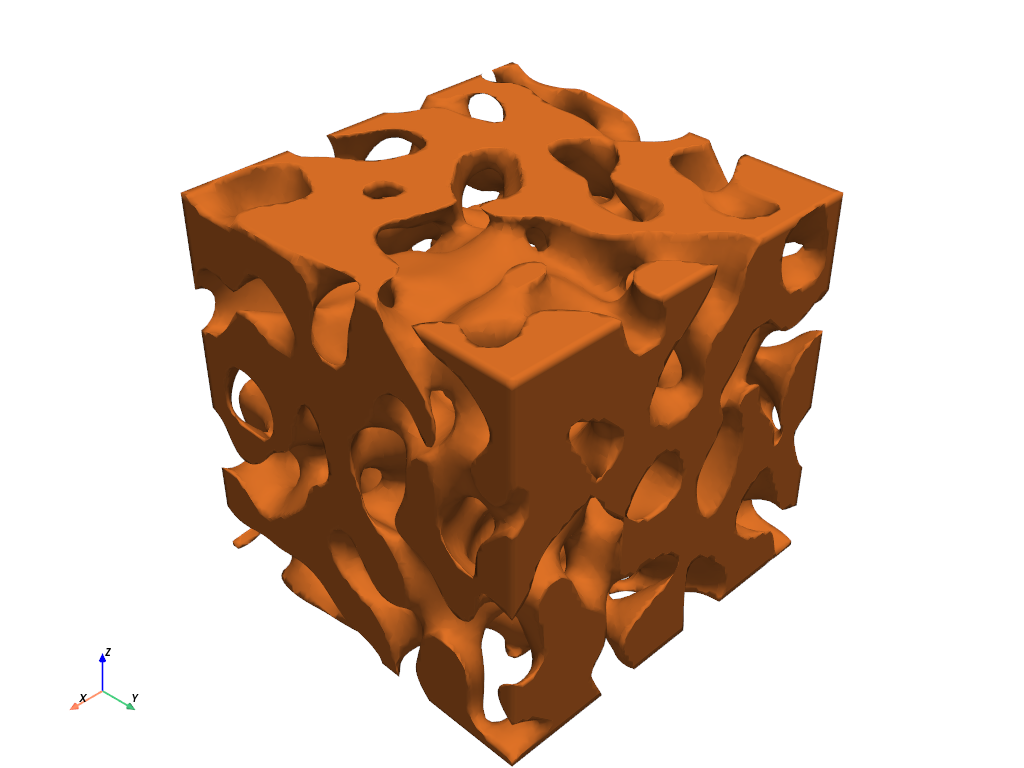
Pieces: 2, largest holds 100.0%
Centre of mass: [0.50079827 0.50099002 0.50163997]
/home/runner/work/microgen/microgen/microgen/shape/spinodoid.py:216: PyVistaFutureWarning: The default value of `algorithm` for the filter
`UnstructuredGrid.extract_surface` will change in the future. It currently defaults to
`'dataset_surface'`, but will change to `None`. Explicitly set the `algorithm` keyword to
silence this warning.
  return self.grid_solid.extract_surface().clean().triangulate()
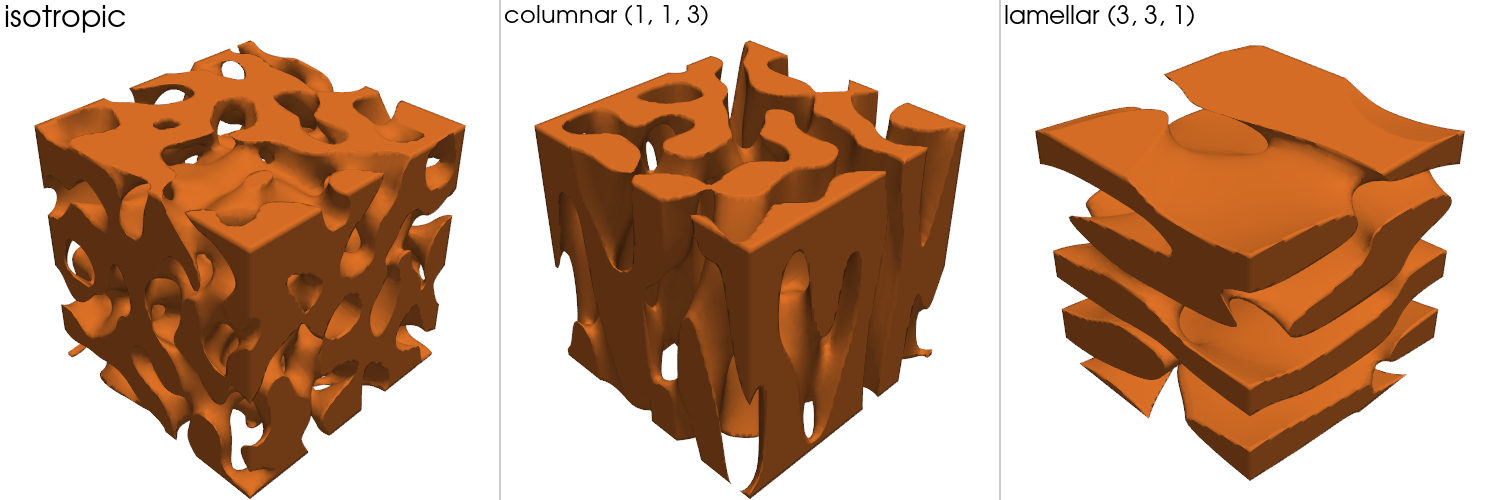
anisotropy stretches the wave vectors along each axis before filtering.
A large factor along an axis removes the modes with a component along it:
(1, 1, 3) gives columns along z, (3, 3, 1) gives lamellae normal
to z.
variants = {
    "isotropic": spinodoid,
    "columnar (1, 1, 3)": Spinodoid(
        k0=30.0, bandwidth=4.0, density=0.5, anisotropy=(1, 1, 3), resolution=64, seed=1
    ),
    "lamellar (3, 3, 1)": Spinodoid(
        k0=30.0, bandwidth=4.0, density=0.5, anisotropy=(3, 3, 1), resolution=64, seed=1
    ),
}

pl = pv.Plotter(shape=(1, 3), window_size=(1500, 500))
for i, (name, shape) in enumerate(variants.items()):
    pl.subplot(0, i)
    pl.add_text(name, font_size=12)
    pl.add_mesh(shape.generate_surface_mesh(), color="#ef7d2d", smooth_shading=True)
pl.link_views()
pl.show()
Total running time of the script: (0 minutes 13.410 seconds)