Note
Go to the end to download the full example code.
Micromechanics Examples
This example studies the evolution of the mechanical properties of a composite material considering spherical reinforcement.
import numpy as np
import matplotlib.pyplot as plt
import simcoon as sim
from simcoon.solver.micromechanics import Ellipsoid
import os
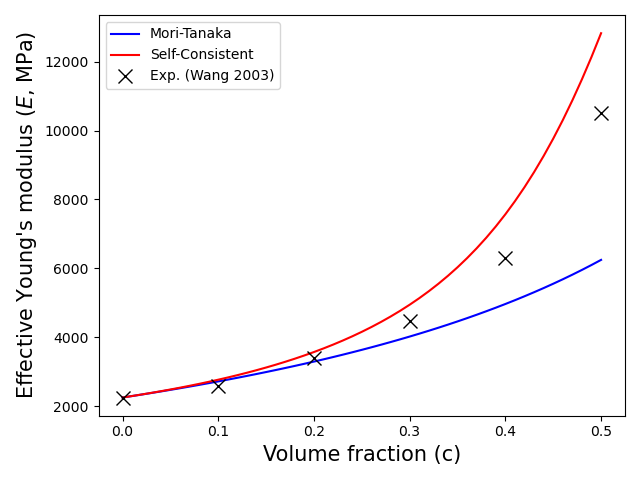
In this example we study the evolution of the mechanical properties of a 2-phase composite material considering spherical reinforcement. Two micromechanical schemes are utilized: Mori-Tanaka and Self-consistent.
First we define the number of state variables (if any) at the macroscopic level and the material properties.
try:
    script_dir = os.path.dirname(os.path.abspath(__file__))
except NameError:   # executed by the docs gallery, from the example's directory
    script_dir = os.getcwd()
nstatev = 0

int1 = 50  # Integration points of the Eshelby integrals, first direction
int2 = 50  # Integration points of the Eshelby integrals, second direction
n_matrix = 0  # Index of the matrix phase in the list of phases

# Mori-Tanaka props: [int1, int2, n_matrix]; the phases themselves are passed as objects
props = np.array([int1, int2, n_matrix], dtype="float")
The two phases are described as objects and handed to L_eff directly. They
used to live in data/Nellipsoids0.dat, rewritten between runs by substituting
keys into a template; changing a volume fraction is now an assignment.
matrix = Ellipsoid(
    number=0, umat_name="ELISO", save=1, concentration=0.8, nstatev=1,
    props=np.array([2250.0, 0.19, 8.8e-5]),
)
reinforcement = Ellipsoid(
    number=1, umat_name="ELISO", save=1, concentration=0.2, nstatev=1,
    props=np.array([73000.0, 0.19, 0.5e-6]),
)
phases = [matrix, reinforcement]
There is a possibility to consider a misorientation between the test frame of reference and the composite material orientation, using Euler angles with the z–x–z convention. The stiffness tensor will be returned in the test frame of reference. We also specify which micromechanical scheme will be used:
MIMTN→ Mori-Tanaka schemeMISCN→ Self-consistent scheme
path_data = os.path.join(script_dir, "data")

psi_rve = 0.0
theta_rve = 0.0
phi_rve = 0.0
Run the simulation to obtain the effective isotropic elastic properties for different volume fractions of reinforcement up to 50%.
concentration = np.arange(0.0, 0.51, 0.01)

E_MT = np.zeros(len(concentration))
umat_name = "MIMTN"
for i, x in enumerate(concentration):
    reinforcement.concentration = x
    matrix.concentration = 1.0 - x

    L = sim.L_eff(
        umat_name, props, nstatev, orientation=(psi_rve, theta_rve, phi_rve), phases=phases
    )
    p = sim.L_iso_props(L).flatten()
    E_MT[i] = p[0]


E_SC = np.zeros(len(concentration))
umat_name = "MISCN"
for i, x in enumerate(concentration):
    reinforcement.concentration = x
    matrix.concentration = 1.0 - x

    L = sim.L_eff(
        umat_name, props, nstatev, orientation=(psi_rve, theta_rve, phi_rve), phases=phases
    )
    p = sim.L_iso_props(L).flatten()
    E_SC[i] = p[0]
Plotting the results
In blue, we plot the effective Young’s modulus vs volume fraction curve using the Mori-Tanaka scheme, in red using the Self-Consistent scheme, and with black crosses the experimental data from (Wang 2003).
fig = plt.figure()
plt.xlabel(r"Volume fraction (c)", size=15)
plt.ylabel(r"Effective Young's modulus ($E$, MPa)", size=15)
plt.plot(concentration, E_MT, c="blue", label="Mori-Tanaka")
plt.plot(concentration, E_SC, c="red", label="Self-Consistent")
expfile = path_data + "/" + "E_exp.txt"
c, E = np.loadtxt(expfile, usecols=(0, 1), unpack=True)
plt.plot(
    c,
    E,
    linestyle="None",
    marker="x",
    color="black",
    markersize=10,
    label="Exp. (Wang 2003)",
)
plt.legend()
plt.tight_layout()
plt.show()
Effect of Aspect Ratio on Effective Stiffness
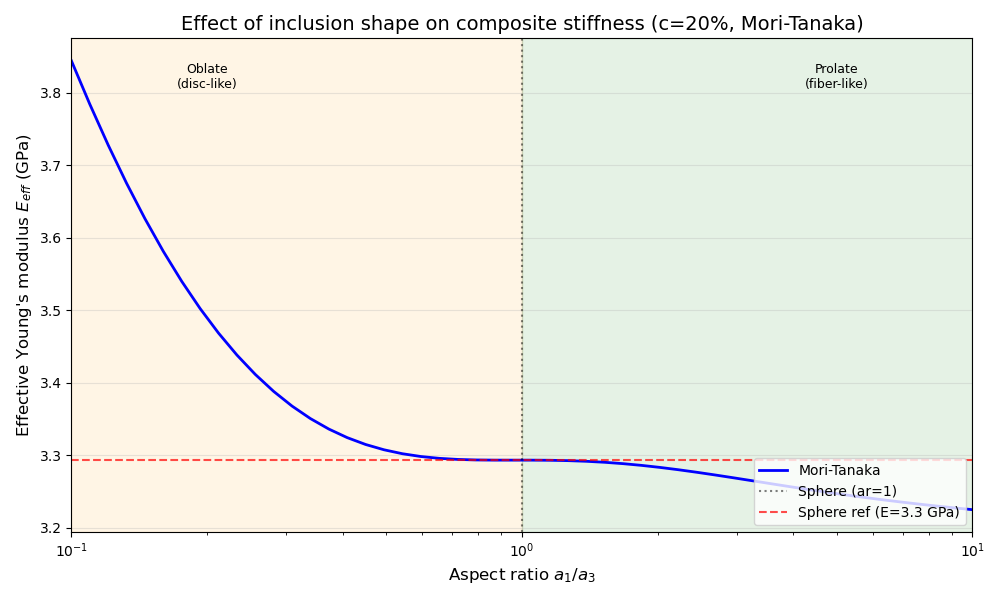
The shape of the reinforcement significantly affects the effective properties. Let’s study how the aspect ratio of prolate (fiber-like) and oblate (disc-like) inclusions influences the effective Young’s modulus using the Mori-Tanaka scheme.
The aspect ratio is defined as \(ar = a_1/a_3\), where:
\(ar > 1\): prolate ellipsoid (fiber-like)
\(ar = 1\): sphere
\(ar < 1\): oblate ellipsoid (disc-like)
# Fixed volume fraction of 20%
c_reinf = 0.20
reinforcement.concentration = c_reinf
matrix.concentration = 1.0 - c_reinf

# Aspect ratios from oblate (0.1) to prolate (10)
aspect_ratios = np.logspace(-1, 1, 50)

E_eff_ar = np.zeros(len(aspect_ratios))
umat_name = "MIMTN"

print(f"\nComputing effective properties for c={c_reinf * 100:.0f}% reinforcement...")
for i, ar in enumerate(aspect_ratios):
    # The semi-axes of the reinforcement: a1/a3 = ar, a2 = a3 = 1
    reinforcement.a1 = ar
    reinforcement.a2 = 1.0
    reinforcement.a3 = 1.0

    L = sim.L_eff(
        umat_name, props, nstatev, orientation=(psi_rve, theta_rve, phi_rve), phases=phases
    )
    p = sim.L_iso_props(L).flatten()
    E_eff_ar[i] = p[0]

# The sweep mutates the reinforcement in place; leave it as it was found, the way the
# old version restored the Nellipsoids0.dat line it had rewritten. Anything appended
# below would otherwise homogenise the last aspect ratio of the sweep.
reinforcement.a1 = reinforcement.a2 = reinforcement.a3 = 1.0

# Get reference value for spherical inclusion (ar=1)
idx_sphere = np.argmin(np.abs(aspect_ratios - 1.0))
E_sphere_ref = E_eff_ar[idx_sphere]
Computing effective properties for c=20% reinforcement...
Plot: Effective Young’s modulus vs aspect ratio
This plot shows how inclusion shape dramatically affects composite stiffness. Prolate (fiber-like) inclusions are more effective at reinforcing the composite than oblate (disc-like) inclusions at the same volume fraction.
fig, ax = plt.subplots(figsize=(10, 6))
ax.semilogx(aspect_ratios, E_eff_ar / 1000, "b-", linewidth=2, label="Mori-Tanaka")
ax.axvline(x=1, color="k", linestyle=":", alpha=0.5, label="Sphere (ar=1)")
ax.axhline(
    y=E_sphere_ref / 1000,
    color="r",
    linestyle="--",
    alpha=0.7,
    label=f"Sphere ref (E={E_sphere_ref / 1000:.1f} GPa)",
)

# Add shaded regions for oblate/prolate
ymin, ymax = ax.get_ylim()
ax.axvspan(0.1, 1, alpha=0.1, color="orange")
ax.axvspan(1, 10, alpha=0.1, color="green")
ax.text(0.2, ymax - 0.1 * (ymax - ymin), "Oblate\n(disc-like)", fontsize=9, ha="center")
ax.text(5, ymax - 0.1 * (ymax - ymin), "Prolate\n(fiber-like)", fontsize=9, ha="center")

ax.set_xlabel("Aspect ratio $a_1/a_3$", fontsize=12)
ax.set_ylabel("Effective Young's modulus $E_{eff}$ (GPa)", fontsize=12)
ax.set_title(
    f"Effect of inclusion shape on composite stiffness (c={c_reinf * 100:.0f}%, Mori-Tanaka)",
    fontsize=14,
)
ax.legend(fontsize=10, loc="lower right")
ax.grid(True, alpha=0.3)
ax.set_xlim([0.1, 10])
plt.tight_layout()
plt.show()
Total running time of the script: (0 minutes 1.127 seconds)