Note
Go to the end to download the full example code.
Transversely Isotropic Elasticity Example
import numpy as np
import simcoon as sim
import matplotlib.pyplot as plt
import os
In transversely isotropic elastic materials, there is a single axis of symmetry. The material behaves isotropically in the plane perpendicular to this axis (the transverse plane). Eight parameters are required:
The axis of symmetry (1, 2, or 3)
The longitudinal Young modulus \(E_L\)
The transverse Young modulus \(E_T\)
The Poisson ratio in the transverse-longitudinal plane \(\nu_{TL}\)
The Poisson ratio in the transverse-transverse plane \(\nu_{TT}\)
The shear modulus in the longitudinal-transverse plane \(G_{LT}\)
The coefficient of thermal expansion in the longitudinal direction \(\alpha_L\)
The coefficient of thermal expansion in the transverse direction \(\alpha_T\)
The elastic stiffness tensor for a transversely isotropic material with axis 1 as the symmetry axis is written in the Voigt notation formalism as:
where \(G_{TT} = E_T / (2(1+\nu_{TT}))\) is the shear modulus in the transverse plane.
The thermal expansion tensor is:
umat_name = "ELIST"  # 5 character code for transversely isotropic elastic subroutine
nstatev = 1  # Number of internal variables

# Material parameters
axis = 1  # Symmetry axis
E_L = 4500.0  # Longitudinal Young's modulus (MPa)
E_T = 2300.0  # Transverse Young's modulus (MPa)
nu_TL = 0.05  # Poisson ratio (transverse-longitudinal)
nu_TT = 0.3  # Poisson ratio (transverse-transverse)
G_LT = 2700.0  # Shear modulus (longitudinal-transverse)
alpha_L = 1.0e-5  # Thermal expansion (longitudinal)
alpha_T = 2.5e-5  # Thermal expansion (transverse)

psi_rve = 0.0
theta_rve = 0.0
phi_rve = 0.0
solver_type = 0
corate_type = 1

props = np.array([axis, E_L, E_T, nu_TL, nu_TT, G_LT, alpha_L, alpha_T])

path_data = "data"
path_results = "results"
pathfile = "ELIST_path.txt"
outputfile = "results_ELIST.txt"

sim.solver(
    umat_name,
    props,
    nstatev,
    psi_rve,
    theta_rve,
    phi_rve,
    solver_type,
    corate_type,
    path_data,
    path_results,
    pathfile,
    outputfile,
)
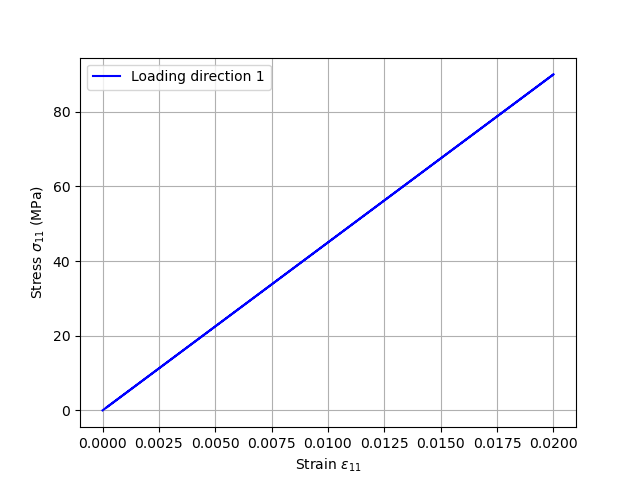
Plotting the results
We plot the stress-strain curve in the loading direction (direction 1).
outputfile_macro = os.path.join(path_results, "results_ELIST_global-0.txt")

fig = plt.figure()

e11, e22, e33, e12, e13, e23, s11, s22, s33, s12, s13, s23 = np.loadtxt(
    outputfile_macro,
    usecols=(8, 9, 10, 11, 12, 13, 14, 15, 16, 17, 18, 19),
    unpack=True,
)

plt.grid(True)
plt.xlabel(r"Strain $\varepsilon_{11}$")
plt.ylabel(r"Stress $\sigma_{11}$ (MPa)")
plt.plot(e11, s11, c="blue", label="Loading direction 1")
plt.legend(loc="best")

plt.show()
Total running time of the script: (0 minutes 0.053 seconds)