Note
Go to the end to download the full example code.
Plasticity with Chaboche Hardening Example
import numpy as np
import matplotlib.pyplot as plt
import simcoon as sim
import os

plt.rcParams["figure.figsize"] = (18, 10)
The Chaboche plasticity model combines isotropic and kinematic hardening. This model is particularly suited for cyclic loading applications where the Bauschinger effect is important.
Ten parameters are required:
The Young modulus \(E\)
The Poisson ratio \(\nu\)
The coefficient of thermal expansion \(\alpha\)
The initial yield stress \(\sigma_Y\)
The isotropic hardening saturation value \(Q\)
The isotropic hardening rate \(b\)
The first kinematic hardening modulus \(C_1\)
The first kinematic hardening rate \(D_1\)
The second kinematic hardening modulus \(C_2\)
The second kinematic hardening rate \(D_2\)
The constitutive law is given by:
where \(X_{ij}\) is the kinematic hardening (back stress) tensor and \(R\) is the isotropic hardening variable.
umat_name = "EPCHA"  # 5 character code for Chaboche plasticity
nstatev = 33  # Number of internal variables

# Material parameters
E = 140000.0  # Young's modulus (MPa)
nu = 0.3  # Poisson ratio
alpha = 1.0e-6  # Thermal expansion coefficient
sigma_Y = 62.859017  # Initial yield stress (MPa)
Q = 416.004456  # Isotropic hardening saturation
b = 4.788635  # Isotropic hardening rate
C_1 = 30382.293921  # First kinematic hardening modulus
D_1 = 172.425687  # First kinematic hardening rate
C_2 = 195142.490843  # Second kinematic hardening modulus
D_2 = 3012.614659  # Second kinematic hardening rate

psi_rve = 0.0
theta_rve = 0.0
phi_rve = 0.0
solver_type = 0
corate_type = 1

props = np.array([E, nu, alpha, sigma_Y, Q, b, C_1, D_1, C_2, D_2])

path_data = "data"
path_results = "results"
pathfile = "EPCHA_path.txt"
outputfile = "results_EPCHA.txt"

sim.solver(
    umat_name,
    props,
    nstatev,
    psi_rve,
    theta_rve,
    phi_rve,
    solver_type,
    corate_type,
    path_data,
    path_results,
    pathfile,
    outputfile,
)
Plotting the results
We plot the stress-strain hysteresis loop which shows the cyclic behavior including the Bauschinger effect from kinematic hardening.
outputfile_macro = os.path.join(path_results, "results_EPCHA_global-0.txt")

fig = plt.figure()

e11, e22, e33, e12, e13, e23, s11, s22, s33, s12, s13, s23 = np.loadtxt(
    outputfile_macro,
    usecols=(8, 9, 10, 11, 12, 13, 14, 15, 16, 17, 18, 19),
    unpack=True,
)
time, T, Q_out, r = np.loadtxt(outputfile_macro, usecols=(4, 5, 6, 7), unpack=True)
Wm, Wm_r, Wm_ir, Wm_d = np.loadtxt(
    outputfile_macro, usecols=(20, 21, 22, 23), unpack=True
)

# First subplot: Stress vs Strain (hysteresis loop)
ax1 = fig.add_subplot(1, 2, 1)
plt.grid(True)
plt.tick_params(axis="both", which="major", labelsize=15)
plt.xlabel(r"Strain $\varepsilon_{11}$", size=15)
plt.ylabel(r"Stress $\sigma_{11}$ (MPa)", size=15)
plt.plot(e11, s11, c="blue", label="Chaboche model")
plt.legend(loc="best")

# Second subplot: Work terms vs Time
ax2 = fig.add_subplot(1, 2, 2)
plt.grid(True)
plt.tick_params(axis="both", which="major", labelsize=15)
plt.xlabel("time (s)", size=15)
plt.ylabel(r"$W_m$", size=15)
plt.plot(time, Wm, c="black", label=r"$W_m$")
plt.plot(time, Wm_r, c="green", label=r"$W_m^r$")
plt.plot(time, Wm_ir, c="blue", label=r"$W_m^{ir}$")
plt.plot(time, Wm_d, c="red", label=r"$W_m^d$")
plt.legend(loc="best")

plt.show()
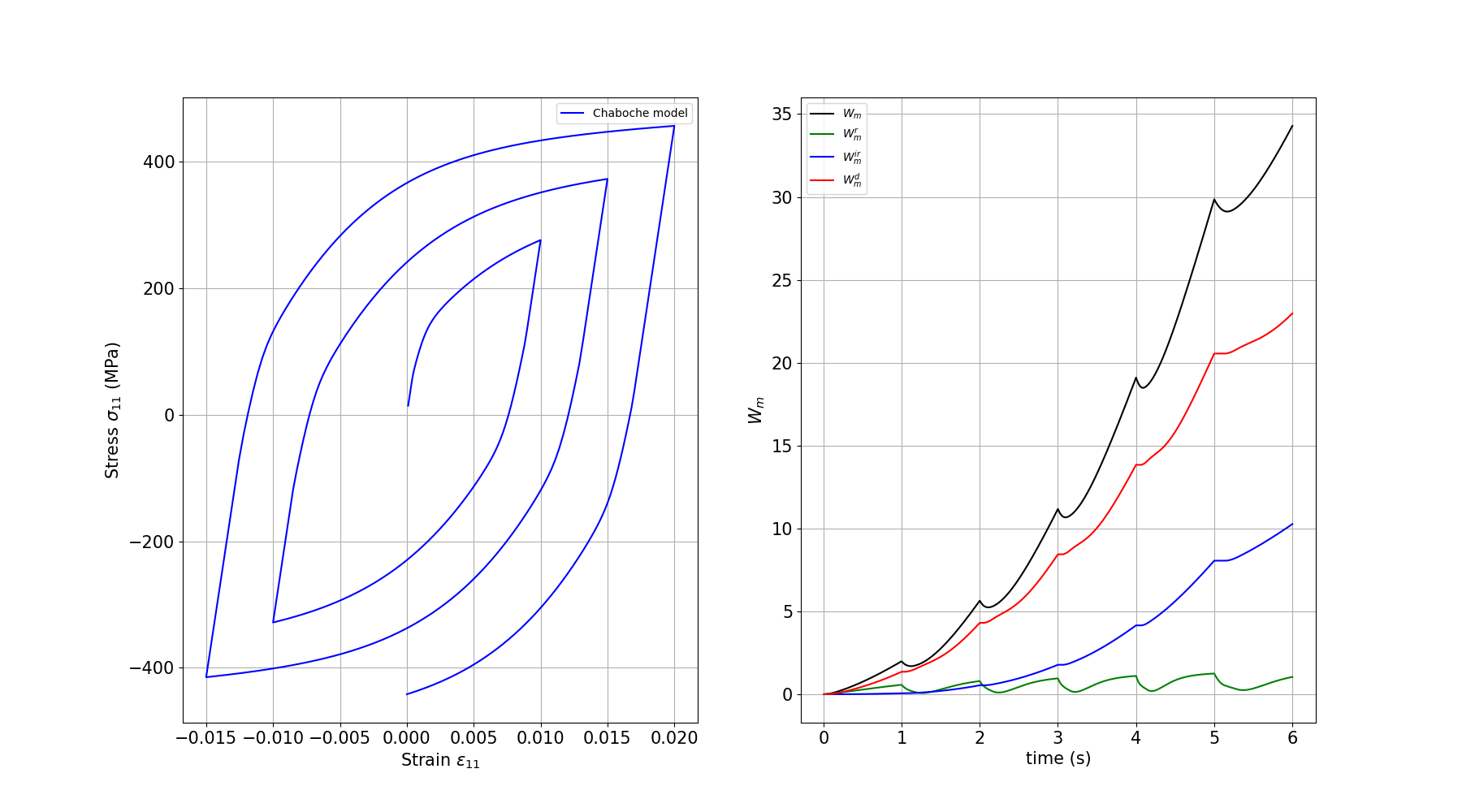
Total running time of the script: (0 minutes 0.163 seconds)