Note
Go to the end to download the full example code.
Transversely isotropic elasticity (thermomechanical)
import numpy as np
import simcoon as sim
import matplotlib.pyplot as plt
import os

plt.rcParams["figure.figsize"] = (18, 10)
In thermoelastic transversely isotropic materials, the following parameters are required:
The density \(\rho\)
The specific heat \(c_p\)
The axis of transverse isotropy (1, 2, or 3)
The longitudinal Young modulus \(E_L\)
The transverse Young modulus \(E_T\)
The Poisson ratio \(\nu_{TL}\)
The Poisson ratio \(\nu_{TT}\)
The shear modulus \(G_{LT}\)
The longitudinal thermal expansion coefficient \(\alpha_L\)
The transverse thermal expansion coefficient \(\alpha_T\)
The elastic stiffness tensor for a transversely isotropic material with axis 1 as the symmetry axis is written in the Voigt notation formalism as:
The thermal expansion tensor is:
umat_name = "ELIST"  # 5 character code for transversely isotropic elastic subroutine
nstatev = 1  # Number of internal variables

# Material parameters
rho = 4.4  # Density
c_p = 0.656  # Specific heat capacity
axis = 1  # Symmetry axis
E_L = 4500.0  # Longitudinal Young's modulus (MPa)
E_T = 2300.0  # Transverse Young's modulus (MPa)
nu_TL = 0.05  # Poisson ratio (transverse-longitudinal)
nu_TT = 0.3  # Poisson ratio (transverse-transverse)
G_LT = 2700.0  # Shear modulus (longitudinal-transverse) (MPa)
alpha_L = 1.0e-5  # Thermal expansion (longitudinal)
alpha_T = 2.5e-5  # Thermal expansion (transverse)

psi_rve = 0.0
theta_rve = 0.0
phi_rve = 0.0
solver_type = 0
corate_type = 2

props = np.array([rho, c_p, axis, E_L, E_T, nu_TL, nu_TT, G_LT, alpha_L, alpha_T])

path_data = "../data"
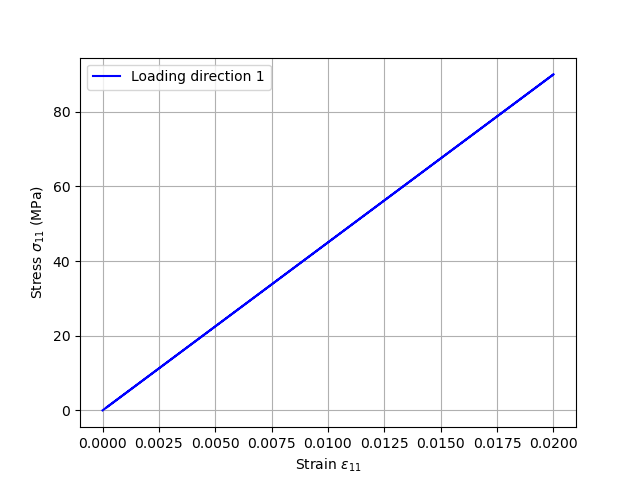
Loading in direction 1
First we apply a uniaxial stress loading along direction 1 (the symmetry axis).
pathfile = "THERM_ELISO_path_1.json"

blocks, T_init, _ = sim.solver.load_path_json(os.path.join(path_data, pathfile))
res_1 = sim.solver.solve(
    blocks,
    umat_name,
    props,
    nstatev,
    T_init=T_init,
    solver_type=solver_type,
    corate=corate_type,
    orientation=(psi_rve, theta_rve, phi_rve),
)
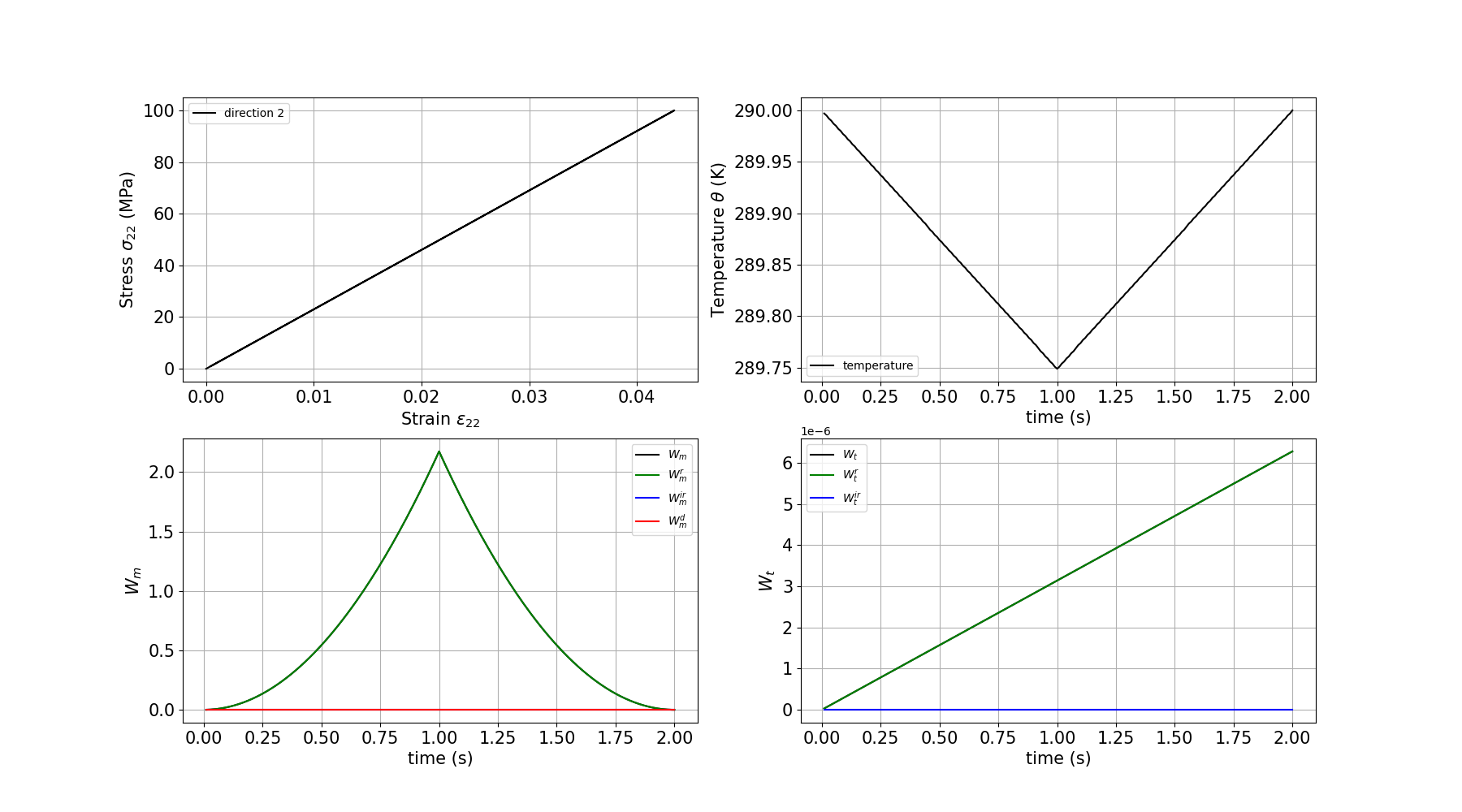
Loading in direction 2
Then we apply a uniaxial stress loading along direction 2 (the transverse direction).
pathfile = "THERM_ELISO_path_2.json"

blocks, T_init, _ = sim.solver.load_path_json(os.path.join(path_data, pathfile))
res_2 = sim.solver.solve(
    blocks,
    umat_name,
    props,
    nstatev,
    T_init=T_init,
    solver_type=solver_type,
    corate=corate_type,
    orientation=(psi_rve, theta_rve, phi_rve),
)
Plotting the results – Loading direction 1
We plot the stress-strain curve, the temperature evolution, and the work terms for loading along direction 1.
fig = plt.figure()

# Get the data
e11, e22, e33, e12, e13, e23 = res_1["Strain"]
s11, s22, s33, s12, s13, s23 = res_1["Stress"]
time, T, Q, r = res_1["Time"], res_1["Temp"], res_1["Q"], res_1["r"]
Wm, Wm_r, Wm_ir, Wm_d = res_1["Wm"]
Wt, Wt_r, Wt_ir = res_1["Wt"]

# Stress vs Strain
ax = fig.add_subplot(2, 2, 1)
plt.grid(True)
plt.tick_params(axis="both", which="major", labelsize=15)
plt.xlabel(r"Strain $\varepsilon_{11}$", size=15)
plt.ylabel(r"Stress $\sigma_{11}$ (MPa)", size=15)
plt.plot(e11, s11, c="black", label="direction 1")
plt.legend(loc="best")

# Temperature vs Time
ax = fig.add_subplot(2, 2, 2)
plt.grid(True)
plt.tick_params(axis="both", which="major", labelsize=15)
plt.xlabel("time (s)", size=15)
plt.ylabel(r"Temperature $\theta$ (K)", size=15)
plt.plot(time, T, c="black", label="temperature")
plt.legend(loc="best")

# Mechanical work vs Time
ax = fig.add_subplot(2, 2, 3)
plt.grid(True)
plt.tick_params(axis="both", which="major", labelsize=15)
plt.xlabel("time (s)", size=15)
plt.ylabel(r"$W_m$", size=15)
plt.plot(time, Wm, c="black", label=r"$W_m$")
plt.plot(time, Wm_r, c="green", label=r"$W_m^r$")
plt.plot(time, Wm_ir, c="blue", label=r"$W_m^{ir}$")
plt.plot(time, Wm_d, c="red", label=r"$W_m^d$")
plt.legend(loc="best")

# Thermal work vs Time
ax = fig.add_subplot(2, 2, 4)
plt.grid(True)
plt.tick_params(axis="both", which="major", labelsize=15)
plt.xlabel("time (s)", size=15)
plt.ylabel(r"$W_t$", size=15)
plt.plot(time, Wt, c="black", label=r"$W_t$")
plt.plot(time, Wt_r, c="green", label=r"$W_t^r$")
plt.plot(time, Wt_ir, c="blue", label=r"$W_t^{ir}$")
plt.legend(loc="best")

plt.show()
Plotting the results – Loading direction 2
We plot the stress-strain curve, the temperature evolution, and the work terms for loading along direction 2.
fig = plt.figure()

# Get the data
e11, e22, e33, e12, e13, e23 = res_2["Strain"]
s11, s22, s33, s12, s13, s23 = res_2["Stress"]
time, T, Q, r = res_2["Time"], res_2["Temp"], res_2["Q"], res_2["r"]
Wm, Wm_r, Wm_ir, Wm_d = res_2["Wm"]
Wt, Wt_r, Wt_ir = res_2["Wt"]

# Stress vs Strain
ax = fig.add_subplot(2, 2, 1)
plt.grid(True)
plt.tick_params(axis="both", which="major", labelsize=15)
plt.xlabel(r"Strain $\varepsilon_{22}$", size=15)
plt.ylabel(r"Stress $\sigma_{22}$ (MPa)", size=15)
plt.plot(e22, s22, c="black", label="direction 2")
plt.legend(loc="best")

# Temperature vs Time
ax = fig.add_subplot(2, 2, 2)
plt.grid(True)
plt.tick_params(axis="both", which="major", labelsize=15)
plt.xlabel("time (s)", size=15)
plt.ylabel(r"Temperature $\theta$ (K)", size=15)
plt.plot(time, T, c="black", label="temperature")
plt.legend(loc="best")

# Mechanical work vs Time
ax = fig.add_subplot(2, 2, 3)
plt.grid(True)
plt.tick_params(axis="both", which="major", labelsize=15)
plt.xlabel("time (s)", size=15)
plt.ylabel(r"$W_m$", size=15)
plt.plot(time, Wm, c="black", label=r"$W_m$")
plt.plot(time, Wm_r, c="green", label=r"$W_m^r$")
plt.plot(time, Wm_ir, c="blue", label=r"$W_m^{ir}$")
plt.plot(time, Wm_d, c="red", label=r"$W_m^d$")
plt.legend(loc="best")

# Thermal work vs Time
ax = fig.add_subplot(2, 2, 4)
plt.grid(True)
plt.tick_params(axis="both", which="major", labelsize=15)
plt.xlabel("time (s)", size=15)
plt.ylabel(r"$W_t$", size=15)
plt.plot(time, Wt, c="black", label=r"$W_t$")
plt.plot(time, Wt_r, c="green", label=r"$W_t^r$")
plt.plot(time, Wt_ir, c="blue", label=r"$W_t^{ir}$")
plt.legend(loc="best")

plt.show()
Total running time of the script: (0 minutes 0.502 seconds)