Note
Go to the end to download the full example code.
Plasticity with kinematic hardening (thermomechanical)
import numpy as np
import matplotlib.pyplot as plt
import simcoon as sim
import os

plt.rcParams["figure.figsize"] = (18, 10)
The elastic-plastic (isotropic with kinematic hardening) constitutive law implemented in simcoon is a rate independent, isotropic, von Mises type material with power-law isotropic hardening and linear kinematic hardening. Nine parameters are required for the thermomechanical version:
The density \(\rho\)
The specific heat \(c_p\)
The Young modulus \(E\)
The Poisson ratio \(\nu\)
The coefficient of thermal expansion \(\alpha\)
The von Mises equivalent yield stress limit \(\sigma_{Y}\)
The hardening parameter \(k\)
The hardening exponent \(m\)
The kinematic hardening parameter \(k_X\)
The constitutive law is given by:
umat_name = "EPKCP"  # 5 character code for combined isotropic-kinematic hardening
nstatev = 14  # Number of internal variables

# Material parameters
rho = 4.4  # Density
c_p = 0.656  # Specific heat capacity
E = 113800.0  # Young's modulus (MPa)
nu = 0.342  # Poisson ratio
alpha = 0.86e-5  # Thermal expansion coefficient
sigma_Y = 500.0  # Yield stress (MPa)
H = 1200.0  # Isotropic hardening parameter
beta = 0.25  # Isotropic hardening exponent
kX = 8000.0  # Kinematic hardening modulus

psi_rve = 0.0
theta_rve = 0.0
phi_rve = 0.0
solver_type = 0
corate_type = 2

# Define the properties
props = np.array([rho, c_p, E, nu, alpha, sigma_Y, H, beta, kX])

path_data = "../data"

# Run the simulation: the path file is parsed in Python and the case runs in
# memory, so no result file is written.
pathfile = "THERM_EPKCP_path.json"

blocks, T_init, _ = sim.solver.load_path_json(os.path.join(path_data, pathfile))
res = sim.solver.solve(
    blocks,
    umat_name,
    props,
    nstatev,
    T_init=T_init,
    solver_type=solver_type,
    corate=corate_type,
    orientation=(psi_rve, theta_rve, phi_rve),
)
Plotting the results
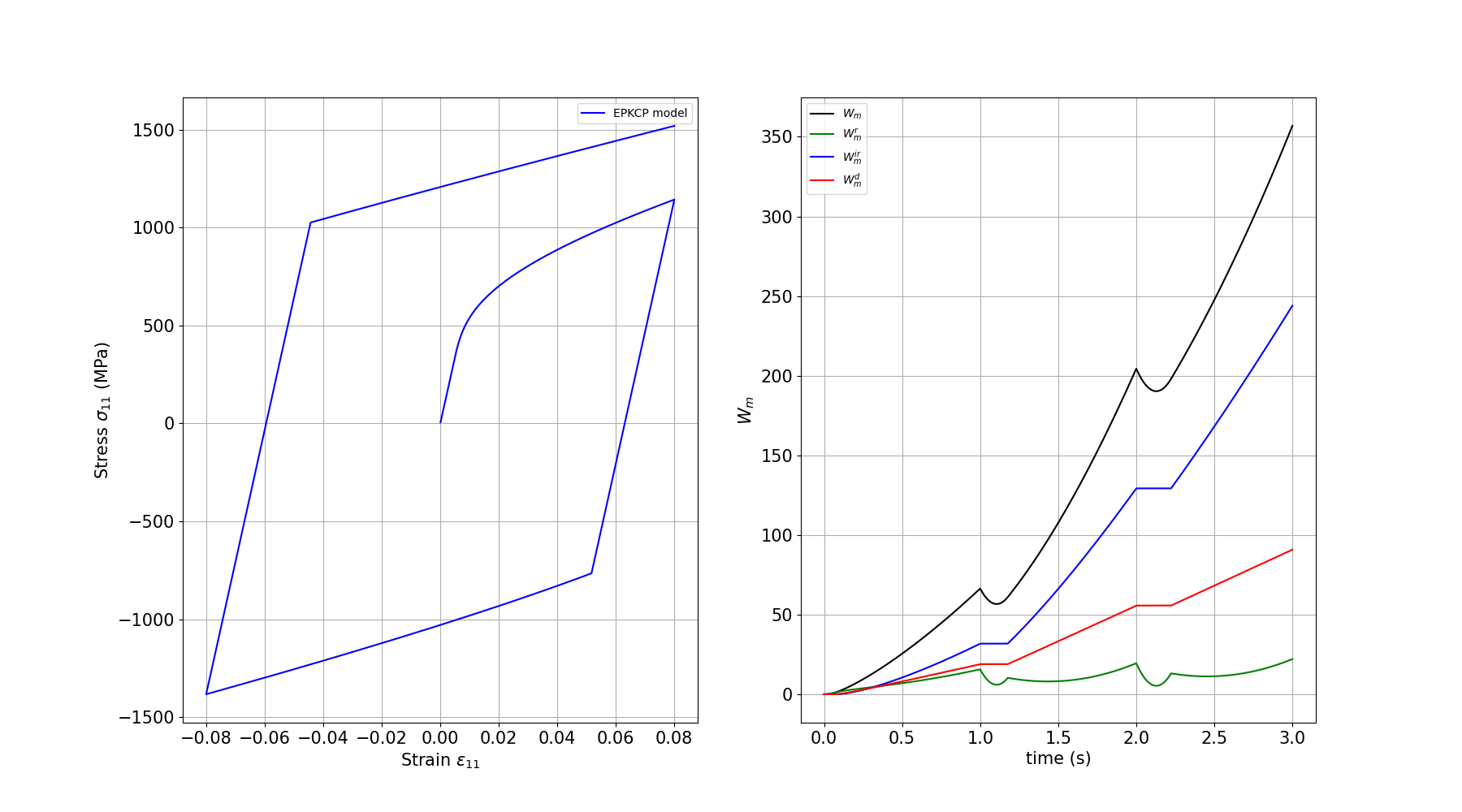
We plot the stress-strain curve, the temperature evolution, the mechanical work terms and the thermal work terms.
fig = plt.figure()

# Get the data
e11, e22, e33, e12, e13, e23 = res["Strain"]
s11, s22, s33, s12, s13, s23 = res["Stress"]
time, T, Q, r = res["Time"], res["Temp"], res["Q"], res["r"]
Wm, Wm_r, Wm_ir, Wm_d = res["Wm"]
Wt, Wt_r, Wt_ir = res["Wt"]

# Stress vs Strain
ax = fig.add_subplot(2, 2, 1)
plt.grid(True)
plt.tick_params(axis="both", which="major", labelsize=15)
plt.xlabel(r"Strain $\varepsilon_{11}$", size=15)
plt.ylabel(r"Stress $\sigma_{11}$ (MPa)", size=15)
plt.plot(e11, s11, c="black", label="direction 1")
plt.legend(loc="best")

# Temperature vs Time
ax = fig.add_subplot(2, 2, 2)
plt.grid(True)
plt.tick_params(axis="both", which="major", labelsize=15)
plt.xlabel("time (s)", size=15)
plt.ylabel(r"Temperature $\theta$ (K)", size=15)
plt.plot(time, T, c="black", label="temperature")
plt.legend(loc="best")

# Mechanical work vs Time
ax = fig.add_subplot(2, 2, 3)
plt.grid(True)
plt.tick_params(axis="both", which="major", labelsize=15)
plt.xlabel("time (s)", size=15)
plt.ylabel(r"$W_m$", size=15)
plt.plot(time, Wm, c="black", label=r"$W_m$")
plt.plot(time, Wm_r, c="green", label=r"$W_m^r$")
plt.plot(time, Wm_ir, c="blue", label=r"$W_m^{ir}$")
plt.plot(time, Wm_d, c="red", label=r"$W_m^d$")
plt.legend(loc="best")

# Thermal work vs Time
ax = fig.add_subplot(2, 2, 4)
plt.grid(True)
plt.tick_params(axis="both", which="major", labelsize=15)
plt.xlabel("time (s)", size=15)
plt.ylabel(r"$W_t$", size=15)
plt.plot(time, Wt, c="black", label=r"$W_t$")
plt.plot(time, Wt_r, c="green", label=r"$W_t^r$")
plt.plot(time, Wt_ir, c="blue", label=r"$W_t^{ir}$")
plt.legend(loc="best")

plt.show()
Increment size effect
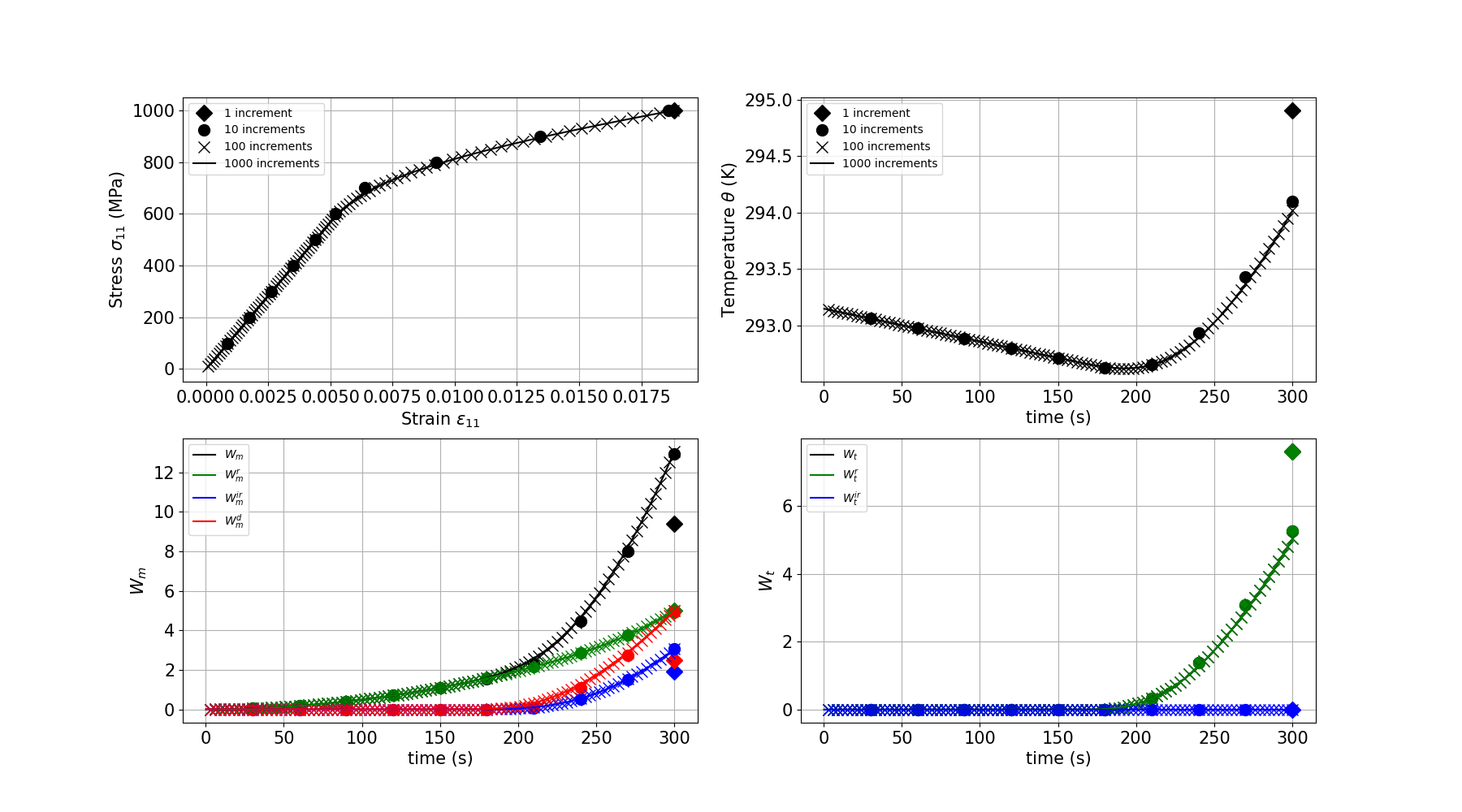
Here we test the effect of the increment size on the results.
increments = [1, 10, 100, 1000]
# Run each case and collect its history: every path file is parsed in Python and
# the case runs in memory, so nothing is written to — or read back from — disk.
data = []
for inc in increments:
    pathfile = f"THERM_EPKCP_path_{inc}.json"
    blocks, T_init, _ = sim.solver.load_path_json(os.path.join(path_data, pathfile))
    res_inc = sim.solver.solve(
        blocks,
        umat_name,
        props,
        nstatev,
        T_init=T_init,
        solver_type=solver_type,
        corate=corate_type,
        orientation=(psi_rve, theta_rve, phi_rve),
    )
    Wm_i, Wm_r_i, Wm_ir_i, Wm_d_i = res_inc["Wm"]
    Wt_i, Wt_r_i, Wt_ir_i = res_inc["Wt"]
    data.append(
        {
            "e11": res_inc["Strain"][0], "s11": res_inc["Stress"][0],
            "time": res_inc["Time"], "T": res_inc["Temp"],
            "Wm": Wm_i, "Wm_r": Wm_r_i, "Wm_ir": Wm_ir_i, "Wm_d": Wm_d_i,
            "Wt": Wt_i, "Wt_r": Wt_r_i, "Wt_ir": Wt_ir_i,
        }
    )
Plotting the increment size comparison
fig = plt.figure()

markers = ["D", "o", "x", None]
labels = ["1 increment", "10 increments", "100 increments", "1000 increments"]

# Stress vs Strain
ax = fig.add_subplot(2, 2, 1)
plt.grid(True)
plt.tick_params(axis="both", which="major", labelsize=15)
plt.xlabel(r"Strain $\varepsilon_{11}$", size=15)
plt.ylabel(r"Stress $\sigma_{11}$ (MPa)", size=15)
for i, d in enumerate(data):
    if markers[i] is not None:
        plt.plot(d["e11"], d["s11"], linestyle="None", marker=markers[i],
                 color="black", markersize=10, label=labels[i])
    else:
        plt.plot(d["e11"], d["s11"], c="black", label=labels[i])
plt.legend(loc="best")

# Temperature vs Time
ax = fig.add_subplot(2, 2, 2)
plt.grid(True)
plt.tick_params(axis="both", which="major", labelsize=15)
plt.xlabel("time (s)", size=15)
plt.ylabel(r"Temperature $\theta$ (K)", size=15)
for i, d in enumerate(data):
    if markers[i] is not None:
        plt.plot(d["time"], d["T"], linestyle="None", marker=markers[i],
                 color="black", markersize=10, label=labels[i])
    else:
        plt.plot(d["time"], d["T"], c="black", label=labels[i])
plt.legend(loc="best")

# Mechanical work vs Time
ax = fig.add_subplot(2, 2, 3)
plt.grid(True)
plt.tick_params(axis="both", which="major", labelsize=15)
plt.xlabel("time (s)", size=15)
plt.ylabel(r"$W_m$", size=15)
work_colors = ["black", "green", "blue", "red"]
work_keys = ["Wm", "Wm_r", "Wm_ir", "Wm_d"]
work_labels = [r"$W_m$", r"$W_m^r$", r"$W_m^{ir}$", r"$W_m^d$"]
for i, d in enumerate(data):
    for j, (wk, wc, wl) in enumerate(zip(work_keys, work_colors, work_labels)):
        if markers[i] is not None:
            plt.plot(d["time"], d[wk], linestyle="None", marker=markers[i],
                     color=wc, markersize=10)
        else:
            plt.plot(d["time"], d[wk], c=wc, label=wl)
plt.legend(loc="best")

# Thermal work vs Time
ax = fig.add_subplot(2, 2, 4)
plt.grid(True)
plt.tick_params(axis="both", which="major", labelsize=15)
plt.xlabel("time (s)", size=15)
plt.ylabel(r"$W_t$", size=15)
therm_keys = ["Wt", "Wt_r", "Wt_ir"]
therm_labels = [r"$W_t$", r"$W_t^r$", r"$W_t^{ir}$"]
therm_colors = ["black", "green", "blue"]
for i, d in enumerate(data):
    for j, (wk, wc, wl) in enumerate(zip(therm_keys, therm_colors, therm_labels)):
        if markers[i] is not None:
            plt.plot(d["time"], d[wk], linestyle="None", marker=markers[i],
                     color=wc, markersize=10)
        else:
            plt.plot(d["time"], d[wk], c=wc, label=wl)
plt.legend(loc="best")

plt.show()
Total running time of the script: (0 minutes 0.632 seconds)